Setting The Lilies Free
We are not misplaced or a blight on nature that must be removed. We are part of her, and we have work to do inside the world.
– 3 min read
We are not misplaced or a blight on nature that must be removed. We are part of her, and we have work to do inside the world.
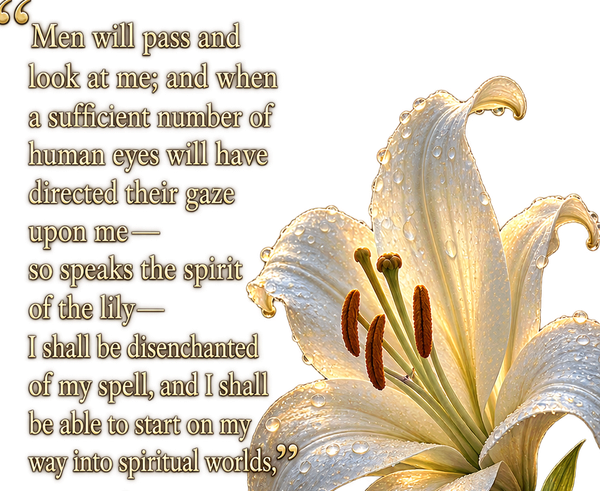
"While unfolding its leaves, but especially its blossom, this lily is really expecting something. It says to itself: Men will pass and look at me; and when a sufficient number of human eyes will have directed their gaze upon me—so speaks the spirit of the lily—I shall be disenchanted of my spell, and I shall be able to start on my way into spiritual worlds.—You will perhaps object that many lilies grow unseen by human eye: yes, but then the conditions are different, and such lilies find their release in a different way. For the decree that the spell of that particular lily shall be broken by human eyes comes about by the first human glance cast upon the lily. It is a relationship entered into between man and the lily when he first lets his gaze rest upon it.—All about us are these elemental spirits begging us, in effect, Do not look at the flowers so abstractly, nor form such abstract mental pictures of them: let rather your heart and your Gemüt enter into what lives, as soul and spirit, in the flowers, for it is imploring you to break the spell.—Human existence should really be a perpetual releasing of the elemental spirits lying enchanted in minerals, plants, and animals."
By Rudolf Steiner
(Michaelmas, and the Soul-Forces of Man)
Because human beings no longer see the spiritual world, the God given task of raising up the living beings that dwell within nature into the spiritual realms has been abandoned. There is a reason why your heart sings when the earth blooms in the spring. A calling stands before you when the tall grass of late summer shimmers in the rays of afternoon heat, when the later rains fall in autumn and blood-red leaves drop softly into misty water. You are actually called.
The calling is not to take photographs of such things, or think about how much you like them and how good they make you feel. Those are doorways, yes, but through the doorway lies the true purpose of man in nature, to lift the material world into the spiritual.
To the reductionist mind, this will sound outrageous. He sees only what he can calculate. He sees utility, organizational projects, and potential profits. He cannot truly see a lily in her grace and fragile beauty because his heart cannot love it. To this reductionist dragon (which we all carry inside and have the potential to act on), the lily must be useful. Even its beauty must be swallowed up and taken over by pragmatism. It must be for him.
The soul warmth of humanity is not pragmatic. It is the call of Michael in us to open ourselves to the unseen beings inside of all things in our world, to unite with these beings through love. This is not an abstract thought; it is an inner unity that takes place in actual reality. When we learn to do this, to move past the pragmatic and into the realm of the mystic, willing to unite with and assist the inner beings of the natural world; we set them free to become greater than they are now.
So it is literally the case, as Steiner points out, that a flower may in fact long to be seen by a human being. “Do not look at the flowers so abstractly, nor form such abstract mental pictures of them: let rather your heart and your Gemüt [soul warmth] enter into what lives, as soul and spirit, in the flowers, for it is imploring you to break the spell.—Human existence should really be a perpetual releasing of the elemental spirits lying enchanted in minerals, plants, and animals.”
We are not here just to live our own lives. The purpose of the human being on the earth is not an accident. We are not misplaced or a blight on nature that must be removed. We are part of her, and we have work to do inside the world. Human beings have the unique ability to exist in the spiritual realms and the material realm at the same time. We are in fact a bridge for other beings who desire to enter the spiritual worlds and become more. This is actually our job.