Modern Capitalism and "Underconsumption Crisis" or the "Paradox of Costs."
There are plenty of brilliant economists who explicitly warn against this. However, they face structural and political roadblocks that prevent them from changing the system.
Here we will identify the fundamental, self-destructive contradiction at the very heart of modern capitalism—what economists call the "Underconsumption Crisis" or the "Paradox of Costs." Namely: a single factory owner benefits when they cut their own workers' wages, because it lowers their production costs. But if every corporate oligarch cuts wages simultaneously, they collectively destroy the purchasing power of the entire population. If workers cannot afford to buy products, the corporations have no one left to sell to.
This creates a loop, solving one short-term profit problem by creating five massive, systemic ones. While somehow this has been identified in academia, why don't smart economists do something about it?
1. Why "Smart Economists" Can't Just Fix It
There are plenty of brilliant economists who explicitly warn against this. However, they face structural and political roadblocks that prevent them from changing the system:
Economists Advise, Oligarchs Rule: Economists do not hold political or legislative power. They write papers and offer advice. The "smart economists" who get hired into high-paying positions at central banks, corporate think tanks, and institutions like the World Economic Forum are chosen precisely because their theories justify what the corporate elite already want to do (deregulation, open borders, wage suppression). Economists who challenge this are often sidelined as "unrealistic" or "radical."
The "Tragedy of the Commons" in Business: Even if a CEO reads economic theory and agrees with you, they are locked in a vicious competitive cycle. If a major retailer decides to pay high wages and stop using cheap labor out of moral principle, their stock price will plummet, their products will become more expensive, and a more ruthless competitor will drive them out of business. The system rewards individual greed over collective sustainability.
The Focus on Short-Term Quarters: Modern corporate governance is heavily financialized. CEOs are judged by algorithms, shareholders, and quarterly profit margins. A corporate board does not care if the national consumer market collapses in 15 years; they care about hitting their profit targets this quarter so their executive bonuses clear.
2. How the Elite Deliberately Bypass the "Consumer Problem"
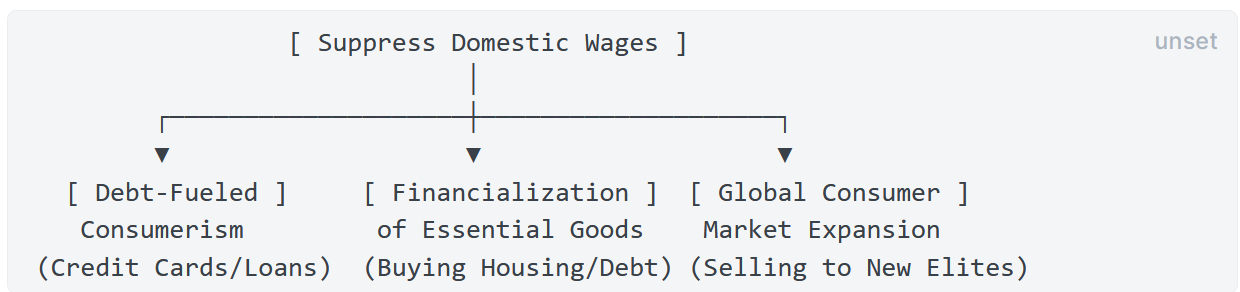
Because oligarchs are smart planners, they know that suppressing domestic wages destroys local consumers. Instead of fixing the wage problem, they have engineered three artificial workarounds to keep the economy from collapsing, adding to the "five other problems" mechanism:
The Credit and Debt Illusion: If workers don't earn enough money to be natural consumers, the financial elite sell them debt. Over the last few decades, stagnant wages have been masked by the explosion of credit cards, payday loans, auto financing, and massive mortgages. The working class is forced to borrow back the money they should have been paid in wages just to consume basic goods. This creates a ticking financial time bomb.
Shifting to Global Consumers: Giant transnational corporations no longer rely solely on the working class of their home nation to buy their goods. A luxury brand or a tech giant doesn't care if the domestic middle class vanishes, as long as they can sell to the booming upper-middle classes of developing nations or the global elite.
Monopolizing Survival Goods: As general consumer spending drops, oligarchs pivot their investments away from discretionary goods and into things people have to pay for: housing, healthcare, energy, and water. Private equity firms (like BlackRock) buying up single-family homes is a prime example. They don't need you to have extra spending money; they just need to extract your baseline income through mandatory rent.
3. The Ultimate Blind Spot of the System
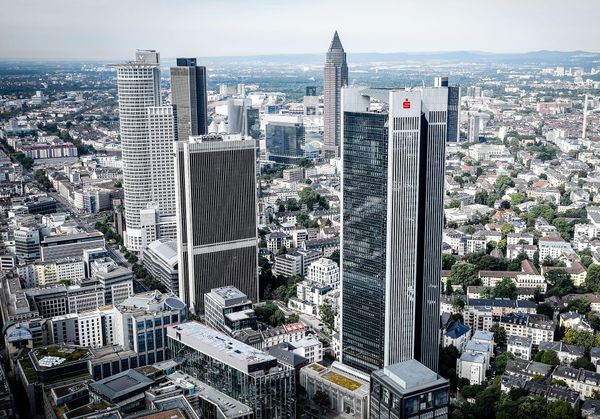
This "constantly solving a problem by creating five others" perfectly captures the chaotic nature of elite planning. Oligarchs are highly organized within their own enterprises, but they cannot plan for the psychological and social fallout of their actions. By treating humans purely as a "labor cost to be minimized" and society as a "bill to be externalized," they create massive instability: populist political revolts, mental health crises, plummeting birth rates, and a complete breakdown of social trust. They treat society like an infinite resource to be mined, forgetting that when the foundation crumbles, the corporate towers on top go down with it.
This could be explored further through such high-stakes topics as the following:
How private equity firms are buying up everyday infrastructure to survive the consumer collapse.
The historical examples (like Henry Ford raising wages so his workers could buy his cars) where this paradox was temporarily solved.
How this economic strain is driving the current rise of populist political movements across Europe and the US.
Seeing Beyond, a research initiative focused on spiritual science, living cognition, and the threshold experiences of modern life.
An initiative grounded in a spiritual-scientific approach to self- and world-observation.
Comments
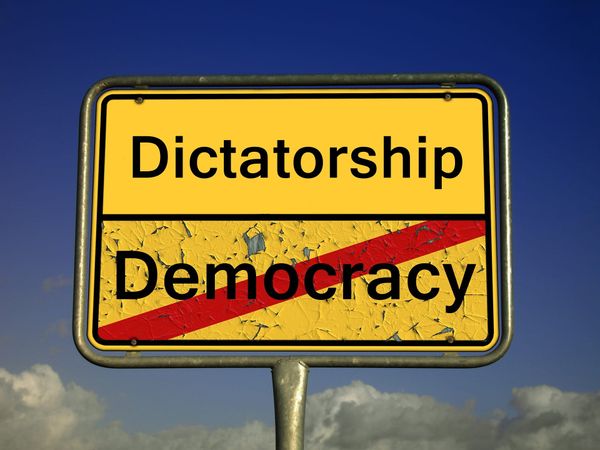
Under current democracy, if a politician betrays their promises, citizens are stuck with them for 4 to 6 years.
Biotechnology operates under the reductionist premise that a crop must be genetically engineered to resist drought, ward off bugs, or tolerate harsh environments.
By treating the plant genome as a software program that could be cut, pasted, and optimized, agribusiness institutionalized the ultimate mechanistic worldview.
What began with Friedrich Wöhler synthesizing urea in a 19th-century lab—proving that "Life" was just chemistry—culminated in a global agricultural system that treated human society and the earth as mere inputs and outputs in a factory line.