The Green Revolution, Not So Green
The name "Green Revolution" itself reveals the political motivations of the era.

– 3 min read
The name "Green Revolution" itself reveals the political motivations of the era.

The Green Revolution of the mid-20th century represents the ultimate, global implementation of the mechanistic, reductionist worldview we discussed earlier. It was the moment that the industrial, petrochemical framework pioneered by Standard Oil was systematically applied to the very fabric of nature to solve world hunger.
It was an era of unprecedented triumph and immense ecological fallout, structured as a massive technological transfer from Western labs to the developing world.
The origin story of the Green Revolution begins in 1943. Appalled by low agricultural yields in Mexico, the Rockefeller Foundation, alongside the Mexican government, launched the Mexican Agricultural Program (MAP). They recruited a brilliant American plant pathologist named Norman Borlaug to solve a critical issue: stem rust, a fungus decimating Mexico's wheat crop. Borlaug’s scientific breakthrough was "Dwarf Wheat". Traditional tropical wheat grew tall and thin-stemmed, competing for sunlight. However, when farmers applied heavy chemical fertilizers, the grain heads grew so heavy that the stalks broke and collapsed—a fatal vulnerability known as lodging. Borlaug cross-bred a short-stemmed, stocky dwarf variety that focused its energy on producing heavy clusters of grain rather than long stalks. This new wheat could absorb massive amounts of synthetic nitrogen fertilizer without tipping over. [9,
The Green Revolution was not just about engineered seeds; it required an entirely new, industrialized ecosystem. Borlaug's "High-Yielding Varieties" (HYVs) could not survive on their own.
They functioned as biological machines that required a specific, capital-intensive "technological package":
* Synthetic Fertilizers:
The engineered seeds were heavily dependent on massive infusions of petroleum-based nitrogen (such as synthesized urea) to stimulate rapid growth.
* Chemical Pesticides & Herbicides:
Because massive plots were planted with identical, uniform seeds, they lacked natural biodiversity and were incredibly vulnerable to pests and weeds. To protect them, farms required systematic dousing with synthetic chemical inputs.
* Massive Irrigation Systems:
The high-volume crops required uniform, intense watering, prompting the construction of massive dams, canals, and groundwater pumping networks.
The name "Green Revolution" itself reveals the political motivations of the era. Coined in 1968 by USAID Director William Gaud, the term explicitly positioned this agricultural modernization as a peaceful, scientific alternative to the violent "Red Revolutions" of Soviet and Chinese Communism.
During the Cold War, American policymakers and philanthropists feared that hungry, impoverished rural peasants were primary targets for communist subversion. By funding agricultural centers—the Rockefeller Foundation partnered with the Ford Foundation to build international research hubs like CIMMYT in Mexico and the International Rice Research Institute IRRI in the Philippines—they exported American industrial methods to countries like India and Pakistan. The goal was clear: feed the population to stabilize capitalist economies.
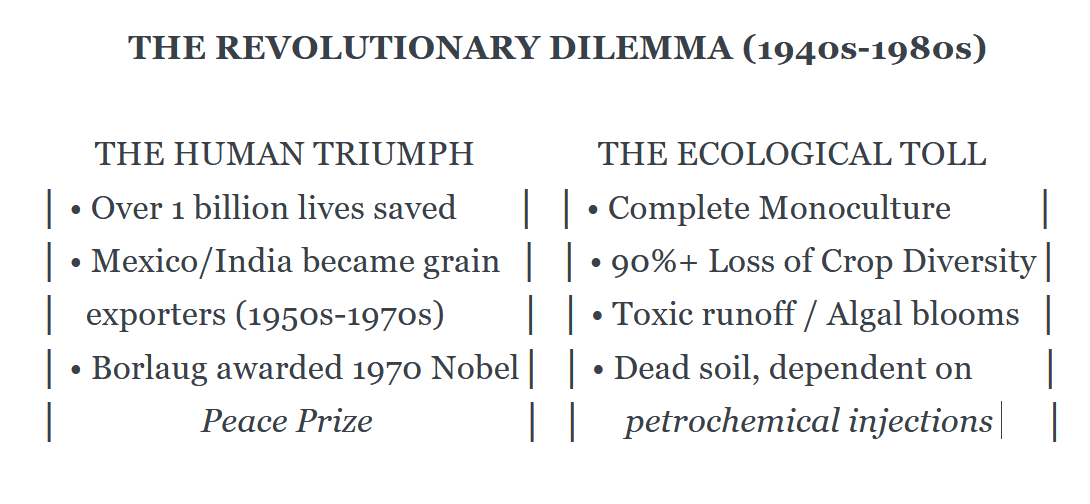
From a strictly numbers-based, utilitarian perspective, the Green Revolution achieved exactly what it set out to do. * Mexico transformed from a wheat importer to a net exporter by 1956. * India, facing catastrophic famine in the 1960s, doubled its wheat yields in just a few years. * Norman Borlaug was awarded the 1970 Nobel Peace Prize, credited with saving up to one billion people from imminent starvation.
However, this victory came at the exact cost the Romantic poets had warned about: the complete flattening and disruption of humanity's relationship with the natural world.
* The Eradication of Biodiversity:
The traditional, rich web of localized crops was entirely wiped out. In India, thousands of distinct native rice varieties were abandoned in favor of just a handful of high-yield strains. Genetic uniformity left fields highly vulnerable to catastrophic pathogen outbreaks.
* The Death of the Soil:
The continuous application of synthetic fertilizers without natural, organic replenishment degraded the living soil microbiome. Soil was effectively reduced to a dead, physical anchor that merely held up the plant while it was artificially fed by petrochemicals.
* Environmental Toxicity:
Millions of tons of nitrogen and phosphorus washed away from farmland, trickling into local water supplies and cascading into rivers. This nutrient-rich runoff fueled massive algal blooms, starving waterways of oxygen and creating aquatic "dead zones" worldwide.
* The Corporate Trap: Small, subsistence farmers who once operated within a self-sustaining ecosystem were suddenly dependent on purchasing proprietary hybrid seeds, synthetic fertilizers, and mechanical equipment year after year. Those who could not afford the capital-intensive packages were pushed off their land, driving massive migrations into overcrowded urban industrial centers.
The Green Revolution proved that humanity could bypass the natural limits of biology using chemical synthesis and sheer engineering. It successfully decoupled food production from the seasonal, organic rhythms of local ecosystems. But in doing so, it locked global agriculture into a profound dependency on fossil fuels and chemical interventions, leaving modern society to navigate the complex environmental fallout.