The Green Revolution and The Capital-Intensive Trap
In parts of Punjab, cancer rates soared so high that a daily train running from Bathinda to Bikaner for cancer treatments became grimly known as the "Cancer Express."

– 3 min read
In parts of Punjab, cancer rates soared so high that a daily train running from Bathinda to Bikaner for cancer treatments became grimly known as the "Cancer Express."

The Green Revolution’s economic victory is undeniable: it scaled up global food production to match a booming human population. However, by looking at agriculture through a purely reductionist, numbers-based lens, it ignored the complex social and human ecosystems that had sustained farming for centuries. When you replace a decentralized, low-cost, natural system with a centralized, high-cost, chemical system, the socio-economic power dynamics of the countryside shift dramatically.
Traditional agriculture was low-input. Farmers saved their own seeds from the previous harvest, utilized their own livestock for manure, and relied on family labor. It was a closed economic loop.
The Green Revolution broke this loop by requiring a "technological package" that had to be purchased from the outside market every single year:
* The Seed Monopoly:
High-Yielding Varieties (HYVs) were often hybrids. Unlike traditional seeds, their offspring didn't produce the same high yields, forcing farmers to buy new seeds from corporate distributors every season.
* The Credit Crisis:
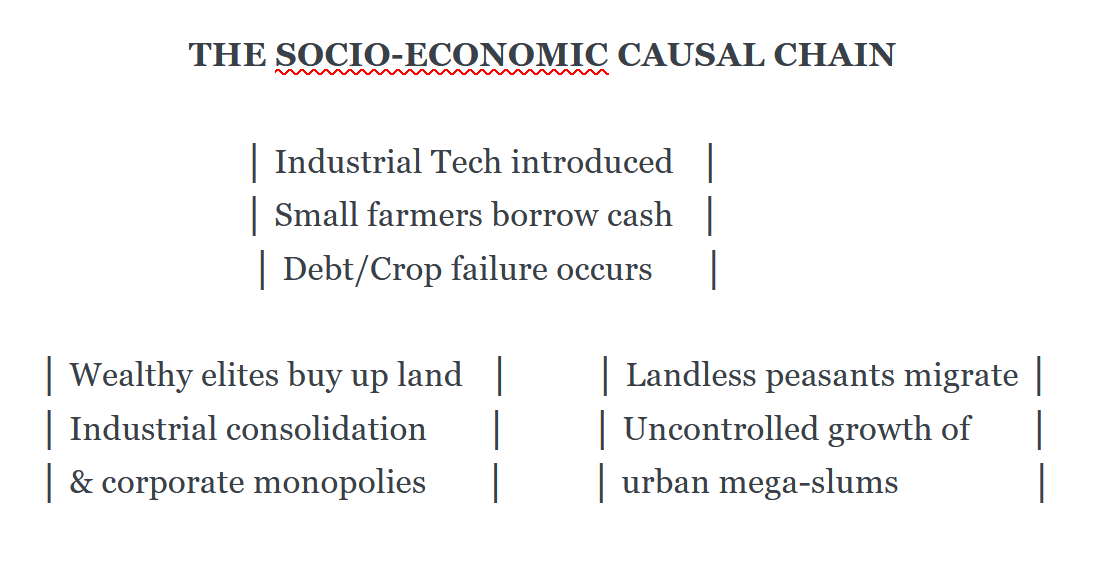
Small, subsistence farmers did not have the cash flow to buy synthetic fertilizers, chemical pesticides, and diesel for irrigation pumps. To participate, they had to take out massive loans.
* The Debt Spiral:
If a crop failed due to a sudden pest outbreak or a delayed monsoon, small farmers could not repay their debts. This led to widespread land foreclosures. Wealthy, large-scale landowners who already had capital easily absorbed these failing small plots.
Before this chemical shift, agriculture was highly labor-intensive, providing employment for vast numbers of rural laborers. The Green Revolution traded human labor for industrial efficiency.
* Mechanization:
Large landholdings required tractors, combine harvesters, and mechanical seeders to maximize the efficiency of the chemical inputs.
* The Displaced Peasantry:
Millions of tenant farmers, sharecroppers, and smallholders found themselves landless or priced out of existence.
* Urban Influx:
With no work left in the countryside, a massive, historic migration wave occurred from rural villages into cities. This surplus of displaced agricultural labor directly fueled the rapid, uncontrolled growth of urban mega-slums in cities like Mumbai, Mexico City, and Manila, supplying cheap labor for the next wave of industrial factory work.
The Green Revolution entrenched a deep geopolitical dependency between the Global South and the Global North.
* Technological Dependency:
Developing nations became entirely dependent on Western multinational corporations for the chemical inputs and machinery required to keep their populations fed. The profits of agriculture were systematically siphoned out of rural villages and into the bank accounts of chemical and agribusiness conglomerates.
* Cash Crops over Food Security:
To pay for these expensive imported chemicals, developing nations were often encouraged by international lenders (like the World Bank) to shift away from growing diverse, localized food crops for their own people. Instead, they prioritized large-scale cash crops (like cotton, sugar, or animal feed) for export to Western markets, making their domestic food security vulnerable to global market volume.
Nowhere are the socio-economic scars of this era clearer than in the Punjab region of India, often called the "Breadbasket of India."
Initially hailed as the greatest success story of the Green Revolution, the long-term human cost has been devastating:
* The Water Crisis:
To sustain thirsty dwarf wheat and rice, farmers dug millions of tube wells. Decades later, the water table in Punjab has plummeted catastrophically, forcing farmers to dig deeper, more expensive wells, further worsening their debt.
* The Cancer Train:
The intensive, unregulated use of synthetic pesticides and fertilizers contaminated the groundwater. In parts of Punjab, cancer rates soared so high that a daily train running from Bathinda to Bikaner for cancer treatments became grimly known as the "Cancer Express."
* The Despair Epidemic:
The economic pressures of debt, failing soil, and corporate dependency triggered a profound mental health crisis. Over the subsequent decades, Punjab and other heavily industrialized farming states in India became hotspots for a tragic epidemic of farmer suicides, as thousands of men swallowed the very chemical pesticides they could no longer afford, escaping a system they could no longer outrun.
What began with Friedrich Wöhler synthesizing urea in a 19th-century lab—proving that "Life" was just chemistry—culminated in a global agricultural system that treated human society and the earth as mere inputs and outputs in a factory line. Rockefeller and the architects of the Green Revolution succeeded in maximizing the calorie count per acre, but they did so by pulling humanity out of its natural, community-driven rhythms and locking it into an industrialized grid.
Further, in a next post, we will look into the role of genetic modification (GMOs) as the "Second Green Revolution" that followed this era.