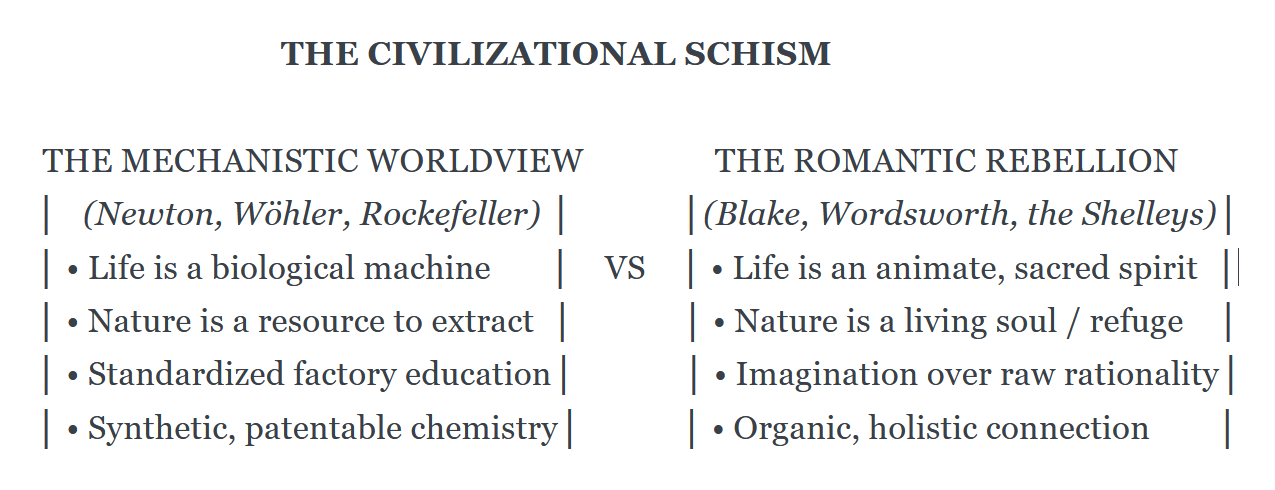
As cities filled with smoke, fields were enclosed for factories, and scientists like Isaac Newton and Erasmus Darwin began mapping the universe as a dead, clockwork machine, the Romantic poets revolted against this "unweaving of the rainbow."
A century before the Flexner Report, the first generation of industrialization was already sparking a massive psychological and spiritual counter-revolution: Romanticism.
The late 19th and early 20th centuries solidified the triumph of mechanistic materialism. Two fascinating battlegrounds reveal how this flattening of life occurred, and how humanity desperately fought to preserve its "vital spark": the institutional enforcement of chemical medicine via the Flexner Report, and the emotional, artistic rebellion of the Romantic Poets.
Part 1: The Flexner Report of 1910
The Flexner Report (formally Carnegie Foundation Bulletin Number Four) is the definitive turning point where medicine transformed from an "art of healing" into a standardized, industrial branch of synthetic chemistry.
The Setup
Before 1910, the North American medical landscape was a diverse, decentralized free market. If you fell ill, you might visit an allopathic (conventional) doctor, but you were just as likely to consult a homeopath, an eclectic herbalist, a naturopath, or a traditional midwife.
The Carnegie Foundation commissioned Abraham Flexner—who was notably not a doctor or scientist, but an expert in humanities and education—to evaluate all 155 medical schools in the US and Canada.
The Purge of
Flexner used the rigorous, laboratory-based model of Johns Hopkins University as his singular benchmark. He dismissed natural healing practices under the pejorative label of "medical sects," publicly attacking them as "quackery" and "charlatanism".
The fallout was catastrophic for alternative medicine:
* Mass Closures: Over half of all medical schools in America were forced to merge or shut down completely because they could not afford to build the massive, high-tech chemical laboratories Flexner mandated. * The Suppression of Botanicals: Schools teaching electrotherapy, traditional osteopathy, herbal medicine, and hydrotherapy were systematically stripped of accreditation. * The Monopolization of Funding: Following the report, John D. Rockefeller’s General Education Board and the Carnegie Foundation pumped millions of dollars exclusively into schools that adopted the new "biomedical model".
The Ultimate
What survived was a highly effective, yet narrow, medical monopoly. Medicine shifted from a holistic paradigm (treating the whole body, lifestyle, and natural balance) to a pharmaceutical and surgical protocol. Patients and doctors alike were integrated into an industrialized supply chain where health was defined by managing symptoms via patentable, laboratory-synthesized chemicals.
Part 2: The Romantic Rebellion Against the Machine
A century before the Flexner Report, the first generation of industrialization was already sparking a massive psychological and spiritual counter-revolution: Romanticism.
As cities filled with smoke, fields were enclosed for factories, and scientists like Isaac Newton and Erasmus Darwin began mapping the universe as a dead, clockwork machine, the Romantic poets revolted against this "unweaving of the rainbow."
1. William Blake: Fighting the "Dark Satanic Mills"
William Blake was the most radical sensory rebel of the era. He looked at the factories of London and famously dubbed them "Dark Satanic Mills."
Blake argued that scientific reductionism (which he blamed on "Bacon, Newton, and Locke") suffered from "single vision"—the inability to see the spiritual essence of reality. To Blake, reducing a tree to its lumber, or a human being to a factory unit, was a crime against the divine imagination. His poetry, like The Chimney Sweeper, was a direct protest against the systematic destruction of human innocence by industrial mechanics.
2. William Wordsworth : Mourning the Loss of Connection
William Wordsworth watched humanity withdraw from the soil and trap itself in the cycle of industrial capitalism. In his iconic 1807 sonnet, The World Is Too Much With Us, he writes:
"Getting and spending, we lay waste our powers;—
Little we see in Nature that is ours;
We have given our hearts away,
Wordsworth championed the Sublime—the idea that nature features an overwhelming, terrifyingly beautiful spiritual presence that heals the human soul from the psychic wounds of urban efficiency. He warned that by treating nature as a commodity to be calculated, we were spiritually bankrupting ourselves.
3. Percy Bysshe Shelley : The Poet as a Cosmic Force
Percy Bysshe Shelley did not hate science; in fact, he was deeply fascinated by chemistry and electricity. However, he fiercely rejected reductionism. In his famous essay A Defence of Poetry, Shelley argued that we have "more scientific and economical knowledge than can be accommodated to the just principles of what is right."
In his poem Ode to the West Wind, Shelley positions nature not as a collection of dead particles to be harvested, but as an uncontrollable, wild, and living spirit of destruction and preservation. For him, poets and artists were the true guardians of humanity's vital spark, acting as the "unacknowledged legislators of the world."
4. Mary Shelley: The Ultimate Warning
As we touched on earlier, Mary Shelley’s Frankenstein remains the ultimate myth of the reductionist era. Victor Frankenstein represents the exact hubris that later defined industrial titans: the belief that life can be mastered by cutting it into pieces, rearranging it in a lab, and jolting it with an external spark. The tragedy of the monster is the tragedy of a world created by pure intellect, completely severed from empathy, nature, and holistic responsibility.
Connecting the Threads
The Romantics lost the immediate political battle; the 19th and 20th centuries belonged to industrialization, monoculture, and Standard Oil. The Flexner Report was simply the logical conclusion of this march—the moment the state and industrial philanthropy codified the reductionist worldview into the very law of medicine.
Today, the ongoing tension between conventional allopathic medicine and the resurgence of "integrative," "holistic," or "functional" medicine is the direct continuation of this exact same historical schism.
To dive deeper into this shift, in a next post we will further explore the Green Revolution of the 1940s, where Rockefeller philanthropy exported synthetic agriculture globally.
Seeing Beyond, a research initiative focused on spiritual science, living cognition, and the threshold experiences of modern life.
An initiative grounded in a spiritual-scientific approach to self- and world-observation.
Comments
Rather than destroying soil with chemical reagents, new precision tools read the unique light signatures emitted by carbon.
Biotechnology operates under the reductionist premise that a crop must be genetically engineered to resist drought, ward off bugs, or tolerate harsh environments.
Biotechnology operates under the reductionist premise that a crop must be genetically engineered to resist drought, ward off bugs, or tolerate harsh environments.
By treating the plant genome as a software program that could be cut, pasted, and optimized, agribusiness institutionalized the ultimate mechanistic worldview.
What began with Friedrich Wöhler synthesizing urea in a 19th-century lab—proving that "Life" was just chemistry—culminated in a global agricultural system that treated human society and the earth as mere inputs and outputs in a factory line.