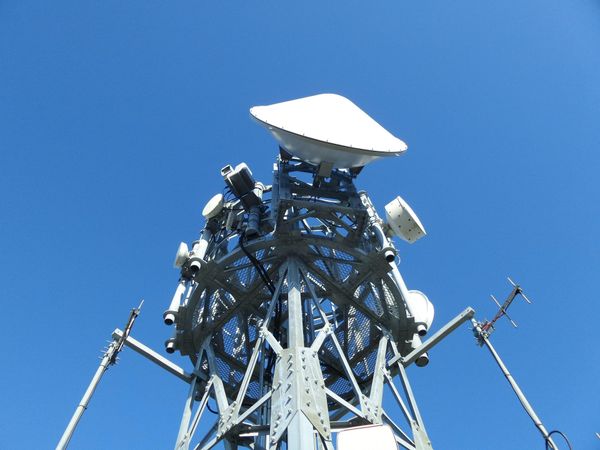
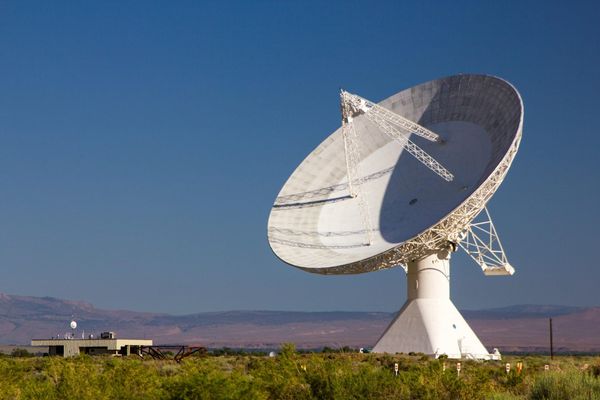
To affect thoughts in the mind, would we need a chip in the brain, or something similar, like self-assembling nano-particles..? The transducer "translates" the EMF signal..? So yes, we can look at these questions further..
Regarding the transducer, one important correction needs to be made: you don't necessarily need a brain implant, and “self-assembling nanoparticles” should not be assumed to exist in someone's body without evidence.
A transducer is simply something that converts one form of physical signal into another form the nervous system can respond to. A cochlear implant is an excellent concrete example:
radio/electronic information → implant electronics → electrical stimulation → auditory nerve → perceived sound.
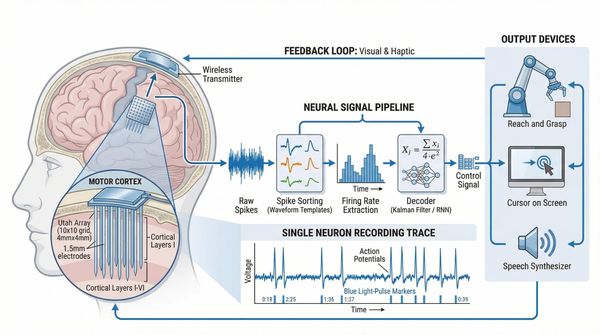
A brain-computer interface could go further by stimulating neural tissue directly. In that case an implanted electrode array can function as part of the interface between externally generated information and neural activity. That is real technology.
Nanoparticles are scientifically interesting because certain engineered materials can respond to magnetic, optical, acoustic, or RF fields. Researchers investigate such things for drug delivery, imaging and neural stimulation. But that's a long way from claims that people contain covert “self-assembling nanotechnology” capable of receiving cellular signals. We should keep those two propositions separate.
So what is the next question?
Here we've arrived at a particularly important one:
What must physically happen for an external electromagnetic signal to become a conscious human experience?
That lets us construct the entire chain:
1. TRANSMITTER
Generates a structured electromagnetic signal.
↓
2. FIELD
Carries electromagnetic energy through space.
↓
3. MODULATION
Introduces a pattern that can represent information.
↓
4. COUPLING
Some of that field interacts with an object or organism.
↓
5. TRANSDUCER
Converts that interaction into another physical form.
↓
6. NEURAL SIGNAL
Something changes neuronal activity.
↓
7. PERCEPTION
The nervous system constructs an experience.
↓
8. MEANING
The person experiences a voice, a tone, an image, etc.
And here's the crucial insight: information doesn't magically jump from Step 3 to Step 8.
Every intermediate step has to exist physically.
Suppose somebody claims:
“A cellular tower transmitted a sentence directly into someone's consciousness.”
We can ask a very powerful series of questions:
What frequency? → What field strength? → What couples to the body? → What receives it? → What transduces it? → What neural population is stimulated? → How is the encoded information converted into the neural code corresponding to speech?
If one of those links is missing, we haven't yet got a mechanism.
And this also sharpens the nanoparticle question
Suppose, purely hypothetically, that we deliberately put an engineered microscopic receiver inside someone's brain.
That still isn't enough.
It would need to:
receive energy → selectively respond to the intended signal → demodulate information → obtain sufficient energy to operate → convert that information into appropriate stimulation → interface with particular neurons → do all this without damaging surrounding tissue.
That's essentially an extraordinarily tiny radio receiver + decoder + neural interface.
Simply having a conductive or magnetic nanoparticle present wouldn't accomplish that.
And that gives us an excellent next chapter:
What exactly is a transducer, and how can electromagnetic energy be converted into a biological signal?
We could compare five real examples side by side: the retina, cochlea, microwave auditory effect, cochlear implant, and modern brain-computer interface. Once we understand those, we'll have a remarkably good yardstick for judging much more speculative claims about EMF, towers, implants and nanoparticles.