Thinking What We See: Awakening to the World Economy
We have to be able to follow a product backward toward the conditions of its production and forward toward the needs it will eventually serve.

– 10 min read
We have to be able to follow a product backward toward the conditions of its production and forward toward the needs it will eventually serve.
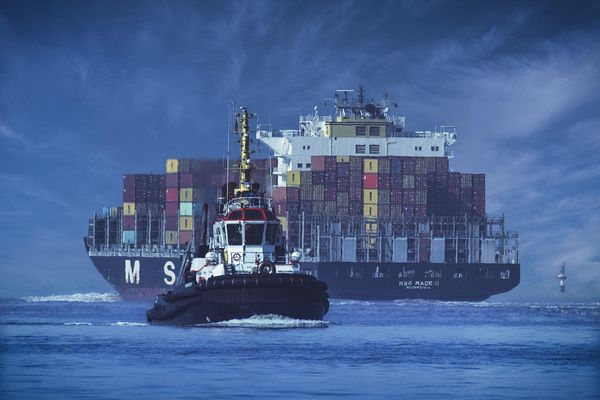
What do we see?
The immediate answer seems obvious. We see an enormous vessel carrying thousands of steel containers across the ocean. Perhaps we know that it is travelling from Asia to Europe or North America. We may recognize the name of the shipping company painted across its hull.
But almost immediately, something else begins to happen.
The image calls up associations.
Globalization. China. Cheap manufactured goods. International trade. Corporate profits. Carbon emissions. Exploited labour. Supply chains. Perhaps the blockage of the Suez Canal, attacks on ships in the Red Sea, or containers falling into the ocean.
Depending upon our political and cultural orientation, other associations may arise: the extraordinary efficiency of global trade, the prosperity it has enabled, economic growth, technological progress, free markets.
None of these associations is necessarily wrong.
But none of them is yet the container ship.
More importantly, none of them is yet the economy that the container ship makes visible.
There is another way of looking. It requires more effort because instead of allowing the object to trigger familiar thoughts, we have to begin actively thinking what we see.
And if we do this with sufficient persistence, the apparently simple image of a container ship begins to open onto something immense.
Suppose the vessel in front of us is travelling from East Asia toward Rotterdam.
The containers aboard it are not simply coloured boxes. Every one of them has a history and a destination.
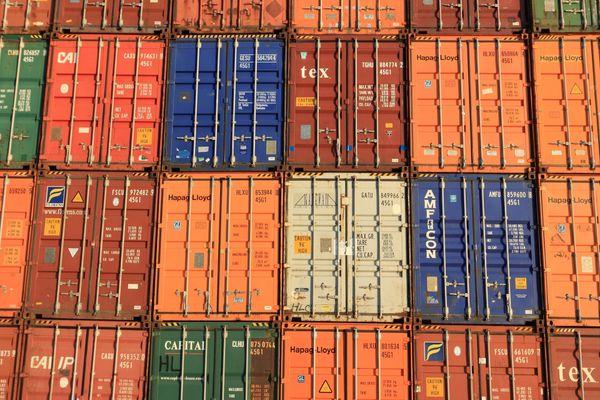
One contains tires manufactured in South Korea. Another contains machine components produced in China. Others may contain furniture, clothing, chemicals, electronic equipment, tools, food products or parts required by factories thousands of kilometres away.
Already the ship can no longer be thought of as an isolated object.
The tires were manufactured somewhere.
Rubber, steel, carbon black, chemicals and energy had to converge upon a factory before a single tire could exist. Machinery had to be designed and maintained. Workers had to be trained. Orders had to arrive. Production had to be scheduled. Someone somewhere had to anticipate a demand that might arise weeks or months later on another continent.
The completed tires then had to leave the factory.
They were placed into a standardized container, sealed, documented and transported to a port. The container entered a vast logistical system in which its location, weight, destination and contents had to be known sufficiently well for it to find its place among thousands of others.
Then a crane lifted it.
The container became part of the ship.
But even here we cannot stop.
Its position aboard the vessel matters because the distribution of thousands of containers affects the stability of the ship. The containers have to be secured. Their destinations matter because they must be accessible according to the sequence of ports at which the vessel will call. Dangerous materials require particular treatment. Refrigerated containers require power.
The ship that appeared at first as a large object has begun to dissolve into relationships.
The important thing is not to speculate.
We do not need to introduce a theory about capitalism, globalization, social justice or the environment.
We need only continue following what is actually happening.
The vessel leaves the port.
Its engines consume fuel. Engineers monitor machinery. Officers navigate. Weather systems have to be followed. Shipping lanes are shared with other vessels. Ports allocate arrival slots. A delay in one place can alter what happens somewhere else.
The ship approaches another port and a pilot comes aboard.
The captain knows the vessel. The pilot knows the harbour.
Tugboats may assist. Cranes are waiting. Trucks and trains are waiting. Other ships are waiting.
Some containers leave. Others come aboard.
Then the vessel continues.
If a geopolitical conflict makes a shipping route unsafe, another route may have to be chosen. That changes distance, fuel consumption and arrival times. Those changes propagate outward. Manufacturers waiting for components may have to adjust production. Warehouses may receive goods later than expected. Retailers may have to alter plans.
Nothing needs to be invented in order for the picture to become increasingly complex.
We are simply thinking the facts.
Yet the more faithfully thinking follows them, the more the original object expands.
The container ship is becoming world economy.
There is a peculiar challenge here.
Human thinking readily contracts toward manageable objects.
One worker.
One company.
One transaction.
One product.
One price.
These are comparatively easy to grasp because we can isolate them.
But the world economy does not exist at that scale alone.
It exists simultaneously through movements connecting continents, industries, resources, climates, technologies and billions of human beings.
If we wish to understand it, our thinking has to become correspondingly mobile.
We have to be able to follow a product backward toward the conditions of its production and forward toward the needs it will eventually serve. At the same time, we have to perceive lateral relationships: transportation, energy, finance, infrastructure, law, communication and innumerable other processes without which the movement could not occur.
This requires something more than having many facts in our heads.
It requires dynamic thinking.
Thinking has to move with the phenomenon.
It must expand without becoming vague and remain exact without becoming fixed.
One might call this kraftvolles Denken: thinking that is inwardly activated and deliberately sustained rather than passively carried along by whatever associations happen to arise.
The difference is fundamental.
Passive thinking hears "container ship" and retrieves an existing picture.
Active thinking asks: What is actually happening here?
Once this activity begins, another change occurs.
We cease thinking primarily in objects and begin thinking in processes.
A tire is no longer merely a tire. It is a temporary configuration within a movement of materials, knowledge, labour and need.
A container is not merely a box. It is a standardized form that allows different transportation systems to cooperate.
A port is not merely a place. It is a concentration of movements.
Even the ship itself becomes less an object than a moment within circulation.
It arrives, exchanges cargo and departs. Its meaning lies precisely in movement.
This is important because much of economic reality consists not of things but of transformations and relationships between things.
Raw materials become components. Components become products. Products move. Needs change. Knowledge enters production. Waste leaves it. Money moves in another direction. Information moves faster than the goods themselves.
What we call "the economy" is therefore extraordinarily difficult to photograph.
We can photograph a factory.
We can photograph a container.
We can photograph a ship.
But we cannot photograph the world economy.
It becomes perceptible only when thinking begins to connect the facts across space and time.
Take one container.
Suppose it contains those Korean tires.
Thinking can follow them backward into the factory. From there it can follow the materials entering production. It can follow the machinery that shaped them, the energy that powered the machinery, the engineers who designed the processes, and the workers who carried them out.
Then thinking can turn around and follow the tires forward.
They cross an ocean. They arrive in Rotterdam. They enter European distribution networks. Eventually they are fitted onto vehicles.
Those vehicles themselves belong to other economic processes. They transport people or goods. Their operation requires roads, fuel or electricity, maintenance, insurance and innumerable other activities.
Every point we reach can be opened again.
The world economy does not appear because we add an abstract concept called "globalization" to the tire.
It appears because the actual relationships contained within the tire lead outward toward the world.
This is an important distinction.
The whole is not imposed upon the phenomenon by theory.
The phenomenon itself leads toward the whole when thought is capable of following it.
The same exercise can begin much closer to home.
Take a banana.
Ordinarily we peel it, eat it and throw away or compost the peel.
But if thinking becomes active, the banana begins to open outward.
Where was it grown?
What climatic conditions made its growth possible?
Who planted and harvested it?
How was it transported from the plantation?
How was it kept from ripening too quickly?
Which port did it leave from?
Which ship carried it?
Where did it arrive?
How was it distributed?
How did it reach the particular shop in which we bought it?
Suddenly the small yellow object in our hand is connected with soil, sunlight, tropical climate, agricultural knowledge, labour, refrigeration, shipping, ports, roads, warehouses, retail systems and human beings across great distances.
None of this is mystical.
It is simply true.
Yet normally almost all of it remains invisible.
The object appears before us while the world contained in its becoming disappears.
Thinking can restore that world.
Something remarkable begins to happen when this exercise is continued.
I remain here.
I am a centre.
The banana is in my hand. The computer is on my desk. The tires are on my car. The tea is in my cup.
Yet the conditions that make these things possible extend outward toward an enormous periphery.
People I will never meet have acted in relation to needs that eventually reach me. Materials have travelled. Knowledge has been applied. Decisions have been made. Ships have crossed oceans.
My apparently private existence is already woven into a planetary human reality.
The world economy therefore creates an unusual relationship between centre and periphery.
Each person experiences themselves from a centre, yet economically the circumference of their existence increasingly reaches around the Earth.
This is not a philosophical proposition imposed upon economic life.
It can be discovered by following almost any ordinary object far enough.
The world enters the centre.
And from the centre, our own activity can move outward into the world.
If this reality is so immense, why do we see it so poorly?
One reason is precisely its scale.
Those directly engaged in economic life necessarily work within particular areas. The engineer knows the engine. The logistics manager knows the movement of containers. The manufacturer knows production. The retailer knows customers. The economist studies particular patterns and relationships.
Specialization makes the system possible, but specialization can also make the whole difficult to see.
The person most deeply involved in one part of the process may have little opportunity to contemplate the entire movement.
At the opposite pole stand theories.
Here the whole is apparently visible, but often at the price of abstraction.
The economy becomes capitalism, markets, class struggle, growth, globalization, GDP, financialization or some other conceptual framework.
Such concepts may illuminate genuine aspects of reality.
But they can also begin to replace it.
Then we have a peculiar situation.
Those immersed in the reality may see only a part, while those speaking about the whole may increasingly be speaking about their theories.
Between the two, the actual world economy can disappear.
There is another reason.
Economic facts today arrive already interpreted.
A container ship is scarcely allowed simply to be a container ship.
It appears under a heading.
Globalization.
Climate change.
Corporate power.
Cheap labour.
Consumerism.
Growth.
These perspectives may identify important realities, but when they become the starting point of perception they can act like veils.
Before we have followed what the ship actually does, we already know what it means.
This is epistemologically dangerous.
The problem is not criticism. The problem is premature judgment.
If environmental consequences are real, sufficiently exact thinking will encounter them.
If labour exploitation is occurring, following the facts will reveal it.
If a company is extracting disproportionate profit, economic investigation can establish this.
Nothing has to be protected from criticism.
But neither should criticism be allowed to prevent the phenomenon from first becoming visible.
There is a profound difference between arriving at a judgment through reality and approaching reality through a judgment already formed.
There is a simple exercise that can help develop this capacity.
Choose an ordinary object and think it.
Not associations about it.
Not opinions about it.
Think what you actually know.
A pencil.
A cup.
A loaf of bread.
A telephone.
Hold attention on the object and reconstruct its reality as exactly as possible.
At first this can feel strangely difficult. Thinking wants to wander.
But if attention is sustained, something changes. The object becomes more articulated. Relationships that were previously implicit become conscious.
Applied to economic life, this elementary exercise can be expanded enormously.
Think the container.
Think the ship.
Think the port.
Think the movement from factory to consumer.
Then continue.
The exercise is no longer merely concentration upon an object. It becomes an attempt to make thinking mobile enough to follow reality across the Earth.
This is not economic theory.
It is an education of economic perception.
Much public discussion remains trapped between the micro and the abstract.
At the micro level we encounter individuals, businesses, prices and transactions.
At the abstract level we hear about "the global economy."
What is often missing is the cognitive movement through which the first becomes the second.
Container shipping offers an extraordinary opportunity because it physically carries us across that gap.
A ship can contain the products of thousands of economic processes at once. It moves between continents. Its route crosses jurisdictions, cultures, industries and natural environments. Its arrival connects immediately with road and rail systems extending inland.
To think such a vessel adequately, thinking itself has to enlarge.
One begins to wake up at the macroeconomic level.
The phrase "world economy" then starts losing its abstract character.
It becomes movement.
One can almost begin to behold it.
And perhaps, somewhere in this process, admiration arises.
But admiration is not the method.
Nor should it be demanded.
It is a possible consequence of seeing.
When thinking succeeds, even partially, in following the extraordinary coordination through which materials, capacities, information and human needs are connected across the Earth, the fact that any of this functions at all can become astonishing.
The feeling is not produced by deciding to adopt a positive attitude toward globalization.
It arises because something previously hidden has become perceptible.
The same can happen in natural science. The more exactly one understands a living process, the more remarkable it may become.
Knowledge does not have to destroy wonder.
Exact perception can produce it.
The container ship becomes impressive not merely because it is 400 metres long, but because thinking begins to perceive the immense field of relationships moving with it.
Perhaps this is one reason our relationship with economic life has become so impoverished.
We encounter it largely through money.
How much does it cost?
What do I earn?
What is the inflation rate?
What is the company worth?
What is the profit?
Or we encounter it through political and moral categories.
Is globalization good or bad?
Is growth sustainable?
Are corporations exploitative?
These are legitimate questions.
But underneath them lies the economy itself.
Things are being produced.
Materials are being transformed.
Human capacities are being applied.
Goods are moving.
Needs are being met.
Consequences arise.
New problems appear.
People respond.
The whole process is continually changing.
To encounter this reality requires thinking that can move with it.
And perhaps this is where a genuinely different relationship to the economy can begin.
Not with praise.
Not with condemnation.
Not with a theory.
With attention.
No human being can contain the entire world economy in consciousness.
That is not the aim.
The aim is to develop enough mobility of thought that the whole begins to become present through the parts.
The container ship can become such a part.
So can the banana.
So can the computer on the desk.
Followed sufficiently far, each leads beyond itself.
Gradually the apparently separate objects surrounding us reveal themselves as intersections within movements extending around the Earth.
And something that had previously existed only as an abstraction begins to acquire experiential content.
World economy.
Not as a theory, but as a reality in movement.
Perhaps the first task in developing a healthier economic life is therefore more elementary than proposing a new economic system.
We may first have to learn to see the economy that already exists.
That requires a certain effort because the whole does not present itself directly to the senses. It must be followed through active thinking. Attention has to be strengthened; thinking has to become mobile, exact and sufficiently powerful to resist the ready-made associations that continually seek to replace perception.
But when that movement succeeds, even for a moment, the world looks different.
The container ship on the horizon is no longer merely an enormous steel vessel.
The world is moving with it.