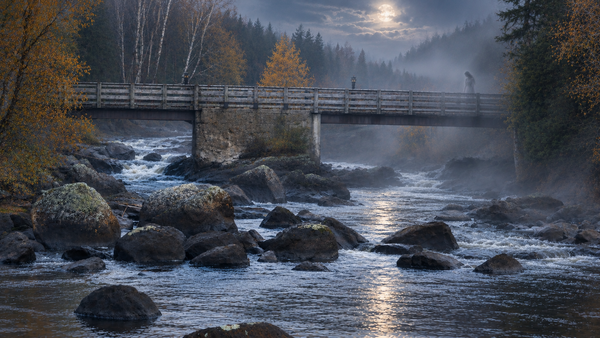
Along the banks of the Rivière du Nord, in the picturesque town of Val-David, Quebec, traces of a sad story still linger. In the evenings, when the sun slips behind the mountains and the moon rises over the clear water, it is said that mournful voices can be heard above the dull roar of the waterfalls. The voices cry for a love that was lost forever, a love that began beside the river more than a century and a half ago.
In the spring of 1849, the first settlers arrived in the area, where they were warmly welcomed by a Mohawk family who helped them find their way through the unfamiliar landscape. The Indigenous people knew the forests, lakes, and streams well, and shared their knowledge of the land with the newcomers. In time, the village grew around the river, where watermills harnessed the rushing current to grind grain and serve the surrounding settlements.
It was here that the story of Agile Deer and Angeline began. As told by Claude Proulx, Agile Deer was the eighteen-year-old son of a Mohawk chief, while Angeline was the seventeen-year-old daughter of the village miller. Her father often delivered flour to the Mohawk reserve at Lac de la Truite, northwest of the village, and Angeline loved to accompany him on these journeys.
During one of these visits, Angeline and Agile Deer first saw one another. They exchanged no words at first, but their glances said enough. Something passed between them that neither could easily dismiss. Before long, the young couple began meeting in secret near the mill, beside the river and its tumbling waterfalls.
Their meetings were filled with the quiet happiness of first love. Agile Deer would make his way over hills and through valleys to see Angeline, who taught children at a small schoolhouse nearby. They walked along the water, spent time together by the mill, and sometimes traveled by canoe along the river to Lac Raymond. On one beautiful summer day, they drifted over the clear water while Angeline sang a song she had learned from her mother:
“At the clear fountain, as I go for a walk,
I found the water so beautiful,
that I bathed in it.
I have loved you for a long time,
I will never forget you.”
The song was a simple one, but its words carried a promise that must have seemed as enduring as the river itself. Agile Deer learned the verses, and the two sang together as their canoe moved gently through the Laurentian landscape. Perhaps the melody stayed with him long after that summer day had passed.
Their love grew, and both families knew of the young couple’s attachment. Agile Deer’s family accepted the match, and his father gave his consent to their engagement. Angeline’s father, who knew the young man and cared for his daughter, appears to have been sympathetic. But her mother strongly opposed the marriage.
Angeline pleaded with her mother, but her appeals could not change her mind. Even a visit from the parish priest, who urged Angeline to consider her mother’s sorrow, did little to settle the conflict in her heart. The lovers had made plans for a wedding, and their future had seemed so certain.
Angeline could bear the struggle no longer. At seventeen, she left her family home and went to a convent in Montreal, where she entered a religious congregation. She and Agile Deer never saw one another again—or so the story tells us. What became of him is not known.
Years passed. The waterfalls continued their restless song, the river flowed through the valley, and the mill carried on its work. The places where the lovers had walked remained, though the young people who had once met there were gone.
When Angeline was forty, she returned to Val-David for a brief visit with her brother. Perhaps she wandered along the familiar riverbanks, remembering the boy who had once crossed the hills to see her. Perhaps she stood near the waterfalls and listened to the water rushing over the rocks, recalling their canoe rides and the song they had sung together. We can only imagine what stirred in her heart as she revisited the landscape of her youth.
One moonlit evening, according to the story, Angeline walked to the place where she and Agile Deer had often met. She began to hum their old song. Then a great wind rose, and a strange, mournful sound answered her from the darkness. It seemed to echo the song’s saddest words, the words of someone whose heart had been left behind.
Today, Parc des Amoureu–Park of the Lover-s–keeps the memory of the story alive. There is something fitting about the place chosen to remember them. The cold, tumbling waters hold their own kind of memory, carrying the past through the present in a language we do not always understand.
If you visit in the evening, when the light fades behind the mountains and the sound of the rapids fills the air, listen closely. Just for a moment, you may hear a distant, tearful note rise above the rushing water. Some say it is the sobbing of Angeline, forever mourning the love she lost along the banks of the Rivière du Nord.