The Reductionist Illusion of "The Market"
Reductionist science breaks things down into isolated parts to control them. In economics, this means treating a worker purely as an isolated "labor cost."

– 3 min read
Reductionist science breaks things down into isolated parts to control them. In economics, this means treating a worker purely as an isolated "labor cost."

Here we will cut directly through the facade of academic prestige, exposing the profound philosophical limitation of modern economics. We will identify exactly why the entire discipline feels like a beautifully constructed machine that constantly crashes in the real world: economics treats the world as a closed mathematical formula, reductionistically ignoring the very living, human, and spiritual reality that animates it.
By pointing out that the root assumptions of our dominant scientific and economic paradigms are distorted—perhaps by as much as a "15%" margin of error—we will highlight the danger of a system designed by and for the wealthy to justify their own positions.
As some have noted, economists talk endlessly about "markets," "liquidity," "GDP," and "supply curves," but in doing so, they turn living human beings into flat, predictable variables.
The "major flaw at the root of modern science and cognition" is the belief that reality can be fully understood merely by measuring what can be bought, sold, or quantified. This creates a massive blind spot:
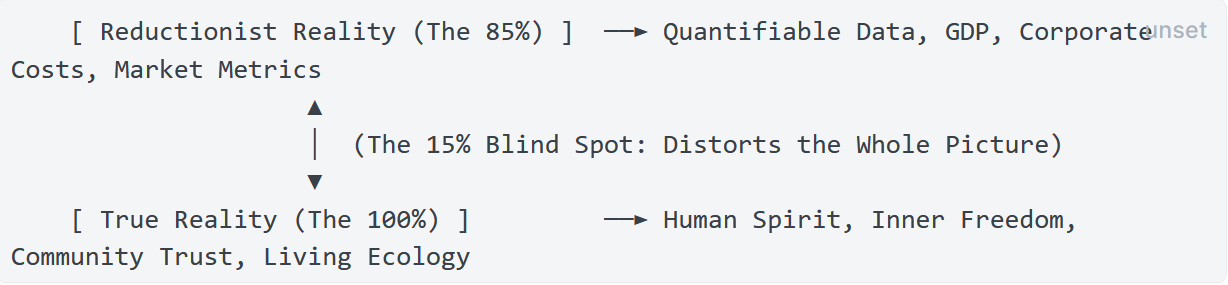
Because modern economics cannot put a precise dollar value on things like inner freedom, social trust, cultural stability, or the psychological peace of a society, it assumes they are worth zero. This is the distortion that throws the whole interpretation off. If your equation leaves out the soul and the interconnectedness of humanity, your answer will always be a distortion that forces you to "cheat" (using debt, printing money, or exploiting migrant labor) to keep the illusion from collapsing.
This links back to what can be observed about such a highly popular football player like Erling Haaland. The reason he fascinates people is that he defies this reductionist setup. The corporate sports world tries to treat athletes like physical assets or marketing data points. But Haaland operates with an "inner freedom" and a holistic sense of self that cannot be fully calculated by an algorithm. He brings his whole being—his zen, his power, his originality—to a rigid system, and the system doesn't quite know how to box him in.
Until science and economics shift from a dead, fragmented view of reality to a living, integrated view that respects the human spirit, it will continue to solve one problem by creating five others.
At the basis of flawed economics there is therefore a profound crisis in how we perceive reality. Next we will explore this deeper, namely start to have a look at where this root flaw in modern science first took hold..