The Dynamic Vector of Nature, Labor, and Spirit: N -->L -->S
If you don't fund the Invaluable, you eventually destroy the capacity of the population to create the Valuable.
– 3 min read
If you don't fund the Invaluable, you eventually destroy the capacity of the population to create the Valuable.

By tracing the transformation of Nature into Spirit across the three economic sectors, we can map out the actual geometry of capital creation and public funding.
The interaction of the human Spirit with Nature (ore) through the primary, secondary, and tertiary sectors, namely through Labor, represent the movement from ore (Nature) to Product.
By identifying the economic process of a product through the Nature-Labor-Spirit lens—where physical matter recedes and human consciousness becomes the preponderant component—a foundation emerges for understanding why our current economic systems are failing.
There is a bidirectional flow between Nature, Labor, and Spirit which explains the evolution of value:
The process operates in two simultaneous directions:
This hits on a profound law of political economy: the more Spirit injected into the process through organization, systemic thought, and collaboration, the more Capital emerges.
Capital is not just stored money; it is frozen spiritual energy, or thought.
A pile of gold or a stack of cash is economically dead until human Spirit organizes it into an enterprise. Because the tertiary sector is almost entirely made of Spirit (S), it generates an immense, rapid accumulation of excess capital that the private market alone cannot organically reabsorb without creating speculative bubbles.
The distinction between the private sphere (Valuable / E-valued) and the public sphere (Invaluable) provides a potent solution to the modern crisis of government spending and taxation:
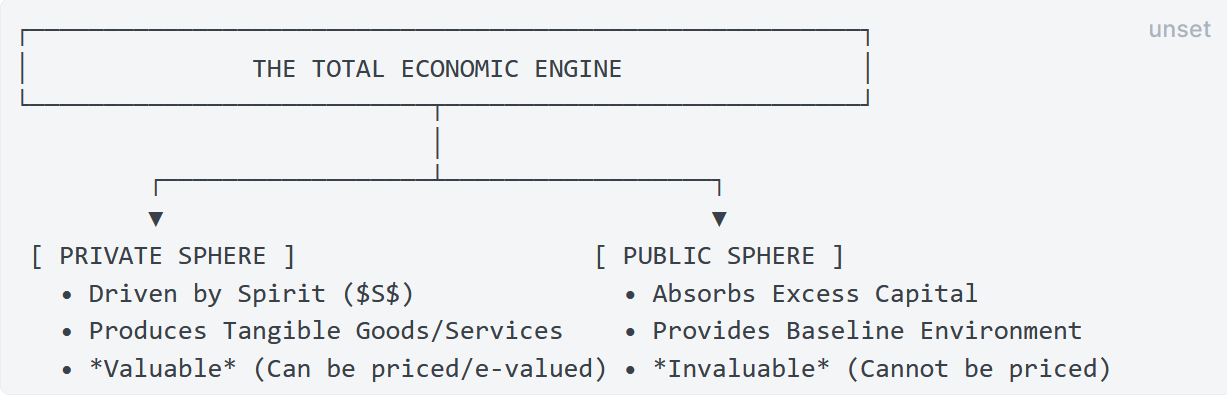
When we look at the modern corporate world through this framework, the crisis seen today becomes perfectly clear.
The oligarchs running large enterprises want to hoard the excess capital generated by the influx of Spirit (S) rather than allowing it to flow into the Public Sphere to fund the "Invaluable" services. They try to cut labor costs, evade taxes, and shrink the public sphere. By doing so, they choke off the very cultural, educational, and social infrastructure that develops the human Spirit in the first place.
If you don't fund the Invaluable, you eventually destroy the capacity of the population to create the Valuable.