Listening Across the Threshold: The Art of Communion with the Dead and the Cosmic Journey
The dead no longer possess physical ears or cerebral brains; they experience reality through the fluidic, pictorial substance of the etheric and astral worlds.
The deceased do not immediately cut ties with the world they left behind. On the contrary...
The loss of a loved one often leaves us standing at a perceived precipice, staring into what appears to be a silent void. Yet, this silence is an illusion created by our reliance on physical senses and abstract, intellectual speech. The dead have not vanished into non-being; they have transitioned into an active, expansive realm of consciousness. To build a true bridge across this threshold, we must learn the language of the dead, understand their ongoing participation in earthly life, and hold a clear picture of their journey through the cosmic spheres.
1. The Language of Communion: Images and Melodic Resonance
When we attempt to speak to the deceased using dry, intellectual logic or by recounting static physical facts—such as news headlines or financial details—we speak a dialect that does not carry into soul space. The dead no longer possess physical ears or cerebral brains; they experience reality through the fluidic, pictorial substance of the etheric and astral worlds. To establish a meaningful conversation across the threshold, our inner gesture must transform:
Speaking in Living Images: Instead of abstract words, we must form clear, vibrant inner pictures. If we wish to share something with a loved one who has passed, we hold the essential, qualitative image of the event or feeling in our consciousness. The dead "read" these living pictures directly.
The Melodic Vibrato: Our inner voice should carry a rhythmic, melodic quality—a soul-vibrato born of warm feeling rather than cold intellect. A thought imbued with deep reverence, love, and musical warmth resonates far into the spiritual world, whereas flat, linear thoughts pass through it without taking hold.
Non-Static Content: The dead are not interested in the hardened, material surface of things. They respond to the meaning, moral quality, and spiritual essence behind earthly actions. Communicating with them means sharing the life of the heart and the soul’s deeper intentions.
2. Ongoing Earthly Participation
The deceased do not immediately cut ties with the world they left behind. On the contrary, those who were connected to us in life continue to take an active interest in our endeavors—particularly in activities, arts, or callings they knew well and in which they still have a spiritual stake. When you engage in a craft, a research project, an artistic pursuit, or a community effort that was dear to a deceased friend or relative, they are drawn to that shared warmth. They participate in your enthusiasm, acting as quiet inspirations or subtle companions in soul space. The threshold becomes porous whenever genuine love and shared purpose unite the living and the dead.
3. The Afterlife Journey: A Panorama of the Spheres
To follow the dead with loving awareness, we must replace vague notions of an abstract "heaven" with a concrete understanding of their journey through the spiritual cosmos. Seen from within, the planetary spheres of our solar system are not cold, orbiting rocks in empty space, but vast, living realms of consciousness—what ancient traditions knew as the heavenly spheres.
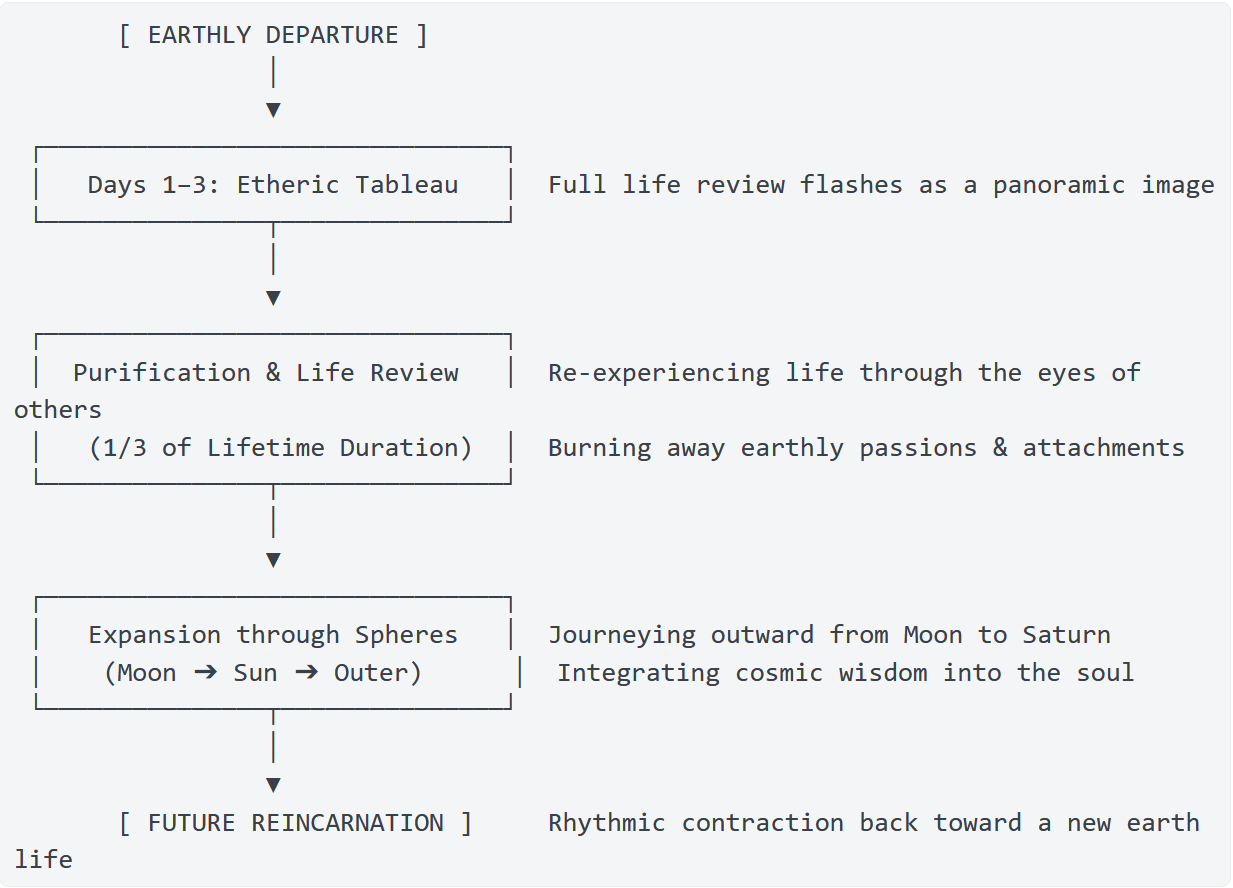
The Afterlife Journey in Overview
The First Three Days: The Panoramic Tableau
Immediately after physical death, as the etheric body expands, the soul experiences a complete, panoramic flash of the life just lived. Every moment, memory, and detail appears simultaneously as a magnificent, illuminated tapestry.
The Life Review and Purification
Following this initial tableau, the soul enters a phase lasting approximately one-third of the duration of the physical life just ended. Here, the life review is re-lived in reverse, but with a profound shift in perspective:
Experiencing the Impact on Others: You do not experience your actions from your own self-centered viewpoint; rather, you feel precisely what every other person, animal, or living thing felt as a result of your words, deeds, and thoughts.
Burning Away Earthly Entanglements: During this period, the soul gradually burns away the dense, egoic passions, cravings, and illusions that bind it strictly to physical matter. Cleansing these heavy attachments frees the soul's vision, allowing it to perceive its new, grander environment clearly.
Expansion Through the Planetary Spheres
Once freed from dense earthly gravitations, the soul begins its journey of expansion outward through the solar system:
Moving sequentially through the spheres—from the closest planetary realms (Moon, Mercury, Venus) to the central solar realm, and outward to the distant spheres (Mars, Jupiter, Saturn)—the soul expands into the "inner world" of the cosmos itself.
In these spheres, the soul harmonizes its experiences with cosmic spiritual forces, meeting higher beings and preparing the spiritual foundations for future world evolution.
4. The Cosmic Arc: Expansion, Contraction, and Return
This journey through the heavens represents one breathing phase of human existence—an expansion outward into the infinite spiritual world. But this expansion is eventually followed by a gentle contraction. In rhythm with the great evolutionary arc of humanity, the soul turns once more toward the Earth:
Drawn back by bonds of love, unfinished moral work, and shared destiny, the soul prepares for a new life on Earth.
It works in concert with spiritual guidance to construct its future life conditions, weaving its path to reconnect with souls already met in past lives, while opening spaces for entirely new encounters.
When we hold this living picture of the afterlife, death loses its terror and its finality. We no longer view the deceased as lost in an inaccessible abyss, but as active travelers along a grand cosmic journey. By sending them living images, warm melodic thoughts, and clear understanding, we offer them real nourishment on their way—standing beside them as conscious companions across the invisible world.
Seeing Beyond, a research initiative focused on spiritual science, living cognition, and the threshold experiences of modern life.
An initiative grounded in a spiritual-scientific approach to self- and world-observation.
Comments
Before written language or abstract intellect, the human soul was embedded in a shared, trans-generational memory stream.