The Metamorphosis of Perception: From the Primordial Mist to the Reawakening of Soul Space
In early epochs, the Earth was not the dry, hardened, and sharply outlined physical world we know today.

– 4 min read
In early epochs, the Earth was not the dry, hardened, and sharply outlined physical world we know today.

To look back into the deep past of human existence is not merely to observe a change in culture, tools, or technology, but to witness a profound evolution in human consciousness and physical constitution. Modern history often projects our present mode of being—sharp, intellectual, and bound to a rigid physical reality—backward into time, assuming early humans were simply modern people living in primitive conditions. Yet the truth is far more dynamic: the physical Earth, the human body, and human perception have evolved together in a continuous stream of metamorphosis.
To understand where we are today—and to restore our lost relationship with the unseen world, including our connection to the dead—we must unfreeze our static pictures of the past and trace the journey of human consciousness from its primordial origins to its current threshold.
In early epochs, the Earth was not the dry, hardened, and sharply outlined physical world we know today. It was hulled in a warm, moisture-laden mist, an environment where the physical and etheric realms interpenetrated seamlessly. Humanity, too, was far less dense. Rather than walking rigidly upon solid ground, human beings moved through a fluidic atmosphere like entities suspended in a living element.
In this mist-laden epoch, physical contours were soft and malleable:
As the atmosphere settled and physical forms began to condense, human culture expressed itself through deep resonance with the cosmos. Before written language or abstract intellect, the human soul was embedded in a shared, trans-generational memory stream.
Over time, as the cosmos became "tamed" and the physical body hardened, this dreamlike, instinctual clairvoyance receded. The pineal organ drew inward, the skull closed, and human beings descended fully into dense physical matter.
This descent into denseness was not an error; it was necessary for humanity to develop clear, logical intellect and genuine individual freedom. However, this achievement brought a severe side effect: the illusion of total isolation.
Having lost the natural, fluid perception of the past, we began to treat our inner world as a private, passive void—a mere collection of brain-generated thoughts and cognitive noise. We came to view the physical world as the only real existence, isolating ourselves behind our physical senses.
This isolation creates a profound fracture in our relationship with the unseen world:
In a purely materialist worldview, the dead are considered "gone," reduced to static memories stored in our neurons. But because consciousness is not bound by physical metrics like weight, height, or distance, the inner world is continuous with the greater spiritual realm of the universe.
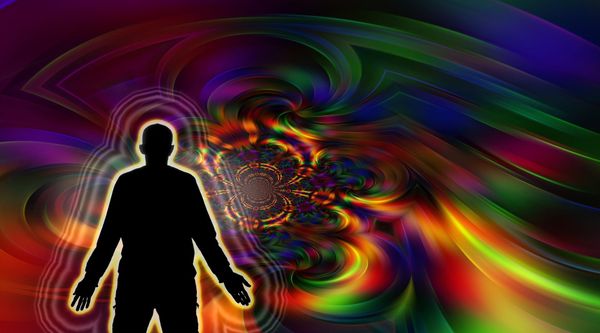
When we think of a deceased person, that thought is not a mere internal picture—it is an actual point of meeting in soul space. The dead, who no longer experience physical distance, perceive us directly. When we meet their presence with doubt or denial, treating them as non-existent, that skepticism acts like a wall of dark glass. For the deceased, human materialist denial is experienced as a real erasure, inflicting a painful, forced isolation.
This same misunderstanding applies to our inner states. When we experience an uncontrollable fit of anger or an obsessive loop of thought, these forces do not feel like deliberate cognitive choices; they exert an autonomous power over us.
Ancient, pantheistic cultures recognized these forces as living elemental entities. What we dismiss as "primitive projection" was a direct recognition of reality. Human passions, uncontrolled impulses, and obsessive thoughts are indeed animated by elemental forces that inhabit non-physical space.
Unlike the rigid physical world, the substance of the soul world is fluidic and subject to immediate metamorphosis. It responds instantaneously to the inner quality of our consciousness:
Herein lies the true, objective meaning of morality. Morality is not a set of arbitrary rules or external commands we "must" obey out of duty. It is a set of spiritual physics. Every thought, mood, and intention carries real, tangible consequences in the fluidic substance of the invisible world, shaping the very environment we share with the living, the elemental realm, and the dead.
To cross the threshold into a healthy future, we cannot simply wish for a return to the dreamlike, instinctual clairvoyance of ancient times. Nor can we remain trapped in the cold, static materialism of the present.
We must learn to bring our rigid pictures of the world into movement. By recognizing that our inner life is a real, substantial soul space—and by approaching it with disciplined, conscious attention—we dissolve the illusion of separation. In doing so, we lift the barrier between ourselves and the invisible world, reclaiming a living, reciprocal relationship with the deceased and the spiritual reality that surrounds us.