To deepen the "concrete" picture of the Chinese folk-soul, we can look at these geographical and architectural features as physical crystallizations of spiritual boundaries.
1. The Himalaya: The Throne of "Himmel" (Heaven)
In an anthroposophical sense, the Himalayas act as the Earth’s "crown chakra." One can note the etymological link to Himmel (Heaven) which resonates with the idea that these peaks reach into the "peripheral" forces of the cosmos, where the air is thin and the etheric life is less bound to the heavy mineral Earth.
- The Vertical Barrier: For the Chinese folk-soul, the Himalayas represent the absolute limit of the terrestrial. It is a wall of "Spirit-Light" that prevents the soul-mood of the Indian subcontinent (more devotional and liquid) from simply flowing into the structured, more "solid" soul-mood of China.
- The Downward Flow: The great rivers (Yellow and Yangtze) born from these "Heavenly" heights bring the "formative forces" of the mountains down into the plains. This creates a soul-tension: the Chinese person lives on the flat, loamy earth but is constantly fed by the "spiritual waters" of the high peaks, leading to a culture that seeks to "earth" the heavenly through precise ritual and bureaucracy.
2. Chengdu: The Basin of Synthesis
Chengdu, situated in the Sichuan Basin, is a perfect "concrete" example of the geographic impact on the soul.
- The "Womb" Effect: Surrounded by mountains, Chengdu acts as a "protected space" or a crucible. In anthroposophical geography, basins tend to concentrate the "Life-Ether." This is why Chengdu is historically characterized by a more relaxed, "soul-warm" atmosphere compared to the harsher northern plains.
- The Transition Zone: Being in the "vicinity of the mountains" means the population there lives in the shadow of the "Himmelaya" heights while standing on fertile, moist ground. This creates a temperament that is more imaginative and "moist" (psychologically speaking)—a bridge between the rarefied air of the Tibetan plateau and the dense social structures of the East.
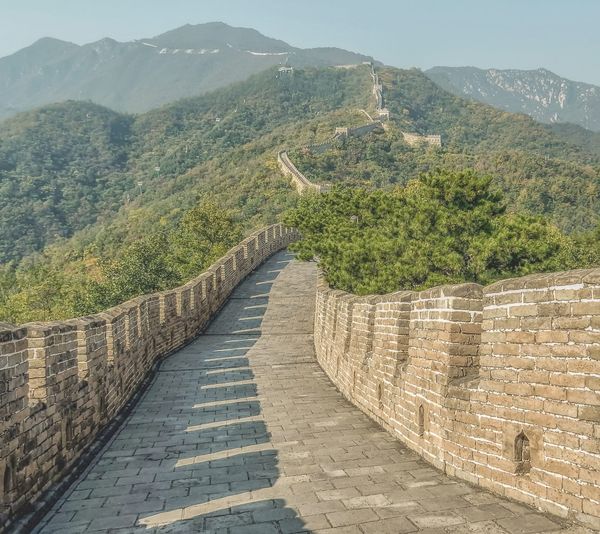
3. The Great Wall: Guarding the "I" against the Wild Hordes
We can also mention Steiner’s indications regarding the Mongolian "wild hordes." In his lectures on the Folk-Souls, Steiner often discussed how different evolutionary stages of humanity coexist.
- The Mongolian Impulse: From a spiritual-evolutionary view, the nomadic tribes of the North represented a "residual" force of an earlier, more instinctive, and "blood-bound" consciousness. To the settled Chinese culture—which was laboring to build a structured, "civilized" soul-life—these hordes appeared as "demonic" or chaotic forces that threatened to dissolve the emerging "social I" back into a primal, astral turbulence.
- The Wall as a "Skin": The Great Wall is more than a military defense; it is a Macrocosmic Skin. Just as the human "I" requires a boundary (the skin) to separate the inner world from the outer chaos, the Chinese folk-soul built the Wall to define its "inner space."
- Ahrimanic Hardening: However, the Wall also signifies a "hardening." By physically blocking out the "other," the Chinese soul-impulse became "compressed," as you noted earlier. It successfully preserved its ancient wisdom but at the cost of becoming a "closed system" for centuries.
Integration Summary
By combining these elements, the picture becomes a triptych:
- The West (Himalaya): The source of Spiritual Inspiration—the "Heavenly" height.
- The Center (Basins/Chengdu): The "Feeling" center where the soul-life is nurtured and protected.
- The North (The Wall): The "Will" boundary that protects the folk-soul from astral dissolution but also risks isolation.
This "poetic-mythical" geography reveals a people who are literally "walled in" by spirit (mountains) and stone (the Wall), forcing the soul to look inward and downward into the Earth to find its own unique path toward the modern "I."
One could ask: what specific aspect of the Chinese "soul-patterns" do you feel is most at odds with the Western individuality they are currently adopting?