The Friction of Intelligence
Artificial intelligence appears to us as something almost weightless. We type a question into a phone or computer, perhaps sitting at a kitchen table, and within seconds an answer appears. There is no visible factory, no moving machinery, no smoke, no freight train carrying the product to us. Information seems simply to appear.
Behind this apparent immateriality, however, an enormous industrial infrastructure is taking shape.
Across the United States and elsewhere, increasingly large data centers are being constructed to accommodate AI. Some consume hundreds of megawatts of electricity; proposed campuses are moving toward the gigawatt scale. They require substations, transmission infrastructure, backup generators, cooling installations, enormous quantities of specialized electronic equipment and, depending upon their cooling architecture, potentially substantial quantities of water.
Michigan offers a striking example. A 2026 University of Michigan report counted 74 existing data centers in the state and 16 proposed projects, although these range greatly in size and should not all be confused with hyperscale AI facilities. What is significant is the direction of development. Michigan possesses an unusual convergence of available land, legacy industrial infrastructure, electrical generation and transmission, fiber connectivity, a relatively cool climate and, of course, access to the Great Lakes freshwater system. The state has also created substantial tax incentives intended to attract data-center investment.
Similar developments are occurring elsewhere. What we casually call “the cloud” is acquiring an extraordinary physical body.
This raises environmental questions concerning electricity, water, land and heat. But behind these lies another question which may ultimately be more important.
How much of this enormous physical infrastructure is actually intrinsic to artificial intelligence, and how much of it results from the particular way in which we have imagined, represented and engineered intelligence?
This is not merely a question of improving efficiency. It is a question about assumptions.
Following the infrastructure backward
Normally, when a data center produces too much heat, engineers ask how it can be cooled more efficiently. When cooling consumes too much water, they investigate closed-loop cooling, air cooling or alternative water sources. When the electrical grid cannot supply enough power, new generation and transmission capacity are considered.
All of these responses may be necessary. But they begin relatively late in the causal chain.
We can instead follow that chain backward.
A data center requires cooling because its equipment generates heat. It generates enormous quantities of heat because very large amounts of electrical energy pass through processors, memory, networking equipment and power-conversion systems. Those systems consume so much electricity because contemporary AI requires enormous amounts of computation and data movement. That computation is concentrated in thousands or tens of thousands of GPUs because this is presently an effective way of executing the mathematical operations upon which large neural networks depend.
At each step we can ask the same question:
Is this a fundamental necessity, or is it the consequence of a choice made one level earlier?
Water consumption, for example, is clearly not an intrinsic property of intelligence. It appears at the end of a sequence of technological decisions. Even among today's data centers it varies enormously. Some use evaporative cooling and consequently consume substantial quantities of water. Others, such as the large AI facility being developed at Abilene, Texas, use closed-loop, non-evaporative cooling precisely because local water is scarce.
Already this tells us something important. Even within the present technological paradigm, the relationship between AI and water is contingent.
But we can travel further upstream.
Why does computation generate so much heat?
At the physical level, electrical resistance contributes to heating. Transistors must continually switch states. Tiny capacitances are charged and discharged billions upon billions of times. Memory must be accessed. Data must move between memory and processors, between processors, between racks and eventually between entire clusters. Electrical signals must be amplified and regenerated. Power must repeatedly be converted from one voltage to another.
Almost all the electrical energy entering this electronic system eventually appears as heat.
In an expanded sense—not as a strict engineering term—we might call all of this friction.
Friction is what appears when something encounters resistance in becoming what it is intended to become.
And perhaps that concept allows us to ask a different kind of question about AI.
The strange journey of a question
Suppose someone in Quebec asks an AI system a question whose computation occurs in Michigan.
The question itself is tiny. As text it may occupy only a few kilobytes.
It travels through telecommunications networks and, for much of the long-distance journey, through optical fiber. Inside that fiber there are no English sentences travelling north or south. There are modulated electromagnetic fields: light whose amplitude, phase, polarization, wavelength or timing can encode symbols from which the message is reconstructed.
The physical carrier has changed.
The same question began as movements of fingers, became electrical states inside a device, perhaps radio waves between the phone and a cellular antenna, electrical signals in networking equipment, and then modulated light travelling through optical fiber.
At the destination it changes physical form again.
The message is reconstructed electronically. Its words are converted into tokens. Those tokens become numerical representations. Inside the neural network, these representations participate in vast patterns of mathematical relationships expressed through vectors, matrices, weights and activations.
Then something remarkable happens.
A tiny input can initiate an enormous quantity of internal activity before another comparatively tiny output is returned through the network.
This asymmetry deserves more attention than it normally receives:
tiny input → gigantic internal transformation → tiny output.
How much of that gigantic internal activity is intrinsic to producing the transformation, and how much results from the particular way we have physically represented and organized the capacity to make it?
That may be one of the central questions facing the future architecture of AI.
The journey through optical fiber demonstrates something elementary but profound.
The information is not identical with any particular physical carrier.
A sentence can exist as ink on paper, electrical states in memory, magnetic states on a disk, radio waves, modulated light or patterns of pixels on a screen. None of these physical manifestations is the sentence itself in any simple sense. What persists is a set of relationships sufficiently preserved that the information can be reconstructed through successive transformations.
This does not prove that information or intelligence can exist without any physical substrate. Physics has not established such a proposition. But it does establish something more modest and nevertheless important: no particular substrate is identical with the information it carries.
This distinction becomes crucial when we consider how AI itself has been constructed.
At the lowest level, today's computers overwhelmingly use binary electronic logic. Physical states are interpreted as zeros and ones, and increasingly complex structures are constructed from them.
But AI itself does not operate conceptually as a vast collection of meaningful zeros and ones. At the level of the neural network, it deals in numerical relationships: weights, vectors, activations, probabilities and transformations among them.
Binary electronic representation is therefore not necessarily the language of intelligence. It is the language of the physical machinery upon which we presently implement these relationships.
Once this distinction becomes clear, the architecture opens up.
Moving light deeper into the machine
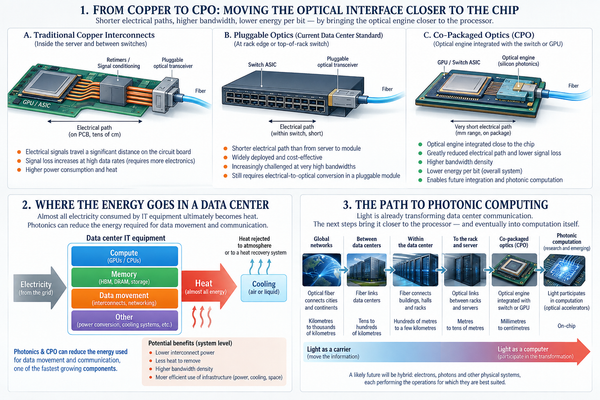
Long-distance telecommunications already demonstrated that photons can move information more effectively than electrical signals through copper over great distances.
The same logic is now penetrating the data center.
Optical fiber first connected cities and continents. It increasingly connects data centers, buildings, racks and computing systems. Silicon photonics and co-packaged optics are moving optical communication progressively closer to processors themselves.
This matters because an increasing part of the difficulty of large-scale AI is not simply performing calculations. It is moving the numbers required for those calculations.
Thousands of GPUs training or operating a model must continually exchange intermediate information. A processor may be capable of performing calculations faster than the surrounding system can provide the data it needs. Energy is spent not merely calculating, but storing, retrieving, transmitting, converting and synchronizing information.
The machine begins to encounter its own architecture as resistance.
Photonics offers one way of reducing this resistance because light can carry multiple information channels simultaneously using different wavelengths and can move enormous quantities of data with comparatively low transmission losses.
But why stop at transmission?
If light can carry numerical relationships, could the physical behavior of light itself perform some of the mathematical transformations AI requires?
This is the promise of photonic computing.
Interfering optical waves naturally combine according to mathematical relationships. Carefully designed photonic structures can therefore perform operations analogous to matrix transformations without reproducing every step through conventional electronic switching.
The conceptual change is subtle but significant.
Instead of:
store → retrieve → move → calculate → store → move
we begin approaching:
configure → propagate → interact → transform.
Nature itself participates more directly in the computation.
Photonics is not magic. Lasers consume electricity. Optical signals suffer losses. Detectors and modulators consume energy. Conversion between optical and electronic domains remains costly. Photonic processors currently complement rather than replace the extraordinarily mature electronic computing ecosystem.
Nevertheless, the direction reveals something important: some of the physical burden we have come to associate with AI may belong not to intelligence itself, but to the particular architecture through which we presently attempt to realize it.
The assumptions hidden inside computation
Once this possibility is admitted, we can examine other assumptions.
Why must memory and computation be separate?
Traditional computing architectures continually move information from memory to processors and back again. Yet this movement itself consumes energy and time. In-memory computing attempts to remove part of this distinction by allowing the physical memory system to participate directly in computation.
Why must every useful operation be digital?
Analog computing allows physical quantities themselves to represent numerical relationships rather than translating everything through sequences of binary states.
Why must every processor remain active during every stage of computation?
Neuromorphic architectures explore sparse and event-driven activity, inspired in part by nervous systems in which most elements are not continuously performing maximum-rate operations.
Why must advanced AI be centralized?
Hyperscale data centers provide enormous economic and engineering advantages, but centralization is not itself synonymous with intelligence. Some computation can occur locally, some at the network edge, some in specialized regional facilities and some in enormous centralized clusters.
Even the assumption that increasing intelligence must primarily mean increasing computation deserves examination.
Current AI provides strong empirical evidence that scaling computation, data and model capacity can increase capability. That should not be dismissed. But it does not logically follow that ever-increasing brute computational scale represents the final architecture of machine intelligence.
It may instead characterize a particular stage in its development.
Twenty watts and a brain
The biological comparison should be made carefully, because a brain and a GPU cluster perform very different operations and cannot simply be compared through a common measure of “computations per second.”
Nevertheless, one fact remains provocative.
The human brain operates on approximately twenty watts.
Within that extraordinarily modest energy envelope occur perception, language, memory, movement, spatial orientation, imagination, learning, bodily regulation and the innumerable processes associated with ordinary consciousness.
The brain also produces heat. Neurons encounter electrical resistance. Chemical reactions dissipate energy. Ion gradients must constantly be restored. Blood encounters viscous resistance. Living organisms are not frictionless.
But they do something our machines largely do not.
They continually regenerate their own organization.
The organism uses energy not merely to transform information, but to maintain gradients, repair structures, grow, differentiate, adapt and integrate its processes into a continuously renewed whole.
A GPU performing an inference does not repair its transistor afterward.
An organism does.
Whatever conclusions we eventually draw from this difference, biological organization at least warns us against identifying intelligence too quickly with massive computational throughput.
Perhaps some of what today's AI accomplishes through enormous quantities of computation could eventually be accomplished through better organization.
More computation can sometimes compensate for architecture.
But compensation should not be mistaken for necessity.
A physical monument to a theory of intelligence
This brings us back to the enormous data center.
We usually regard it simply as infrastructure: a necessary collection of buildings, processors, cooling equipment and electrical systems required to provide AI services.
But it can also be read differently.
It is the physical endpoint of a chain of ideas.
We conceptualize artificial intelligence largely through mathematical neural networks. We instantiate those networks through digital computation. We perform that computation through electronic processors. We scale capability by multiplying those processors. We centralize them into enormous clusters. Those clusters demand electricity. Electricity passing through the architecture becomes heat. Heat requires cooling. Cooling may require water. The electrical load requires generating stations and transmission lines.
Eventually, a philosophical and mathematical conception of intelligence becomes substations, cooling towers, pipelines and buildings beside the Great Lakes.
In that sense, the gigantic data center is not merely an engineering achievement. It is a physical monument to our present theory of intelligence.
Some of that theory may prove profoundly correct. Some may prove transitional. Some elements may simply reflect the historical path by which computing developed.
The task is to distinguish them.
Can AI participate in questioning its own architecture?
There is a fascinating recursive possibility here.
Artificial intelligence itself can increasingly participate in searching alternative physical architectures.
AI systems can explore photonic structures, semiconductor layouts, cooling configurations, materials and network topologies across design spaces too large for human engineers to investigate exhaustively. A proposed structure can be simulated, evaluated against physical constraints, modified and tested again.
The process can become:
AI proposes → physics tests → results return → AI reorganizes → physical experiment tests → reality answers.
The important point is that reality remains the arbiter.
AI cannot reason its way out of thermodynamics. Photons still encounter materials. Devices still have imperfections. Heat still has to go somewhere. Materials still have to be manufactured.
But AI can help us discover which constraints genuinely belong to nature and which belong to our previous engineering assumptions.
And perhaps that should become an explicit research objective.
Instead of asking only:
How can we cool 100,000 GPUs more efficiently?
ask:
Why did this task come to require 100,000 hot GPUs?
Instead of asking:
How can we supply enough water to AI infrastructure?
ask:
What sequence of assumptions resulted in intelligence requiring this quantity of water in the first place?
Instead of asking:
How can we produce more computation per watt?
perhaps eventually ask:
How little physical transformation is actually necessary for this act of intelligence to appear?
This is not an argument against technological development. It is an argument for carrying technological development further—back through its own assumptions.
Intelligence and manifestation
At this point engineering encounters a philosophical question it cannot settle by engineering alone.
Where, precisely, does intelligence enter this sequence?
Is intelligence the information?
Is it the transformation of information?
Is it the learned organization that makes particular transformations possible?
Does intelligence emerge when sufficient complexity has been achieved?
Or are information, meaning, intelligence and physical manifestation different levels of reality which our present conceptual framework has not adequately distinguished?
Science does not presently give us a settled answer to these questions.
But the answer we assume matters enormously, because assumptions about intelligence eventually become engineering decisions.
If intelligence is imagined primarily as something manufactured by accumulating physical computation, then greater intelligence naturally appears to demand more processors, more electricity and increasingly massive infrastructure.
If instead intelligence is approached as something whose manifestation depends upon particular forms of organization, another engineering ideal becomes conceivable: discover the organization through which the greatest meaningful capacity can appear with the least unnecessary physical mediation.
The difference is profound.
It changes the question from how much machinery intelligence requires to how little resistance we can place in the way of its manifestation.
Perhaps future AI will therefore not simply consist of today's architecture made larger.
It may combine electronics, photonics, analog processes, distributed computation and physical principles we have barely begun to exploit. Some operations may remain digital. Others may be performed through the propagation and interference of light. Memory and processing may cease to be so sharply separated. Computation may become increasingly sparse, local and dynamically organized.
We cannot yet know.
But we can begin by recognizing that the infrastructure surrounding artificial intelligence is not neutral. It embodies a conception.
And whenever the embodiment becomes extraordinarily cumbersome—gigawatts of electricity, immense cooling installations, vast flows of information, water requirements and mountains of specialized hardware—it is legitimate to ask whether we are encountering an unavoidable cost of intelligence or resistance produced by the way we have conceived it.
Perhaps the deepest efficiency gain will not come from making the existing machine marginally better.
It may come from discovering that parts of the machine were never necessary in the first place.