Electromagnetic fields possess energy and momentum. Radiation can transfer energy, exert radiation pressure and interact with matter. So modern physics treats the electromagnetic field as physically consequential in its own right.
What changes extraordinarily rapidly is the electromagnetic field associated with those charges and currents.
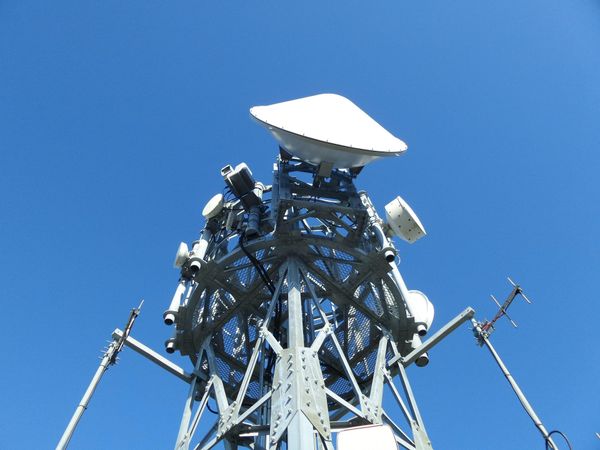
Once we ask “What exactly is an electromagnetic wave?”, the subject becomes much more interesting than the usual discussion of whether cellphone towers are “safe” or “dangerous.”
1. What is actually moving?
Suppose the antenna is transmitting at 900 MHz.
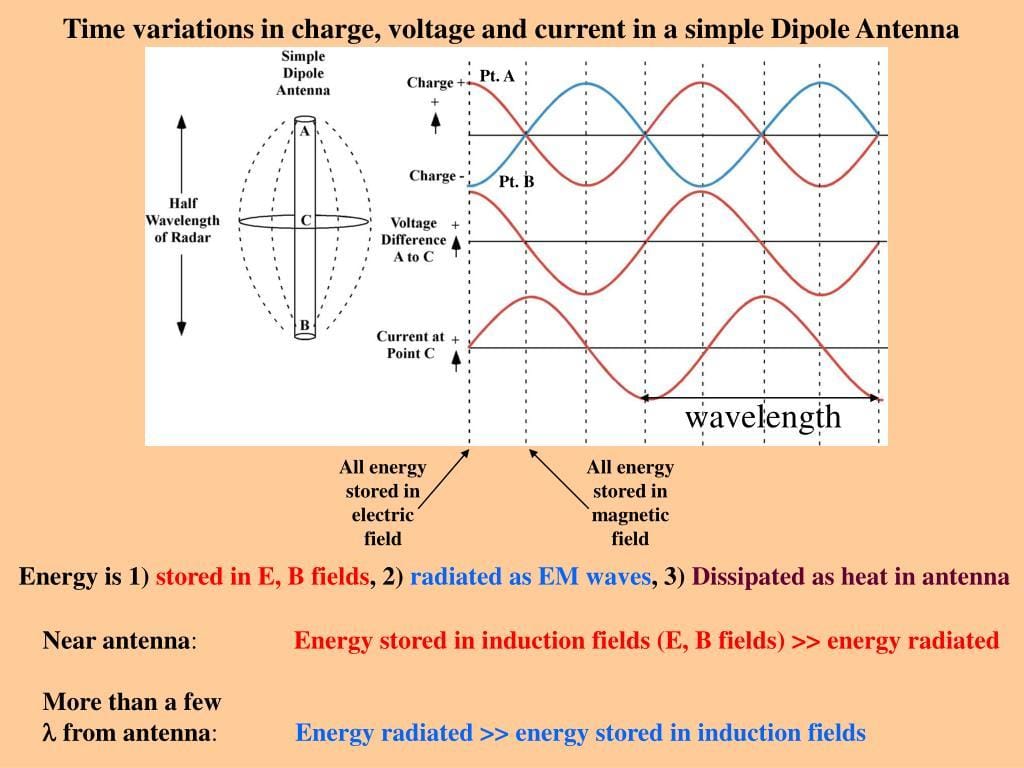
Electrons in the metal do not leave the antenna and fly toward your cellphone. Their net movement through the conductor is tiny. What changes extraordinarily rapidly is the electromagnetic field associated with those charges and currents.
At 900 MHz, the electrical conditions reverse roughly 900 million times per second.
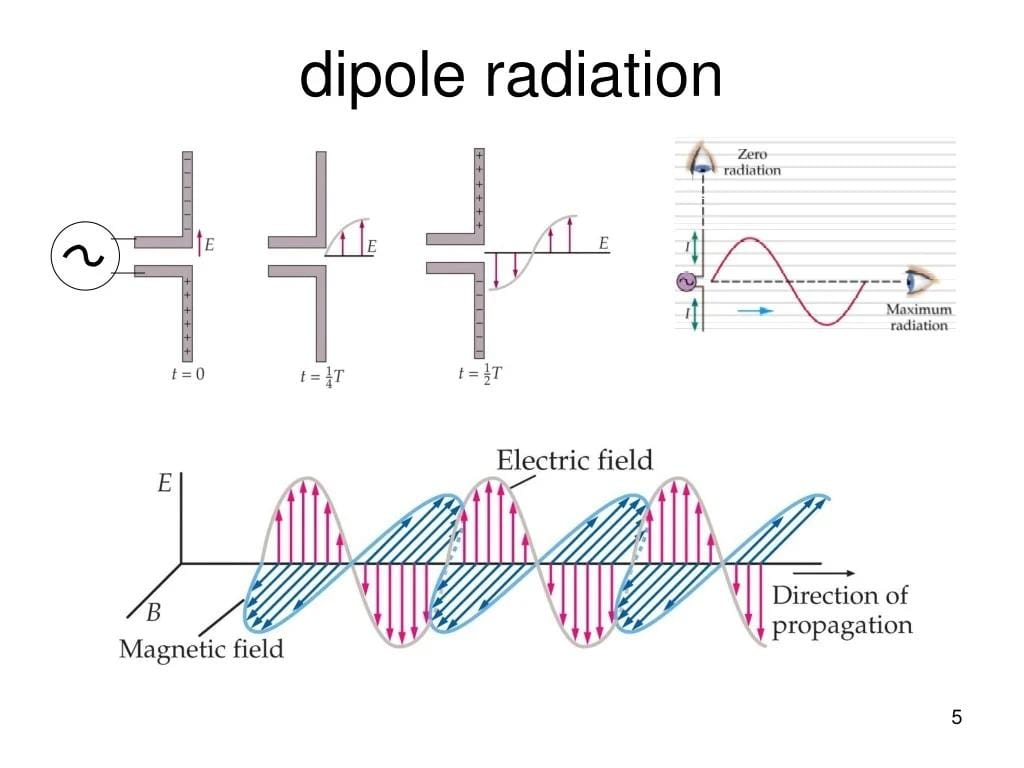
That changing electrical configuration creates a changing electric field; the changing current produces a magnetic field. Maxwell's equations describe how changes in these fields are coupled so that the disturbance can propagate away from its source.
And here comes the strange part:
The wave doesn't need air.
Remove the atmosphere completely and the radio transmission still propagates. Electromagnetic radiation travels through a vacuum.
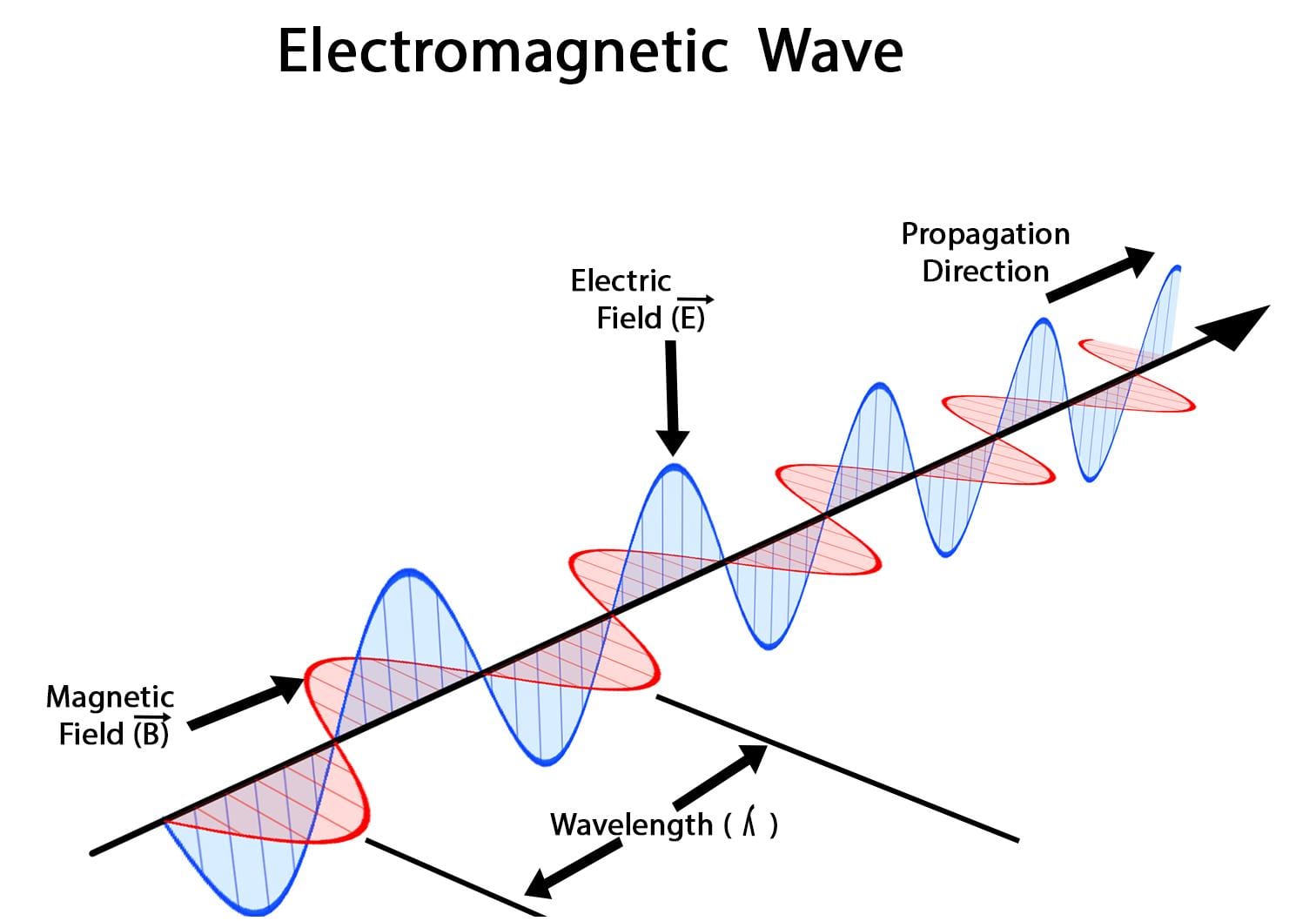
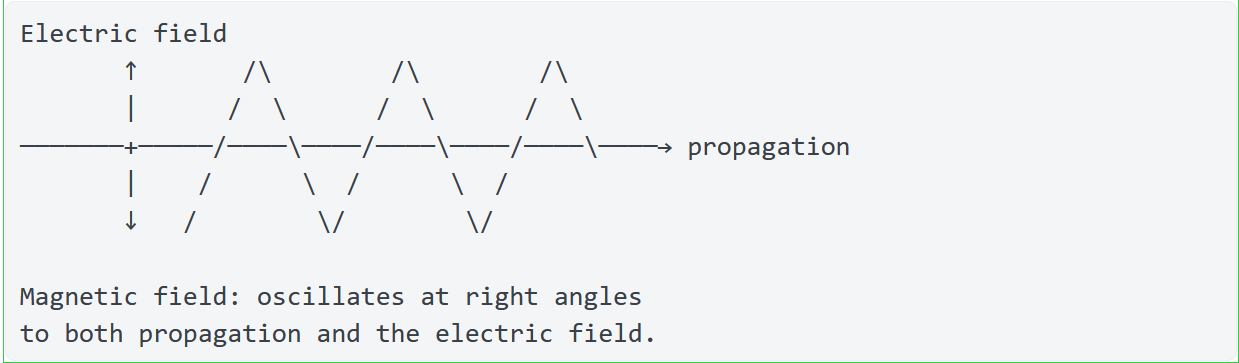
So when diagrams show something like this:
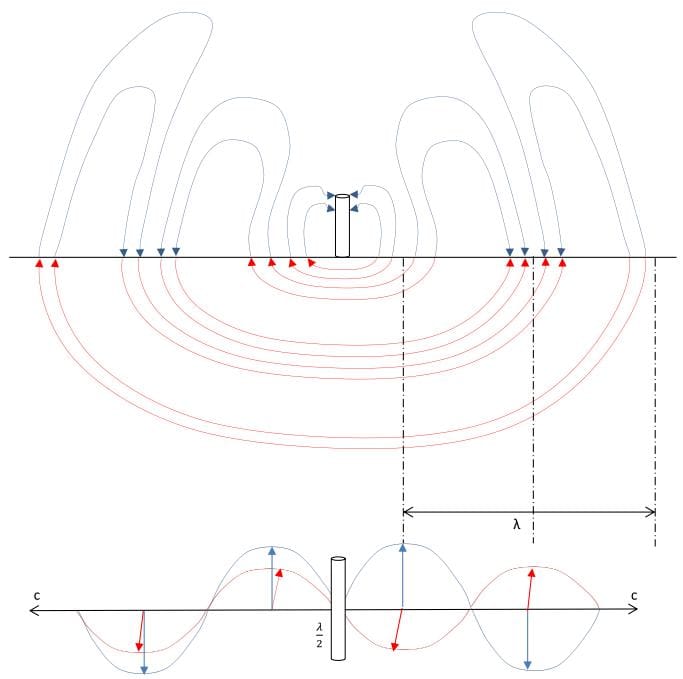
those curves should not be imagined as physical strings waving through space. They represent the magnitude and direction of a field.
That leads immediately to the deeper question:
2. Then what is a field?
This is where everyday explanations become surprisingly slippery.
A field assigns a physical quantity to every point in space. Put an electrically charged particle at a particular point, and the electromagnetic field determines the force it would experience.
But that doesn't mean the field is merely a mathematical bookkeeping device.
Electromagnetic fields possess energy and momentum. Radiation can transfer energy, exert radiation pressure and interact with matter. So modern physics treats the electromagnetic field as physically consequential in its own right.
And that gives us a fascinating transition:
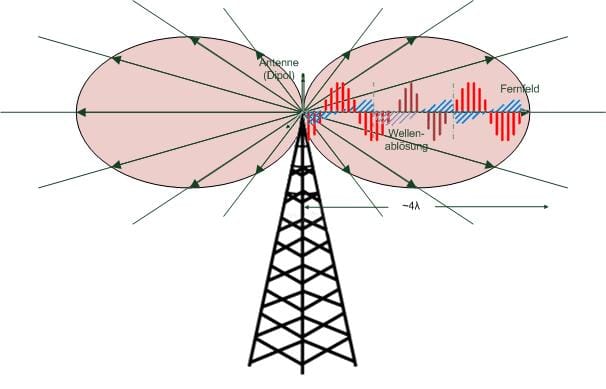
antenna current → local electromagnetic field → freely propagating radiation → interaction with matter somewhere else.
3. How does something happening in the antenna get over there?
Imagine that we suddenly switch on a transmitter.
A receiver 10 kilometres away does not respond instantaneously.
The change propagates outward at approximately the speed of light. Ten kilometres takes about 33 microseconds.
So there is a genuine causal propagation:
Tower → space → receiver.
And something even more interesting happens at the receiving antenna.
The incoming electromagnetic field encounters electrons in the metal of the receiving antenna and causes them to move. Thus:
electrical oscillation in antenna A → electromagnetic radiation through space → electrical oscillation in antenna B.
That is extraordinary when you strip away the engineering familiarity.
4. But where is the information?
Now we can add another layer.
Suppose the carrier is 3.5 GHz. Simply producing a perfectly repetitive 3.5-GHz wave doesn't communicate your photograph, voice or webpage.
The transmitter systematically changes properties of the radio signal—its amplitude, phase, frequency relationships, timing, etc. Modern cellular systems use sophisticated digital modulation such as OFDM and QAM.
Therefore several things need to be distinguished:
field → carrier → modulation → encoded information.
Your photograph isn't literally travelling through the atmosphere as a photograph. A highly structured electromagnetic field carries patterns from which the receiving electronics reconstruct digital information.
That distinction becomes important when people say that modern telecommunications produce an increasingly complicated electromagnetic environment. It isn't simply a matter of "more radiation." The temporal and spectral structure of the signals has also become extremely complicated.
5. Then put a human body into that field
Now the question changes again.
A human isn't electromagnetically transparent.
The body contains water, ions, membranes, electrically excitable cells and tissues with frequency-dependent electrical properties. An incoming RF field therefore encounters a complex dielectric object.
Some energy can be:
reflected — transmitted — scattered — absorbed.
Absorbed RF energy ultimately contributes to molecular motion—heat. This is the best-established interaction underlying RF exposure standards.
But that should not automatically be turned into:
"Therefore heating is the only conceivable biological interaction."
Nor should we make the opposite jump:
"The body is electrically active, therefore cellphone RF must disrupt it."
Those are two different claims. Whether biologically significant non-thermal interactions occur at ordinary environmental exposure levels is precisely where careful experimental evidence becomes necessary.
6. And now an auditory experience such as Tinnitus becomes an experimental question
This is where we need to be especially careful about the statement “I hear the electromagnetic fields.”
Rather than dismissing it or accepting the causal interpretation beforehand, we can separate:
Phenomenon: One perceives a persistent sound/noise.
Interpretation: One experiences it as connected with the electromagnetic environment.
Hypothesis: Changes in electromagnetic exposure cause changes in the auditory perception.
Those are three different statements.
And that gives us something testable.
For example, suppose the perceived noise becomes dramatically stronger in one room than another. We could ask simultaneously:
What changes acoustically? Are there transformers, LED drivers, chargers, refrigerators, heat pumps, switching power supplies, etc.?
What changes electrically at low frequencies? Electric field? Magnetic field? Wiring currents?
What changes in RF? Cellular bands? Wi-Fi? Other transmitters?
What changes perceptually? Pitch? Loudness? Pulsation? Direction? Continuous versus intermittent?
If the perceived phenomenon repeatedly tracked a particular measured variable under controlled conditions, then we would have something genuinely interesting to investigate.
7. And this takes us to an even deeper question
There are therefore at least four levels that are very easily collapsed into one another:
electromagnetic field → interaction with matter → biological response → conscious perception.
The first is primarily electromagnetic physics.
The second is biophysics.
The third is physiology.
The fourth is neuroscience and phenomenology.
And this is precisely where our investigation could become unusually worthwhile, because instead of beginning with the polarized question—
“Are cellphone towers harmful?”
—we could begin much further upstream:
What actually exists between a transmitting antenna and a human being standing within its field?
From there we can work through the chain one piece at a time: antenna → field → modulation → propagation → environment → body → nervous system → perception.
That would give us a solid foundation before we even approach the contested questions surrounding EMF sensitivity.
Seeing Beyond, a research initiative focused on spiritual science, living cognition, and the threshold experiences of modern life.
An initiative grounded in a spiritual-scientific approach to self- and world-observation.
Comments
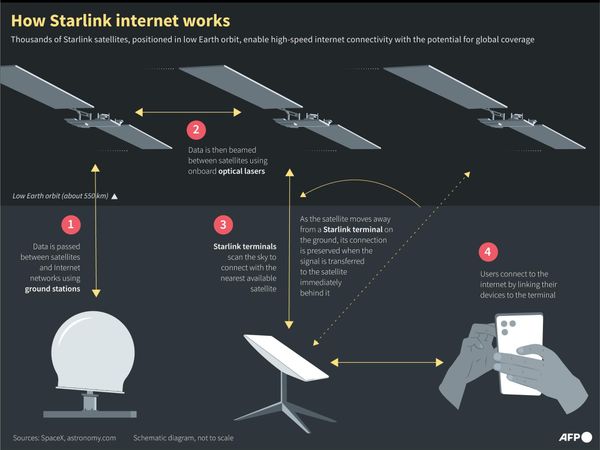
StarLink does change the geography of the question.