We Do Not Create Reality — We Participate in Its Creation
Between a world that is simply “given” to us and a world supposedly manufactured by our thoughts lies something far more interesting: participation.
– 3 min read
Between a world that is simply “given” to us and a world supposedly manufactured by our thoughts lies something far more interesting: participation.

To say that human beings participate in creating reality does not mean that whatever happens to us is something we have imagined, attracted, or “manifested.”
The world is not simply a projection of our consciousness.
We encounter realities we did not create: nature, history, other human beings, economic conditions, illness and health, accidents, consequences, resistance, and the countless circumstances into which life places us. Other people have their own freedom and their own paths. The world continually pushes back against our ideas about it.
And yet we are not merely passive observers of this world either.
Between a world that is simply “given” to us and a world supposedly manufactured by our thoughts lies something far more interesting: participation.
Our inner orientation — our Einstellung — influences what we are capable of perceiving in a situation. What we perceive influences what possibilities become available to us. What we recognize as possible affects what we do. What we do changes relationships, circumstances, and sometimes the course of an entire biography.
Over time, these are not small effects.
Two people may stand before similar circumstances and nevertheless encounter remarkably different worlds. One sees only obstruction; another discovers a possibility. One enters a human encounter already armed with assumptions; another remains sufficiently open to discover the person who is actually there.
This is particularly visible in economic and social life.
An opportunity is not necessarily an object sitting somewhere waiting to be picked up. Often it first becomes visible through interest: interest in another person's needs, in an unused capacity, in something that could be connected with something else, in a possibility that has not yet taken form.
In this sense, Einstellung is not merely a private psychological mood. It can become a formative element of reality.
But there is an essential condition.
Our inner orientation must serve perception of the world rather than replace it.
Otherwise the idea that “we create our reality” easily degenerates into the belief that whatever we happen to think must somehow be true.
The opposite is required.
The more consciously we participate in reality, the more interested we must become in what reality itself is telling us.
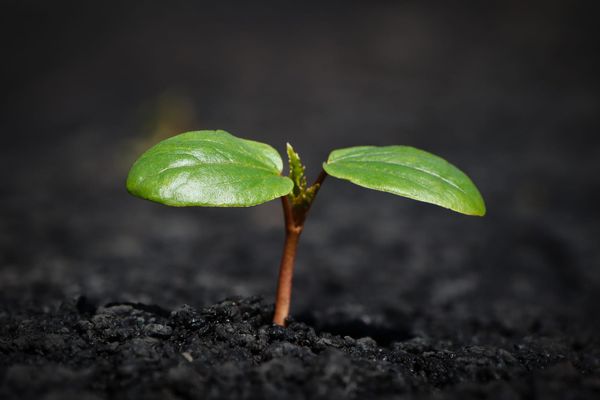
A plant has its own laws of development. Another person has an existence and freedom independent of our expectations. An economic situation has real conditions. Nature does not rearrange its laws according to our preferences.
Reality corrects consciousness. But consciousness also acts back upon reality. There is therefore a continuous movement:
World → perception → inner activity → action → changed circumstances → new perception.
A human biography develops within this reciprocal process.
We can even observe how an inner orientation gradually builds its own environment. Thoughts become decisions; decisions become actions; repeated actions become habits; habits shape relationships and circumstances; and those circumstances can eventually reinforce the very orientation from which they arose.
This can become a closed circle.
But it can also become a point of freedom.
A change in Einstellung may allow us to perceive something that was present all along but that we had become incapable of seeing. A new perception makes a new action possible. That action alters the next situation. This is already a form of co-creation.
Spiritual science carries the question further.
If human consciousness is not enclosed within the physical organism, but participates in realities extending beyond it, then we must at least investigate whether the formative activity of consciousness also extends beyond immediately observable psychological and social effects.
That possibility should neither be accepted through wishful thinking nor rejected beforehand through materialistic assumptions.
It has to become a question of knowledge.
And here a paradox appears:
The greater our capacity for spiritual creativity becomes, the less arbitrary it should become.
True creativity does not mean imposing ourselves upon the world. It means becoming sufficiently perceptive to recognize what is trying to become possible within it.
The artist must encounter the nature of the material. The gardener must learn the plant. The teacher must perceive the child. The entrepreneur must recognize actual human needs. And spiritual cognition must increasingly learn to perceive the lawfulness of the reality in which it participates.
Freedom, then, is not freedom from reality. It is the growing ability to act creatively within reality because we have learned to know it more deeply.
Perhaps we therefore need to modify the familiar expression:
We do not simply create our reality. We participate in its creation.
And the more deeply we learn to perceive what is, the more freely we can participate in what can become.