The Sovereign Illusion: Why Late-Stage Capitalist Systems Are Stranded at the Threshold of Reality
By propping up the dead forms, the West ensured that its institutions became primarily occupied with suppressing economic reality rather than adapting to it.
When an economic or corporate configuration can no longer stand on its own terms, it does not immediately collapse.
There is a moment in macroeconomic history when a civilization’s primary output ceases to be goods, services, or innovation, and becomes something entirely different: the production of compensatory structures to hide its own systemic wounds.
When an economic or corporate configuration can no longer stand on its own terms, it does not immediately collapse. Instead, it enters a state of suspended animation. It constructs a global apparatus—a matrix of skyrocketing public debt, perpetual asset-price interventions, protectionist tariffs, and institutional bailouts—designed specifically to prevent underlying contradictions from becoming visible.
This is the phenomenon of the scaffolded organism. Like a mortally wounded animal held upright by a labyrinth of wooden props, the system appears to be standing. But a highly provocative question must now be leveled at our global institutions: What is actually standing—the living, productive capacity of society, or the dead weight of the scaffolding holding it up?
The Geopolitical Theater: Suppressing the Information of Reality
The current global economic tension—particularly between the United States and the ascending industrial ecosystems of Asia—is not merely a trade war. It is an epistemological war. It is a desperate struggle to reject the uncomfortable information that reality is delivering.
For decades, Western capital optimization operated on a convenient formula of geographic extraction: shift complex manufacturing and engineering ecosystems eastward to maximize short-term corporate margins. It was an ideology built on a weaponized, half-extracted reading of Adam Smith. The West retained Smith’s emphasis on self-interest and competition but completely discarded his foundational premise: that individual initiative must operate within a deeply felt, socially embedded moral universe.
When you remove the moral psychology from the market, the proposition "freedom allows an order to emerge" degenerates into the dangerous delusion: "whatever makes money must be the correct order".
Today, that one-sided focus has produced an irreversible macroeconomic migration. The nations once cast as low-cost subcontractors are now producing advanced electric vehicles, battery technologies, and smartphones that render Western legacy flagships uncompetitive dinosaurs. In response, the established hegemony does not transform; it adds more beams to the scaffolding. It enacts aggressive protectionist barriers, permanent tariffs, and national security exclusions.
But we must look past the political theater and ask the harder question: Is this protection buying time for genuine transformation, or is it merely protecting an obsolete cost structure from the information reality is trying to give it? When a system chooses to make its citizens pay inflated prices for inferior products just to keep an obsolete industrial architecture from failing, it is no longer practicing strategy. It is cheating reality to preserve a ghost.
The Core Inversion: Rescuing Functions, Not Institutions
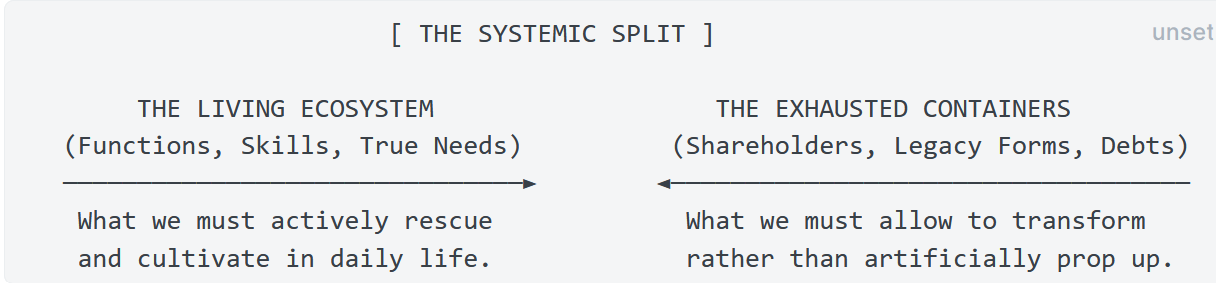
This structural blindness reached its peak during the financial interventionism of 2008 and the systemic bailouts that followed. The ruling elite argued that letting failing financial conglomerates or automotive giants collapse would destroy the world. They intentionally confused the living, vital function with the historical container carrying it.
A society absolutely needs banking—it needs payments, payroll processing, credit creation, and the secure circulation of value. But society does not need every existing legacy bank, nor does it owe an eternal existence to incompetent executive structures, speculative asset claims, or concentrated financial ownership.
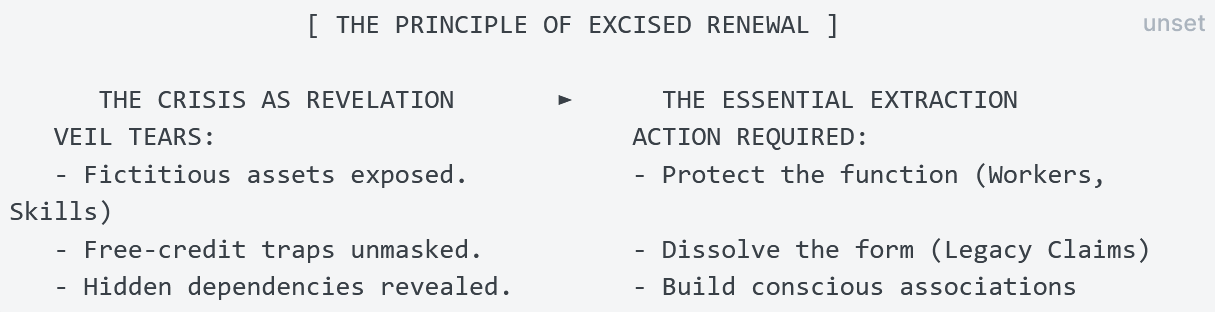
The system committed a profound error by rescuing the institution to save the function. The truly radical, hard-hitting alternative would have been to execute an precise separation: rescue the depositors, protect the workers' livelihoods, keep the viable factories running—but let the toxic ownership claims, the speculative gains, and the failed organizational structures collapse completely.
By propping up the dead forms, the West ensured that its institutions became primarily occupied with suppressing economic reality rather than adapting to it. A crisis should never be romanticized, but it possesses a peculiar, sacred utility: it is an act of revelation. It tears away the scaffolding and forces us to look at what can actually stand on its own feet.
Beyond Individuality: The Tapestry of Conscious Interdependence
The path forward is not a retreat into the suffocating, blind collectivism of the twentieth century, which abstracts human beings into lifeless statistical units. The historical sequence of human evolution moves through three distinct phases: Dependence → Individuality → Conscious Interdependence.The emancipation of the individual from inherited tribes, castes, and predetermined social roles was a magnificent civilizational achievement. But individualism was never meant to be the endpoint. It was merely the necessary training ground to produce autonomous human beings who could then choose to form a conscious whole.
True economic health requires the development of associative organs—spaces where individual initiative is balanced by social perception and conscious coordination. The anonymous market mechanism only knows that Person A bought from Person B for a specific price; it remains completely blind to the human beings, the exploited labor, the depleted soil, or the long-term geopolitical dependencies hidden behind that transaction.
An associative economic approach transforms abstract curves into humanly perceptible realities. It brings needs, capacities, and consequences into direct, conscious encounter, turning the blind "Invisible Hand" into an awake, visible coordinate of human awareness.
The Sovereign Blueprint: 4 Lessons for Daily and Professional Life
You do not have to wait for global macroeconomics to reform to apply these insights. The breakdown of the global scaffolding offers a clear, uncompromising framework for individual leadership, professional strategy, and personal resilience:
1. Audit Your Personal Scaffolding
Look closely at your career, your business model, or your personal finances. How much of your current success is standing on its own organic merits, and how much is being artificially propped up by temporary, unsustainable scaffolding (unbacked debt, toxic relationships, legacy prestige, or avoiding difficult adjustments)?
The Action: Stop adding beams to a failing internal structure. Face the uncomfortable information your reality is trying to give you, and let unviable projects or outdated skill sets fail cleanly so you can rebuild on solid ground.
2. Differentiate the Function From the Container
When facing a professional crisis or organizational restructuring, do not waste energy trying to save a legacy form just because it is familiar. Strip away the ego and ask: What is the core, indispensable function that must be preserved here?
The Action: If a business structure, a specific job role, or an administrative process is no longer working, let the container dissolve. Aggressively protect and salvage the raw human talent, the foundational knowledge, and the core relationships—the living assets—and build a entirely new form around them.
3. Stop Outsourcing Your Perception to "Prices"
In professional settings, it is easy to succumb to the delusion that if a transaction is profitable on paper, it is automatically correct. Cheap shortcuts, outsourced labor with unmonitored conditions, or burning out your team for quarterly margins are the corporate equivalent of an extracted breakfast table. The immediate price tag is concealing a massive, compounding liability.
The Action: Build a personal "sensory organ" for your choices. Actively investigate the long-term human, ecological, and strategic costs of your professional decisions. True sustainability means optimizing for the whole ecosystem, not just the isolated transaction.
4. Practice "Association After Individuality"
Do not fall into the trap of hyper-isolated individualism or passive compliance. True power in the modern workplace belongs to the autonomous professional who possesses the maturity to consciously collaborate.
The Action: Shift your networking and collaboration away from transactional manipulation. Create authentic associations where you actively seek to perceive the genuine capacities, unused resources, and real needs of those around you. Move your team from blind competition into a conscious tapestry of mutual realization.
An order does not die because its metrics contract or its legacy structures fracture. It begins to die when maintaining its rigid conception of reality becomes more important than perceiving reality itself. Step off the scaffolding, strip away the theater, and look directly at what is alive. Start there. And build from that.
Seeing Beyond, a research initiative focused on spiritual science, living cognition, and the threshold experiences of modern life.
An initiative grounded in a spiritual-scientific approach to self- and world-observation.
Comments
The darker the night, the greater the morning to come will be.
The Algonquin people, who once roamed the Laurentian Mountains of Quebec, spoke of a Mishiginebig, a giant water serpent with horns that ruled the realm of the dead.