The Russian – Ukraine Conflict: The World-Situation in a Nutshell
Alice Weidel’s demand that Ukraine return significant sums (which she estimates to be over €70 billion) relies on three main political contexts
– 7 min read
Alice Weidel’s demand that Ukraine return significant sums (which she estimates to be over €70 billion) relies on three main political contexts
We live in an era of unprecedented data and profound blindness. When we look at the conflict between Russia and Ukraine, our screens are flooded with a relentless stream of reductionist analysis: weapon counts, GDP fluctuations, territorial maps, and the cold mathematics of energy supply lines. Yet, despite this mountain of information, the modern world feels entirely unequipped to understand the horrific spectacle unfolding before its eyes. We sense that the conventional explanations are hollow, serving merely as a polished veneer to conceal a far more volatile reality.
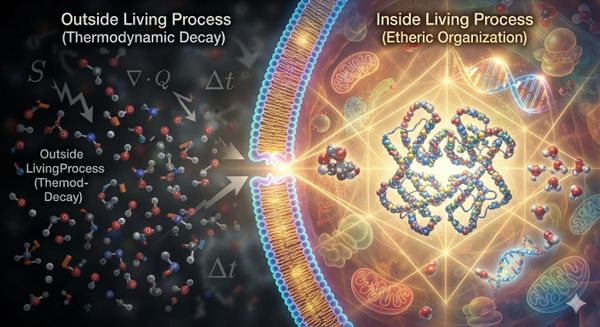
This text did not begin as an abstract academic theory, but as an active intervention into the immediate, raw headlines of our time. It began with a simple, concrete inquiry into European political rhetoric and the economic gridlock of the global diesel supply. However, by refusing to stop at the surface, the inquiry naturally forced its way downward—through the porous, bleeding boundary where legitimate state power merges with illicit networks, and deeper still, into the psycho-spiritual geography that shapes the collective soul of nations.To understand the crisis, we must abandon the illusion that nations are separate, mechanical blocks competing in a vacuum. The world is a single, living organism, and this war is a severe autoimmune crisis tearing its anatomy apart.
The Russian – Ukraine Conflict: The World-Situation in a Nutshell is an invitation to look into the mirror of current affairs and see the evolutionary challenge of our time. It is an exploration of how the hyper-individualized, speculative intellect of the West and the vast, communal expanse of the Slavic soul have become trapped in a destructive, one-sided polarity. Ultimately, it suggests that the "way out" of our civilizational debacle will not be found through transactional treaties or drawn borders, but through a profound awakening: learning how to consciously inhabit our distinct national identities while simultaneously serving the balance of the whole global body.
Most modern geopolitical analysis is trapped in a state of scientific reductionism. It treats nations as identical billiard balls colliding on a flat map, measuring reality purely through the lenses of GDP, troop movements, energy barrels, and legal treaties. This framework is not merely incomplete—it is failing. Because it refuses to look at the whole, it cannot comprehend the severe autoimmune crisis currently tearing the global body apart.
To find a way out of the unfolding debacle, we must trace the thread directly from the raw, daily headlines of political friction down to the deep, psycho-spiritual geography of human evolution.
The crisis manifests first as domestic political friction within Europe’s economic anchor, Germany. In the wake of significant shifts in the European political landscape, voices like Alice Weidel of the Alternative for Germany (AfD) party have demanded a complete halt to Western aid to Ukraine, insisting on the repayment of over €70 billion in financial and military capital.
On the reductionist surface, this is dismissed as populist rhetoric. However, the demand forces a confrontation with two uncomfortable, real-world realities that conventional media seeks to sanitize:
The demands for payback are directly linked to the September 2022 sabotage of the Nord Stream gas pipelines. German federal investigations have progressively uncovered specific evidence pointing to a coordinated Ukrainian operation. With the indictments and arrests of Ukrainian nationals—including trained divers and military officers using forged passports via the yacht Andromeda—the narrative of a "clean" alliance fractures.
The physical destruction of this infrastructure permanently severed Germany's access to direct pipeline gas, forcing a rapid, high-cost reliance on LNG terminals. This structurally higher cost of energy has severely harmed Germany's heavy industrial sectors, inducing a permanent economic slowdown.
Simultaneously, the arrival of over one million Ukrainian refugees represents one of the fastest demographic shifts in modern German history, pushing municipal budgets, housing markets, and social welfare systems (Bürgergeld) to their absolute limits. This influx functions as a massive lever of geopolitical influence. For some, it is a humanitarian crisis; for others, it mirrors a form of weaponized migration—where the deliberate destruction of civilian infrastructure forces millions westward to destabilize the European Union from within.
The conventional view artificially separates the world into the "legal state" and the "criminal underworld." The reality of post-Soviet power structures reveals that this membrane is entirely porous.
The political rise of figures like Volodymyr Zelensky was heavily engineered by media empires and financed by controversial billionaire oligarchs, such as Ihor Kolomoyskyi (who was later arrested amid anti-corruption crackdowns mandated by Western donors).
The intense empathy and multi-billion-euro capital transfers directed toward Kyiv by Western leaders are not driven by shared moral values. The relationship is transactional realism. The lines between legitimate commerce, state intelligence, and shadow syndicates—ranging from money laundering to illicit trafficking networks—have blurred.Regular citizens feel a profound cynicism because they intuitively detect this moral vacuum. The "signature" of these illicit worlds bleeds through the very demeanor, stances, and micro-gestures of modern political actors, revealing a hyper-wealthy elite entirely detached from the base of regular human society.
Why doesn't the West simply enforce an immediate peace to stop this bleeding? The answer lies in the hyper-speculative, tightly wound gears of global capitalism. The West is trapped by the very market dependencies it created.Forcing an immediate peace would require absolute leverage over both combatants, a strategy that immediately collapses when it collides with the global energy bottleneck:
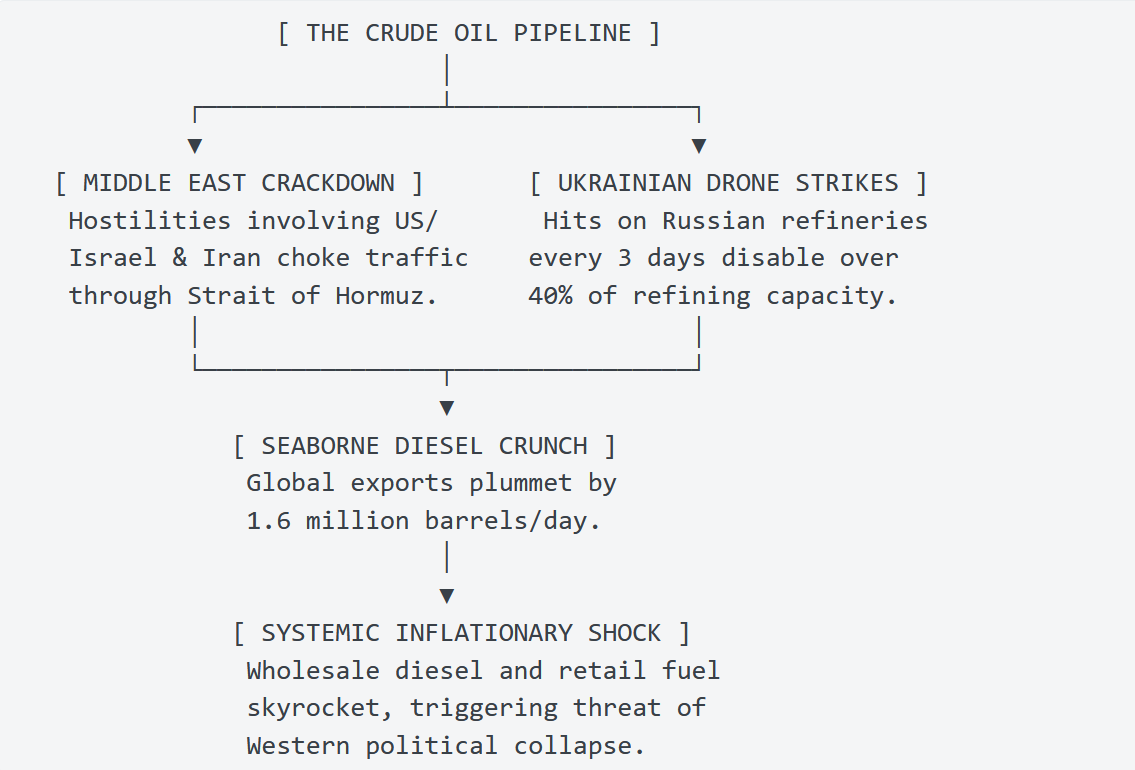
To force Russia to the table by cutting off its global energy buyers (like India or China) would instantly remove 10% of the world's supply. The resulting inflationary shock—pushing crude past $100 a barrel and retail diesel past $6 a gallon—would cause domestic political collapse for Western governments.Thus, the West is gridlocked. It cannot choke Russia without choking itself, while Ukraine uses its drone campaign against Russian oil infrastructure as a desperate strategic lever to starve the Kremlin’s petrodollars, inadvertently threatening the global supply chain that keeps Western societies fed and fueled.
To understand why this gridlock exists, we must abandon scientific reductionism and view the world as an organic, living body. Each nation or cultural region forms an organ with a specific, non-negotiable place, function, and psycho-spiritual constitution. This constitution is not accidental; it is forged by the landscape, the soil, the terrain, and the climate.
When mapped anatomically, the global body reveals a trifold architecture:
Within this anatomy, Russia and the Slavic soul represent a distinct state of being. Shaped by the infinite, flat horizon of the steppe—a geography devoid of natural protective barriers—the Russian psyche is landlocked, vast, and enduring. It naturally birthed a collective, communal consciousness. It is no wonder that the concept of the "Comrade" (Tovarishch or Kameraad) emerged here in raw polarity to Western capitalism.This model embodies Sobornost—a spiritual community bound by a shared fate rather than Western contract law (Gemeinschaft vs. Gesellschaft). By its very existence, the Russian soul exposes the one-sidedness, isolation, and spiritual loneliness of Western hyper-individualism.The West views this as an existential threat to its inner makeup. Yet, by attempting to completely eliminate or crush the Russian organism, the West undergoes a cultural self-castration. It attempts to destroy the mirror reflecting its own moral bankruptcy, thereby impoverishing the entire global body and leaving behind a sterile, purely mechanical world.
The ultimate debacle unfolding before us is an initiation crisis. No single party is entirely right or wrong; each is trapped in a primitive survival mechanism on the outside world. True peace cannot be engineered by redrawing borders or signing transactional treaties between corrupt elites. The "way out" requires situating national belonging within the modern process of evolutionary individuation.
At the turn of the 20th century, materialistic globalism assumed that an interconnected economy would cause national identities to fade away into a uniform, borderless state. The violent resurgence of nationalism and populist movements (such as the MAGA movement in America, which seeks a lost identity buried under a caricature of capitalism) proves this was a fatal misunderstanding. National identities are a spiritual reality—they are the expressions of Folk-Souls.
In our current era—a Michaelic age of individual consciousness—the human "I" must learn to stand in true freedom. However, true individuation does not mean arrogant uprooting. As described in the profound experience of the Guardian of the Threshold, when a soul views reality from the perspective of the spiritual world, it is stripped of all illusions, yet it must consciously acknowledge and honor everything it owes to its folk-soul. To deny one's cultural and geographic foundation out of a false, intellectualized "global citizenship" starves the soul of its foundational warmth and turns the path dark.
The evolutionary task of our time is to learn how to inhabit the Folk-Soul without being locked inside it. We must maintain a global perspective—which the economy has already physically forced upon us—while simultaneously cultivating the unique psycho-spiritual function of our own land.
True grandeur does not rely on the size of a territory or the dominance of a market. It lies hidden in a nation's true nature. The organs of the world will continue to tear each other apart in a bloody, illicit spectacle until the individual "I" within each culture awakens to its true identity: a unique, irreplaceable servant to the balance of the whole global body.