The Invisible Competence That Holds the World Together
The container is almost a physical language spoken by the world economy.
Truck, ship, crane, railway and harbour understand the same object.
And around that simple agreement an immense choreography becomes possible.
Civilization depends upon countless people whom we will never meet doing things that we will never see.
There is a way of looking at the modern economy in which almost everything appears problematic.
Globalization becomes exploitation. Container shipping becomes pollution. International production becomes cheap labor. Large corporations become concentrations of power. Economic growth becomes depletion of the Earth.
None of these concerns are imaginary. Yet it is possible to become so accustomed to looking for what is wrong that we gradually cease to perceive something else that is happening before our eyes: the almost unimaginable amount of human competence, cooperation and responsibility through which the world is kept functioning every day.
I was reminded of this recently while watching a documentary about global container shipping.
The documentary itself begins on a distinctly critical note. Container ships are presented as the spearhead of globalization. They transport an enormous proportion of the goods upon which modern life depends, while at the same time contributing to pollution, precarious working conditions and the vulnerabilities of an interconnected global economy.
All of this is true.
But then something happens.
The camera goes aboard.
And slowly another reality becomes visible.
Twenty-Three People and 18,000 Containers
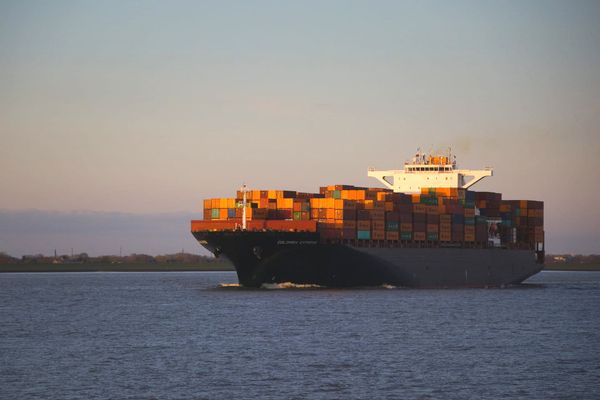
The Merete Mærsk is almost 400 metres long and capable of carrying some 18,000 containers. Yet the vessel is operated by a crew of only 23 people.
One of them is Camille, a young sailor from the Philippines.
We see her walking between immense walls of containers, checking whether securing mechanisms remain properly locked. She notices when something is out of place. She checks barriers designed to prevent rats from climbing aboard. She paints and maintains the vessel. She works long hours, sometimes exhausted.
Yet what comes through most strongly is not misery.
Camille is remarkably joyful.
She had wanted to become a sailor since high school. She wanted to travel. Her reasons have changed somewhat; earning money for her family has become increasingly important. But she is unmistakably present in what she does.
And around her there is social life.
The crew eat together. They play games. A suckling pig is roasted for a barbecue. There is laughter. People who have come from different countries and cultures have formed, for several months, a small floating society in the middle of an ocean.
The critical narrative has not become false.
But it has become insufficient.
Something has appeared that cannot be adequately described by the categories of labor cost, exploitation, globalization or corporate profit.
Human beings are doing something together.
And they are remarkably good at it.
The Captain Knows His Ship; the Pilot Knows the Harbour
One scene in particular reveals something essential about modern economic life.
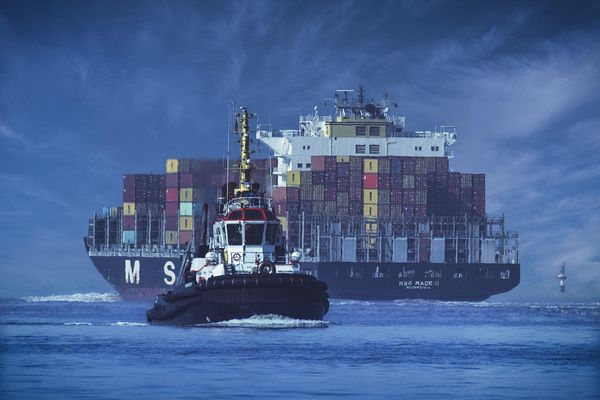
When the vessel enters the enormous Chinese port of Ningbo, a local harbour pilot comes aboard.
The captain knows his ship intimately. The pilot knows the harbour.
Neither can replace the other.
The captain commands a vessel almost 400 metres long whose behaviour, inertia, systems and peculiarities he understands through years of experience. The pilot possesses another kind of knowledge: the channels, traffic, depths, procedures and local conditions of this particular harbour.
For a brief period, these two forms of knowledge have to meet.
And this small encounter is repeated everywhere throughout the world economy.
The tire manufacturer in South Korea knows how to manufacture tires, but does not know how to transport them to Rotterdam.
The shipping company knows how to transport them, but cannot manufacture them.
The crane operator possesses another capacity.
The person who secures the containers possesses another.
The marine engineer another.
The customs official another.
The railway operator another.
The truck driver another.
Eventually a mechanic somewhere in Europe may place one of those tires onto a vehicle.
No single person understands or controls the whole process.
And yet the process works.
This may be one of the most remarkable characteristics of modern civilization: we live within an immense structure of distributed human competence.
The World Inside a Steel Box
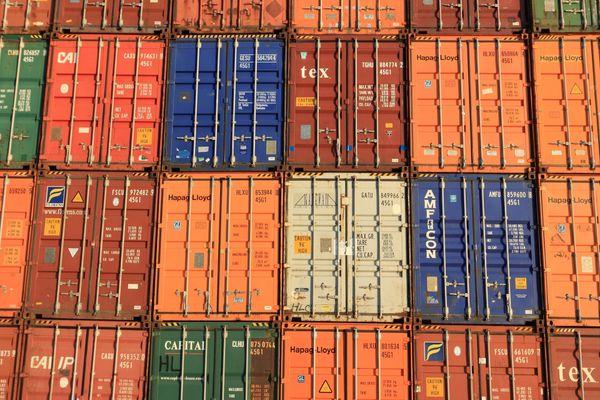
Perhaps nothing expresses this more clearly than the shipping container itself.
It is technologically almost primitive.
A steel box.
Yet by agreeing upon dimensions, fittings and standards, humanity created something extraordinary. The same container can be filled at a factory, placed on a truck, lifted by a crane, stacked aboard a ship, transferred onto a train, moved through a warehouse system and transported thousands of kilometres without its contents being individually handled.
The container is almost a physical language spoken by the world economy.
Truck, ship, crane, railway and harbour understand the same object.
And around that simple agreement an immense choreography becomes possible.
We usually encounter only the final result.
A refrigerator appears in a shop. A replacement part arrives at our door. Tea from another continent sits in our cupboard. A camera manufactured in Asia is delivered to a small town in Canada.
We see the object.
We rarely see the human relationships condensed within it.
Behind almost every ordinary object stands an extraordinary sequence of people who have done something correctly.
Someone designed it.
Someone manufactured it.
Someone inspected it.
Someone packed it.
Someone prepared documentation.
Someone moved it.
Someone kept a ship's engine running through the Indian Ocean.
Someone watched the weather.
Someone calculated fuel.
Someone guided the vessel into harbour.
Someone operated the crane.
Someone drove through the night.
Civilization depends upon countless people whom we will never meet doing things that we will never see.
The Invisible Achievement of Ordinary Life
We have become very skilled at perceiving failure.
When the aircraft is delayed, we notice.
When the parcel disappears, we notice.
When the computer system fails, the road deteriorates, the bureaucracy becomes absurd or the mechanic does poor work, we notice immediately.
But the millions of occasions upon which something simply works tend to disappear from consciousness.
The aircraft lands.
The bridge holds.
The water arrives.
The surgeon's instruments are sterile.
The container is where it needs to be.
The engine keeps turning.
The hotel receptionist quietly solves a problem.
The electrician connects the correct wire.
Nothing dramatic happens.
And precisely because nothing happens, we fail to see the competence that prevented something from happening.
There is an enormous invisible achievement concealed within ordinary life.
Seeing the Economy Again
This suggests that perhaps we have to learn to see the economy again.
Not sentimentally.
The maritime economy shown in the documentary contains genuine problems. Sailors may work under difficult conditions. Economic power is unevenly distributed. Global production can exploit differences in wages. Container ships pollute. The relentless demand for growth raises serious questions.
To acknowledge the beauty of economic life does not require blindness toward any of this.
But neither should criticism make us blind.
Underneath financial speculation, corporate strategies, political struggles and economic theories there remains something astonishingly simple:
Human beings have needs, and other human beings possess capacities through which those needs can be met.
Between capacity and need arises economic life.
Seen from this perspective, the economy is not primarily money.
It is not the stock market.
It is not GDP.
It is not even "capitalism."
Before all of these abstractions, there is the farmer growing something another person will eat; the engineer solving a problem another person cannot solve; the sailor carrying something another continent needs; the teacher developing capacities that will become useful decades later.
The real economy consists of human beings doing things for other human beings.
Money accompanies this activity and makes increasingly complex forms of exchange possible. Institutions organize it. Capital can enable it. Finance can serve it.
But none of these is its substance.
Its substance is mutual provision.
Finding One's Place Within It
And this changes another question.
Many people today experience themselves as standing outside society.
They may feel professionally displaced, economically insecure, retired, unemployed, unsuccessful, or simply uncertain what place remains for them in a world that appears increasingly impersonal.
If the economy is imagined primarily as a gigantic mechanism, the individual confronts it from outside:
How can I get into it?
How can I get a job?
How can I make enough money?
Where is there still a place for me?
But another question becomes possible when economic life is seen as a living network of human capacities and human needs:
What can I do that another human being needs?
This is a very different starting point.
In German there is a particularly expressive word for it: sich hineingliedern.
It means more than simply to participate. Glied means a member or limb of an organism. Sich hineingliedern suggests finding one's place within a larger whole—not by disappearing into it, but by becoming an active member precisely through one's particular capacities.
Perhaps this is one of the things we have lost in our relationship to economic life.
We have learned to think of ourselves as consumers, employees, taxpayers, investors or economic units.
But we are also centres of capacity within a world of need.
And the world surrounding us is simultaneously a vast periphery of other human beings, each with capacities and needs of their own.
To find one's place within this movement is not merely to obtain employment.
It is to become a participant in the world.
The World Is Being Maintained
Perhaps that is what moved me most while watching the Merete Mærsk cross the oceans.
Not globalization itself.
Not the astonishing size of the ship.
Not even the engineering.
It was the gradual realization that, at every moment, innumerable human beings are quietly maintaining the world.
Somewhere tonight an engineer will hear that an engine sounds slightly different.
A sailor will discover that a container fastening has loosened.
A pilot will climb aboard a vessel approaching a harbour.
A truck driver will carry something through the night that somebody else needs tomorrow morning.
Most of these acts will never become news.
Nobody will celebrate them.
Frequently, the people performing them will hardly think of what they are doing as remarkable.
But taken together, they constitute something immense.
We may rightly ask how this world economy can become more just, more sustainable and more human.
But perhaps before we can transform it wisely, we have to become capable of seeing it.
And when we really begin to see it, we may discover that beneath everything that is distorted, exploited or abused, another economy has been there all along:
an immense circulation of human capacities toward human needs.
A world held together, hour after hour, by invisible competence.
Seeing Beyond, a research initiative focused on spiritual science, living cognition, and the threshold experiences of modern life.
An initiative grounded in a spiritual-scientific approach to self- and world-observation.
Comments
Depending upon our political and cultural orientation, other associations may arise.