To analyze how they successfully built world-class infrastructure, we must pull back the curtain on their planning models, fund partitioning, and the strict division between financial speculation and real development.
Unlike Western market economies, the GCC model utilizes centralized, top-down state optimization plans.
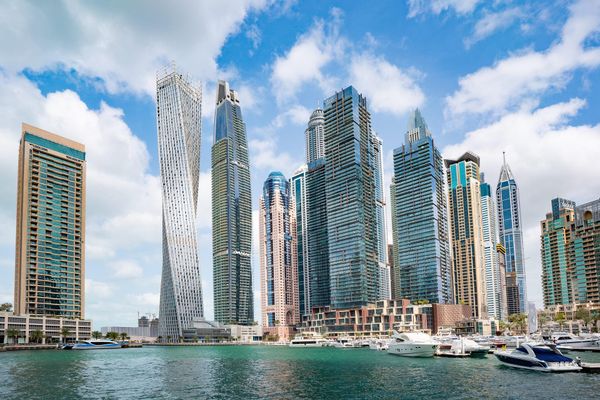
The case of the Gulf Cooperation Council (GCC) countries, specifically Saudi Arabia and the United Arab Emirates (UAE), provides an extraordinary real-world macroeconomic laboratory. They demonstrate what happens when a state is flooded with massive financial capital (via oil extraction) and must decide how to map that abstract currency onto concrete, physical reality.
To analyze how they successfully built world-class infrastructure, we must pull back the curtain on their planning models, fund partitioning, and the strict division between financial speculation and real development.
📅 1. How the Planning Happened: The Sovereign Master Plan
Unlike Western market economies, where infrastructure is often reactive, piecemeal, and dependent on private developer profit margins, the GCC model utilizes centralized, top-down state optimization plans.
The Blueprints: These are multi-decade frameworks—such as Saudi Vision 2030 and Abu Dhabi Economic Vision 2030. The state identifies exactly what non-oil sectors it needs to create to survive a post-hydrocarbon world (e.g., global logistics, smart-city tech, AI compute infrastructure, and tourism).
Reversing Cause and Effect: In traditional economics, cities grow organically, and infrastructure catches up later. The GCC inverted this cart: they built massive, state-of-the-art airports, deep-water automated ports, grid infrastructure, and digital networks first. By establishing a highly efficient physical baseline, they naturally compelled global supply chains, corporations, and tourism to anchor within their borders.
📊 2. How the Money is Allocated: Partitioning the Wealth Engine
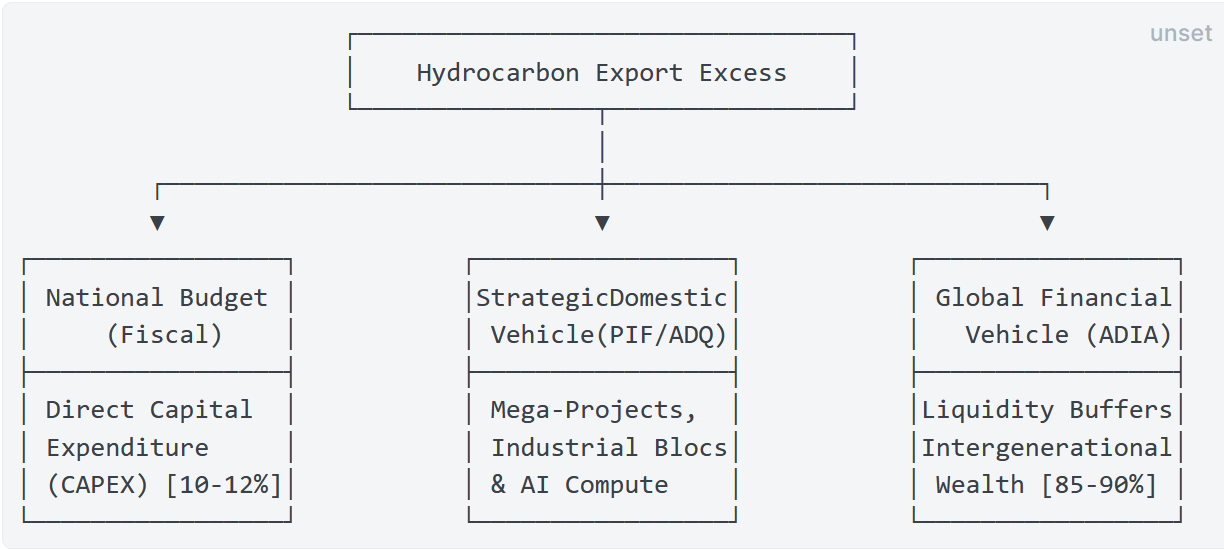
The core secret to the GCC’s structural success lies in how they rigidly segregated their capital into distinct institutional circuits. They do not use a single "pot" of money for everything; instead, they operate through a three-tiered institutional matrix:
Circuit A: The Direct Fiscal Budget (The Social Baseline)
This is the standard government budget (e.g., Saudi Arabia’s SAR 1.3 trillion / $350 billion budget). This money handles immediate public consumption and infrastructure maintenance. Roughly 10% to 12% is assigned to direct government Capital Expenditure (CAPEX) for roads, schools, and hospitals.
Circuit B: The Strategic Domestic Development Funds (The Real Economy Engine)
To build massive mega-projects without triggering hyper-inflation or completely draining the state treasury, the GCC utilizes specialized domestic investment vehicles—primarily Saudi Arabia’s Public Investment Fund (PIF) (managing over $900 billion) and Abu Dhabi’s ADQ (managing ~$150+ billion).
The Mandate: These funds are explicitly barred from passive global speculation. Their job is to mobilize capital into national productive assets: launching local industrial champions (like ACWA Power or DP World), funding smart cities like NEOM, and purchasing global technology transfers to localize manufacturing.
Circuit C: The Intergenerational Sovereign Wealth Funds (The Financial Buffer)
This is where the pure financial capital is held, best exemplified by the Abu Dhabi Investment Authority (ADIA), which holds over $1.1 trillion in assets.
The Mandate: ADIA’s primary focus is global diversification. It functions as a massive shock absorber for the state, keeping cash moving out of the local economy to prevent inflation, while recycling capital through international equities, private equity, and foreign bonds.
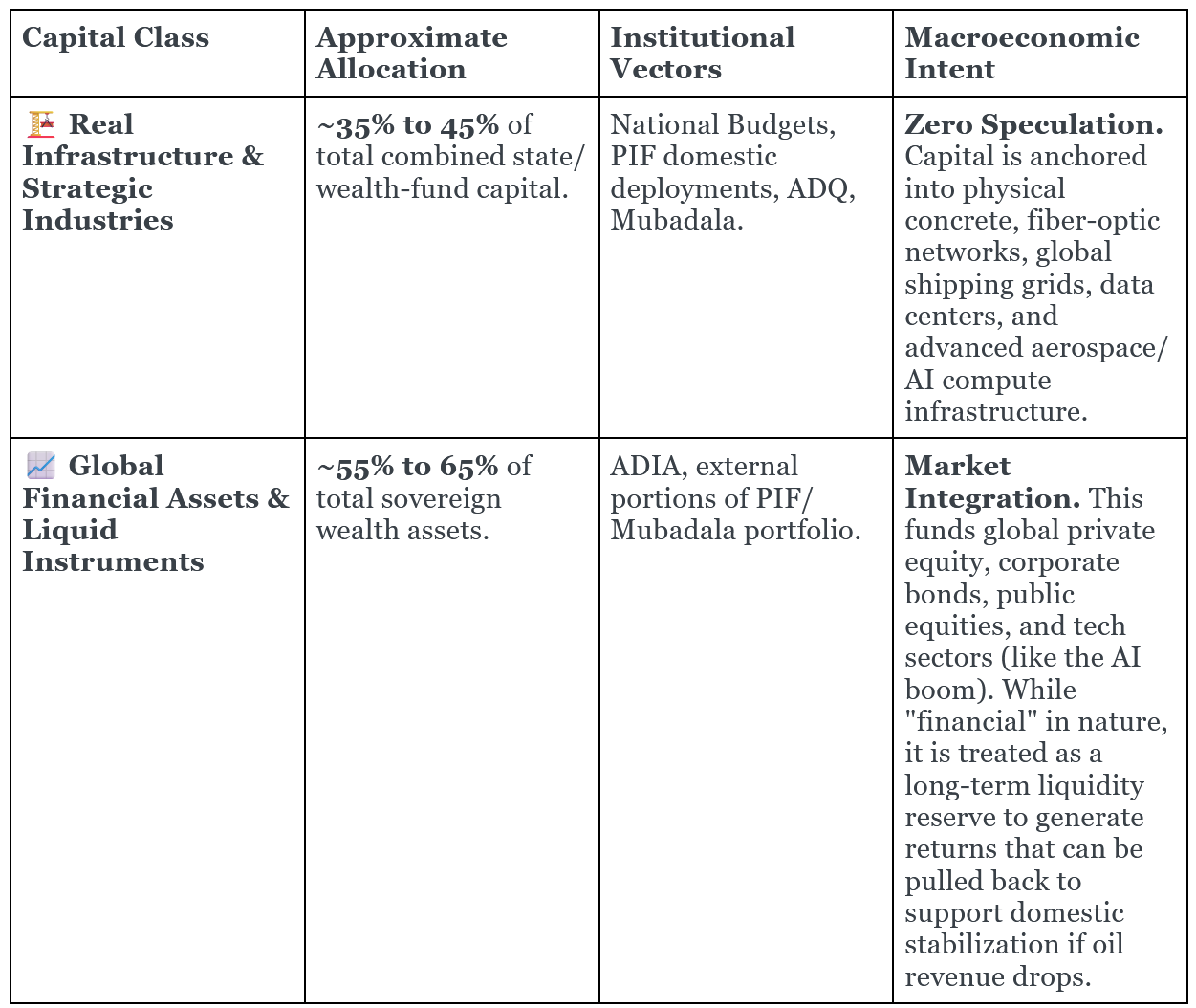
🔎 3. Speculation vs. Real Infrastructure: The Hard Math
When looking at the breakdown of where this wealth actually lands, a distinct operational split emerges:
The Systemic Lesson: Overcoming the "Hedge Fund" Trap
What makes the GCC case study relevant to our earlier points about capital extraction is that they realized they could not leave their development to the whims of the global financial market.
If Saudi Arabia or the UAE had relied on Western-style private venture capital or commercial bank credit to build their countries, global speculators would have trapped them in debt cycles or extracted the profits "behind hedges." By using state-backed sovereign funds to command the capital directly, they forced financial wealth to bend to the needs of physical infrastructure.
In a sense, they used the fruits of global capitalism (selling oil to the world market) to build an insulated, hyper-efficient, state-directed domestic physical reality.
Seeing Beyond, a research initiative focused on spiritual science, living cognition, and the threshold experiences of modern life.
An initiative grounded in a spiritual-scientific approach to self- and world-observation.
Comments
If a society commands its financial surpluses directly and transparently, it can build a physical world that operates on a completely different plane of efficiency.