The Electromagnetic Field, its Energy, and it Encoded Information
The field is not the energy and it is not the information. It is the physical entity/state through which electromagnetic energy and signals are represented and propagated.
The electromagnetic field is the physical quantity described at every location by an electric component E and a magnetic component B.
What is the difference between the electromagnetic field itself, the energy carried by that field, and the information encoded into it..
This distinction is fundamental, because field, energy, and information are three different levels of description. A useful analogy is a lake: the lake is the medium/state capable of having waves; a wave carries energy across it; and patterns imposed on waves could encode a message. Electromagnetism differs because no material medium like water is required, but the distinction remains useful.
1. The electromagnetic field: what is present?
The electromagnetic field is the physical quantity described at every location by an electric component E and a magnetic component B.
Even without a radio transmission, electromagnetic fields can exist. A stationary electric charge has an electric field. A magnet has a magnetic field.
When charges accelerate—as they do in a transmitting antenna—the disturbance can detach from the immediate vicinity of its source and propagate outward as electromagnetic radiation.
So we can say:
The field is not the energy and it is not the information. It is the physical entity/state through which electromagnetic energy and signals are represented and propagated.
There is a subtlety here. Physics is extremely good at specifying mathematically what fields do, but asking what a field ultimately is moves quickly toward foundational physics and philosophy. Modern physics does not need to posit a mechanical ether underneath the electromagnetic field.
2. Energy: how much physical capacity is being transported?
An electromagnetic field contains energy.
For an electromagnetic wave, stronger electric and magnetic fields correspond to greater energy density. The flow of electromagnetic energy is described classically by the Poynting vector:
\[ \mathbf S=\mathbf E\times\mathbf H \]
Its direction tells us the direction in which electromagnetic energy is flowing, while its magnitude relates to power per unit area.
So imagine two otherwise identical transmitters:
Transmitter A: 1 watt Transmitter B: 100 watts.
They might transmit exactly the same message.
The second can put much more electromagnetic energy into the environment, but it does not necessarily contain 100 times more information.
That's our first major separation:
Energy ≠ information.
3. Information: what pattern has been imposed upon the field?
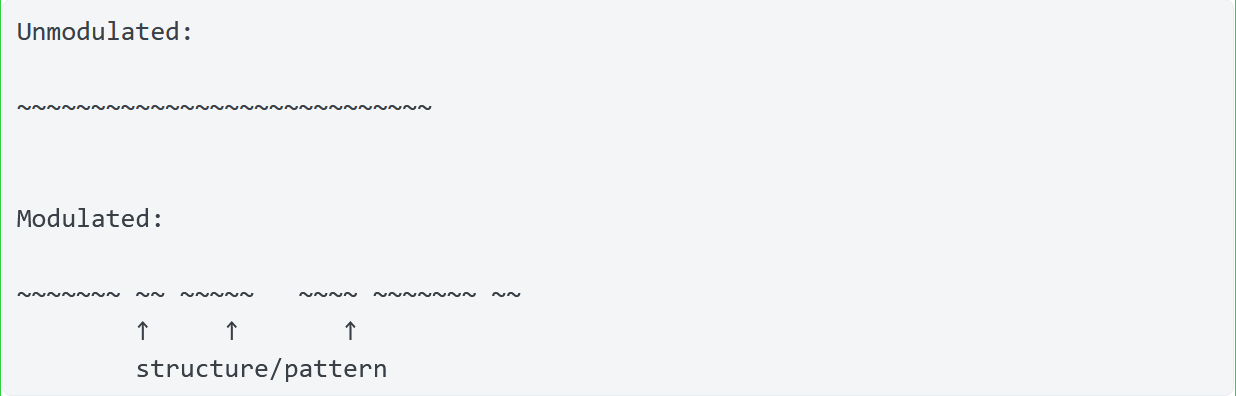
Now suppose the transmitter produces a perfectly regular carrier:
\[ \sim\sim\sim\sim\sim\sim\sim\sim \]
If nothing changes, there is very little to communicate beyond something like:
“A carrier is present.”
To transmit information, we introduce structured differences.
Very schematically:
Real cellular modulation is vastly more sophisticated, but the principle remains.
The information resides in distinguishable states or relationships in the signal—for example phase, amplitude, frequency/time allocation, symbol sequences, coding relationships.
So:
FIELD What physical electromagnetic state exists?
↓
ENERGY How much electromagnetic energy does that state contain/transport?
↓
INFORMATION What distinguishable pattern of changes has been encoded into that state?
An illuminating example: Morse code
Imagine a radio transmitter sending:
SOS
The transmitter sends:
· · · — — — · · ·
The electromagnetic radiation carries energy while transmitting every dot and dash.
But SOS isn't an additional physical substance travelling alongside the energy.
The information resides in the pattern.
And something remarkable follows.
A receiver that doesn't understand Morse still receives the electromagnetic energy.
A receiver capable of distinguishing pulses detects:
short short short / long long long / short short short
Only a system possessing the appropriate decoding relationship interprets:
SOS.
So we now have another distinction:
physical pattern ≠ interpreted meaning.
That becomes enormously important when talking about information.
Consider your cellphone
Suppose I send you a photograph of a tree.
At one stage, cellular RF carries encoded data corresponding to that photograph.
But there is no little picture of a tree floating through the electromagnetic field.
Instead there might be something conceptually like:
TREE
↓ camera
optical electromagnetic radiation
↓ sensor
electrical signals
↓ computation
binary data
↓ encoding/modulation
structured RF electromagnetic field
↓ receiving antenna
electrical signal
↓ demodulation/decoding
binary data
↓ display
visible electromagnetic radiation
↓ eye
retinal activity
↓ nervous system
perception of tree
Notice something rather beautiful.
The tree disappears as a visible tree in the middle of this process.
Its representation passes through radically different physical forms.
Yet certain relationships are preserved sufficiently for the photograph eventually to reappear.
And this gives us a fourth category: meaning
Now our original three have become four:
FIELD → ENERGY → INFORMATION → MEANING
And these should not be conflated.
A radio wave may carry electromagnetic energy without carrying a meaningful message.
A signal can carry information that a particular receiver cannot decode.
A receiver can decode information without understanding its meaning.
And two messages can require roughly comparable electromagnetic energy while conveying utterly different meanings:
“Everything is fine.”
versus
“Evacuate immediately.”
Almost the same physics.
Enormously different meaning.
This becomes particularly important for the EMF question
When somebody asks:
“What does this cellular signal do to a human being?”
there are actually several quite different questions hidden inside it.
Energetic question: How much electromagnetic energy is absorbed by tissue?
Frequency question: At what frequencies does the field oscillate?
Signal-structure question: How is the electromagnetic field varying over time?
Biophysical question: Can biological structures respond to any of those variations?
Informational question: Does biological matter respond merely according to deposited energy, or can particular temporal structures matter independently of average energy?
That last question needs considerable care. It is tempting to reason that
Seeing Beyond, a research initiative focused on spiritual science, living cognition, and the threshold experiences of modern life.
An initiative grounded in a spiritual-scientific approach to self- and world-observation.
Comments
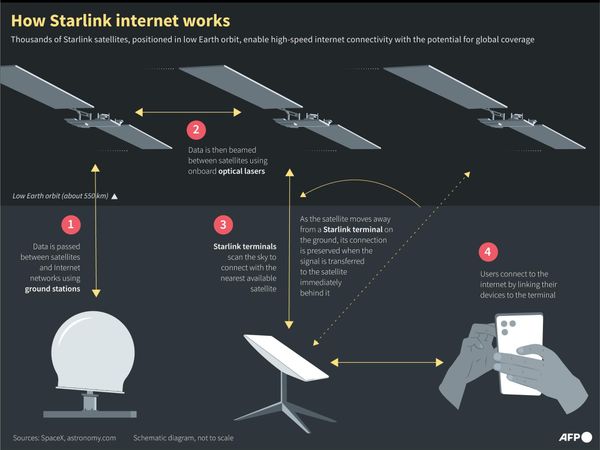
StarLink does change the geography of the question.