Michigan is rapidly becoming one of the places where the physical reality of artificial intelligence becomes impossible to overlook. Dozens of data centers already operate there, with major new facilities proposed. The attractions are understandable: electrical and industrial infrastructure, land, fiber connectivity, a relatively cool climate and the immense freshwater resources of the Great Lakes.
But perhaps these gigantic installations should also make us ask a more fundamental question.
Why does something as apparently immaterial as artificial intelligence require so much stuff?
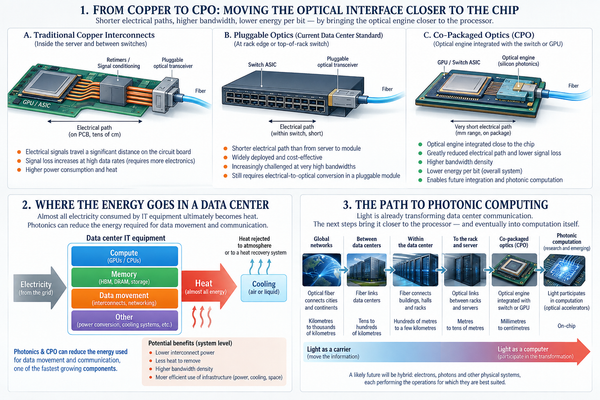
Behind a simple exchange with an AI system stand GPUs, memory systems, electrical substations, transmission lines, cooling equipment, buildings, water infrastructure and enormous flows of electricity. Much of that electricity ultimately becomes heat and has to be removed again.
We naturally respond by asking how to provide more electricity and better cooling. But perhaps we should also travel backward through the problem and ask how much of this physical burden is truly intrinsic to intelligence, and how much results from the particular architecture through which we presently implement it.
Here fiber optics provides an intriguing clue.
A question asked in Montreal can travel hundreds or thousands of kilometres through optical fiber before reaching the machines that process it. What travels through that fiber is not a miniature physical copy of the question, nor “intelligence” itself, but structured modulations of light from which information can be reconstructed.
A remarkably small optical signal can therefore encounter an enormous computational installation, initiate billions or trillions of operations, and return another relatively small informational package to the user.
The contrast is striking:
lightweight communication, heavyweight computation.
What if we could move some of the qualities that make optical communication so effective deeper into the machine itself?
That is already beginning to happen.
Fiber optics increasingly connects not merely cities and data centers, but racks and computing systems within data centers. Silicon photonics and co-packaged optics are moving optical communication closer to the processors. The reason is straightforward: one of the great energy costs of contemporary AI is not simply calculation, but moving enormous quantities of information between memory, processors and thousands of GPUs.
Electrical communication encounters resistance, capacitance, signal limitations and heat. Photons can move enormous quantities of information with comparatively low transmission losses.
But the next question is more interesting still.
Why should light merely transport information?
Photonic computing explores whether the properties of light itself—amplitude, phase, wavelength, propagation and interference—can participate directly in the mathematical transformations required by neural networks.
Instead of continually translating relationships into billions of electronic switching operations, certain relationships can potentially be embodied in optical processes themselves.
The progression then becomes almost visible:
fiber between continents → fiber between data centers → optics between racks → optics between chips → photonics within computation.
In this sense, perhaps the future of AI involves literally lightening the machine.
Not eliminating matter. Not escaping thermodynamics. Lasers consume electricity, optical devices have losses, and electronic systems will remain indispensable for many functions.
But the important principle is that today's massive physical infrastructure should not automatically be mistaken for an intrinsic requirement of intelligence.
The Michigan data-center boom embodies our present solution: concentrate enormous amounts of electronic computation, supply it with enormous amounts of electricity, and then construct another enormous infrastructure to remove the resulting heat.
Perhaps this is necessary today.
It does not follow that it must remain necessary tomorrow.
A more mature AI architecture may become heterogeneous: electronics where electronics work best, photonics where light offers advantages, memory and computation brought closer together, and physical processes chosen according to the relationships they need to transform rather than forcing every operation through the same electronic machinery.
The deeper objective would then no longer be simply to make ever larger data centers.
It would be to ask:
How lightly can intelligence touch the physical world and still become effective within it?
Michigan's enormous new AI infrastructure may therefore represent both an achievement and a question.
It shows us what our present conception of artificial intelligence physically requires.
Photonics points toward another possibility: not merely making that machinery faster, but gradually removing some of the machinery that our present way of computing made necessary in the first place.
Perhaps the next great step in AI will not be making the machine bigger.
Perhaps it will be learning how to make it lighter.