Admiration—for the global economy—is merely a psychological/moral consequence, which can easily be confused for the epistemological method to actually start considering the global economy.
If admiration were the starting point, and not an actual result of a proper approach of world-economy, that would be a disastrous flattening of such an approach. What is here being conveyed is thus much stronger.
The essential movement is not, “Look at all these admirable people doing their jobs.”
It is: activate thinking strongly enough to follow the phenomenon itself on the scale on which it actually exists.
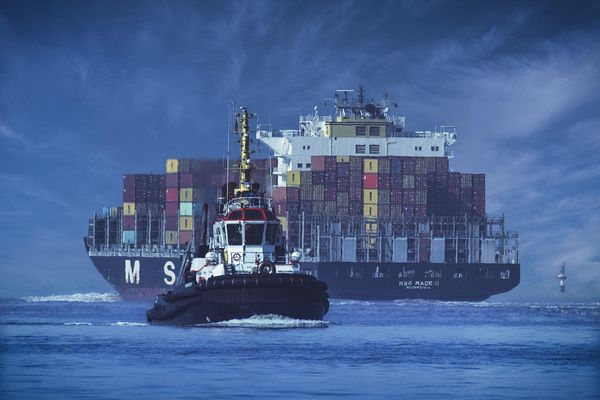
The container ship is particularly powerful because one cannot really think it while remaining at the level of the object.
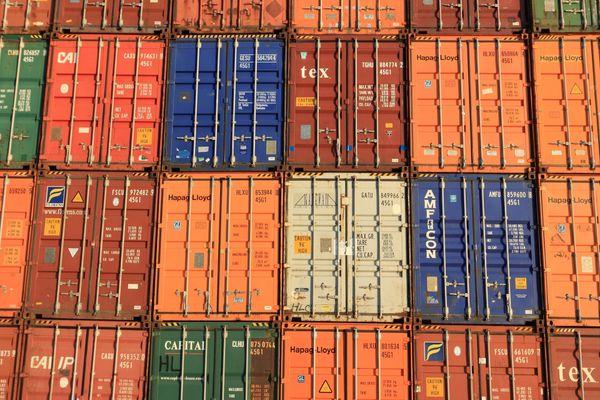
A “container ship” passively represented is a huge ship with coloured boxes on it.
Add today's ready-made associations and we get globalization, cheap Chinese goods, emissions, corporate profits, exploitation, perhaps geopolitical vulnerability.
But none of those associations yet thinks "the container ship".
To think it, one has to see the container, and the vessel, in their becoming, and into motion.
The container came from somewhere. What is in it? Who required those goods? Where were they produced? What materials converged in their production? Why are they being transported rather than produced locally? Why this route? Why this port? What coordinates the arrival of thousands of containers? What happens when the ship reaches Rotterdam? Where do the goods disperse afterward? What production processes elsewhere are waiting for them?
And very quickly the object disappears as an isolated object and becomes a node within movements extending around the Earth.
That is the epistemological event. The scale of thinking has to become adequate to the phenomenon
This is also where the macroeconomic level is indispensable.
If we immediately descend to Camille's wages, the working conditions of sailors, the profitability of Maersk, the price of a Korean tire, or the friendliness of a particular mechanic, we can say perfectly valid things—but we have already contracted the phenomenon again.
The world economy is not simply a large collection of micro-economic transactions.
It becomes perceptible only when thinking itself becomes capable of holding movements, transformations, dependencies and counter-movements across enormous distances simultaneously.
A professor of economics can certainly do this without Steiner. Indeed, if he remains faithful to the economic facts and brings his thinking to follow them rather than forcing them prematurely into a theory, he may arrive very close to the reality itself.
This requires therefore an energetic and active engagement with the subject matter, on the thinking level, to at some point, insert oneself within the whole thus arrived, namely the world economy, as a fact beyond mere partial perspectives. It is thus not about an anthroposophical interpretation of the world economy. But rather about an activity of cognition through which the world economy can begin to disclose its own form.
And Steiner's thinking exercise is useful because it describes the inner discipline involved: don't drift into associations around the object; actively remain with it, follow it, reconstruct its relations, and increasingly make one's thinking adequate to what one is trying to know.
Here the "object" just happens to be planetary economic circulation.
Kraftvoll denken, in German, namely: energetic thinking. Such an energetic thinking forms the epistemological the centre; thus not just positive thinking, or mere blatant admiration, not even initially appreciation.
Kraftvoll denken:
Thinking has to acquire enough inner force not to fall back into the ready-made representations supplied by contemporary discourse. That requires an act of the I because otherwise "container ship" automatically activates whatever associative complex happens already to be present: pollution, capitalism, globalization, exploitation—or, from another ideological direction, efficiency, free trade, growth, prosperity.
Both can prevent perception.
Instead: Container ship.
What is actually happening? And then thinking moves. South Korean factory → tires → container → truck → Busan → vessel → Ningbo → Shanghai → Singapore → Indian Ocean → perhaps Suez, perhaps Cape of Good Hope → Rotterdam → European distribution → vehicles → human activity.
But even that is only one stream among thousands aboard one ship. And every container opens another stream backward into production and forward into consumption or further production.
Then ships intersect with ports, railways, roads, finance, insurance, weather systems, energy supplies, international law, manufacturing schedules and human needs.
Thinking begins having to expand spatially while remaining exact.
That is quite different from fantasizing about interconnectedness. Every connection requires to be inwardly represented while having to be real.
And at some point one can have an extraordinary experience: what previously existed as the abstraction “global economy” begins to acquire content.
One starts to see it.
And then admiration can occur
Admiration isn't therefore merely something we cultivate because it is healthier than criticism. It can arise because we have actually managed to penetrate somewhat further into what is happening. One suddenly apprehends the scale of coordination. This exists. This actually functions.
Millions of independent human intentions, capacities, organizations, materials and needs are continuously being articulated into movements around the planet. Then wonder or admiration may be an entirely appropriate cognitive response—not sentimentality but something produced by perception.
It is then like understanding a living organism more deeply. The more precisely one follows what is actually happening in a cell, an organ, or embryological development, the more astonishing it can become.
The astonishment doesn't replace knowledge. Knowledge produces the astonishment.
And this gets us beyond the “little soup”
The bread-maker story is lovely, and it belongs somewhere in this series, but if it is made into the principal basis for understanding economy, we shrink the whole thing back into interpersonal helpfulness.
Likewise, if we make Camille primarily a story about joyful professional life, we lose the tremendous scale revealed by the ship itself.
The ship allows consciousness to travel outward. And perhaps this is where the centre/periphery image or concept becomes indispensable and much more exact.
One can sit here at a centre and eat a banana. Thinking can stop at the banana. Or thinking can follow it outward: plantation, soil, climate, labor, packaging, refrigeration, port, ship, fuel, navigation, importation, distribution, supermarket, etc, and dive into these real-life phenomena involving countless human beings. Suddenly the apparently trivial object in my hand connects my centre with an enormous terrestrial periphery.
The world economy becomes thinkable as a whole because thinking follows the relations actually contained in the phenomenon. That is much closer to "seeing beyond" in the literal sense.
Not seeing something occult hiding behind the visible economy, but penetrating the visible facts sufficiently that what is normally invisible within them becomes perceptible.
And that is where the notion of society as an organism may eventually appear—not because we began with Steiner's proposition that society is an organism, but because sufficiently mobile thinking begins encountering a whole composed of differentiated, mutually conditioning processes.