To understand the friction between East and West, we must look far beyond modern industrial dominance or political systems. We must return to the foundational metaphysics of the earth: to the Orient, the place where the sun rises first.
While the West represents the evening—the place where the day settles, matures, hardens, and dries out into individual personality—the Far East holds the cosmic blueprint of the morning. It carries the freshness of the budding day, the exact moment the flower first appears into light.
The Freshness of the First Day
This "dawn consciousness" is still visible in China today. It is a state of being that is inherently childlike—untouched by the dry, hard rigidity of Western individuality that first began to harden with the legalistic, structured personas of ancient Rome.
Even in the modern landscape, when the West outsourced its clothing manufacturing to China, it inadvertently tapped into an ancient, structural genius. The Chinese soul possesses a relationship to color and fabric that is incredibly subtle, fresh, and nuanced—carrying the vibrant, awakening hues of the first light of day. This is a manifestation of an inner, devotional attitude toward reality; a subtlety of perception that the West, in its heavy, earthbound materialism, painstakingly lacks to its own great detriment.
The Levant, Levity, and the Rising Sun
This cosmic layout stretches from the Levant (the Middle East) to the Far East. Both are the lands of the aurora, the threshold where the light breaks free from the night.The word Levant shares its etymological and spiritual roots with levity. The rising sun does not merely illuminate the world; it pulls it upward. It stimulates growth, drawing the sap up through the stems of plants, pulling humanity out of the heavy sleep of night and into day-consciousness.
Historically, this region of the world operated under a different spiritual gravity. In the ancient consciousness of China and the high Tibetan plateaus, humanity maintained a relationship with this force of levity—the upward pull of the cosmos.
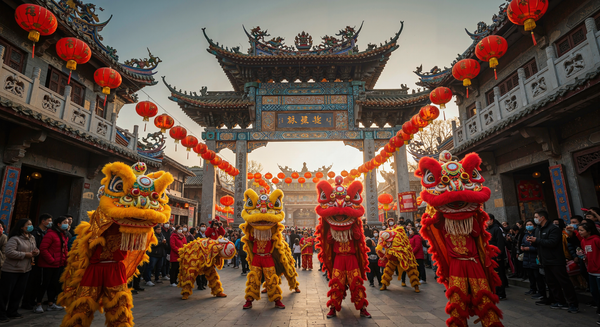
This is the true meaning behind the Dragon culture. The dragon—fiery, ancient, and capable of flight—is a creature of levity. It represents a past epoch where the laws of material weight and gravity were not yet absolute, where the fiery spiritual forces could still lift off the earth and command entire regions.
The Traumatic Counter-Force: The Cogs of Production
This deep, morning spirituality and capacity for finer perception is precisely what makes the current state of the Far East so tragic.
To survive the gross, earthbound, and aggressive individuality of Western industrialization, both China and Japan had to violently adapt. China endorsed a heavy, materially bound stance through the Maoist Revolution, while Japan transformed its ancient warrior traditions into the hyper-efficient, mechanical discipline of corporate production.
Today, these two cultures are deeply embarrassed by their own cosmic mystique in a hyper-materialistic world. Trapped in the frantic cogs of global manufacturing, they are forced to operate in a state of heavy density, masking their natural affinity for levity behind a wall of industrial output.
The Civilizational Balance
True global harmony cannot be achieved by forcing the morning to act like the evening. The West desperately needs the nuance, the subtlety, and the upward-pulling levity of the Orient to save itself from its own dry, mechanical exhaustion.
The Far East does not need to lose its soul to the cogs of production. Its ultimate evolutionary destiny is to remind the global body of the freshness of the beginning—proving that human consciousness can remain highly advanced while still retaining the delicate, colorful innocence of the awakening dawn.
#Geopolitics #SystemsThinking #China #Japan #TheOrient #CulturalPsychology #Philosophy #GlobalIdentity #Leadership #Metaphysics