Canada as the Geopolitical Translator
If we view the world as a living body, conflicts occur when organs can no longer communicate, mistaking their specific regional function for universal reality.

– 2 min read
If we view the world as a living body, conflicts occur when organs can no longer communicate, mistaking their specific regional function for universal reality.

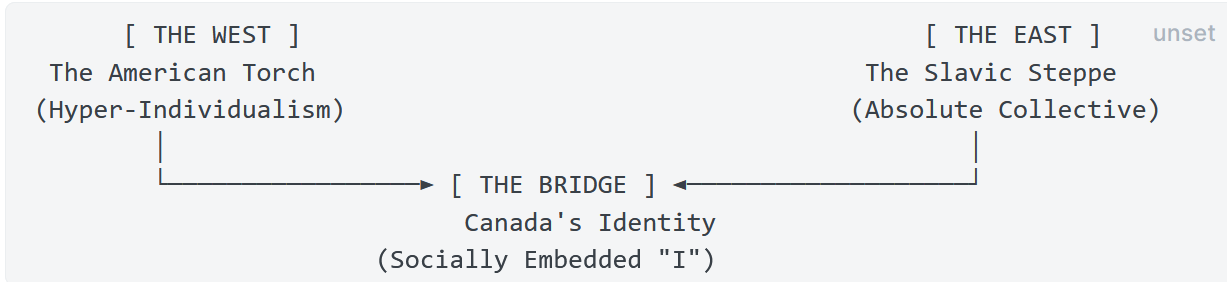
If we view the world as a living body, conflicts occur when organs can no longer communicate, mistaking their specific regional function for universal reality. The current gridlock between the Western Head Pole (spearheaded by the United States’ hyper-individualism) and the Slavic/Eastern Collective Pole (rooted in the vast, communal steppe) is precisely this kind of linguistic and spiritual breakdown.
The West speaks the language of the absolute, detached individual. The East speaks the language of the absolute, self-sacrificing collective. Because their foundational premises are entirely polarized, their dialogue has degenerated into economic extortion and warfare.
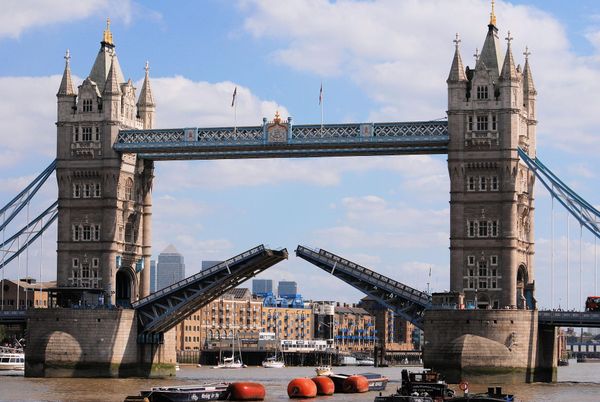
This is where Canada’s northern constitution offers an invaluable, yet entirely overlooked, geopolitical function: acting as a natural translator and diplomatic bridge between these two seemingly irreconcilable worlds.
Because Canada is firmly situated within the North American Head Pole, it possesses a highly advanced, intellectually driven, and democratic infrastructure. It understands and protects the foundational Western concepts of human rights, legal sovereignty, and personal freedom.
However, because Canada’s identity was forged by a harsh, horizontal northern geography that penalized lone-wolf survival, it avoids the blind spot of American hyper-speculative individualism. When Canada looks at the Eastern or Slavic desire for community, it does not automatically see an existential threat or a backward "mafia state." It recognizes a variation of its own foundational truth: that the individual cannot exist without the structural warmth of the social fabric.
Canada can translate Western ideals of freedom to the East in a language that does not demand the total destruction of their communal base.
Conversely, Canada is uniquely equipped to explain the realities of the Eastern collective to a hyper-capitalistic West that has grown entirely detached from the base of society.
The United States often miscalculates geopolitically because its reductionist model assumes every society can be easily re-engineered into a free-market, individualistic consumer culture. Canada, by contrast, understands that large, challenging landscapes require massive, centralized coordination and public infrastructure to maintain social cohesion.
Because the Canadian "I" chooses to remain horizontally integrated with the community, it can show the West how to value a nation's "State of Being" and inner composure without reducing human wealth to mere market liquidity or corporate efficiency.
In the heat of global conflict, America brings an explosive, vertical fire—a fierce, protective drive for liberty that can easily overstep and inflame global tensions. Russia brings a Dionysian, expansive passion that risks collapsing into fanaticism.
Canada’s northern light acts as a psychological cooling agent. Its cultural preference for accommodation, the "mosaic," and quiet mediation is not a sign of weakness, but a structural capacity born of its landscape. It is the natural temperament of an organ designed to integrate, filter, and balance the extremes of continental energy.
By recognizing Canada's unique placement in this global anatomy, we see that the West already contains the precise medicine needed to heal its own one-sidedness. Canada proves to the world that it is entirely possible to champion the highest levels of human individuation while remaining deeply, consciously embedded in the well-being of the comrade.