Based on the Life of Merlin
There are figures who belong not only to history, but to thresholds in human consciousness. Merlin is one of them.
Not the later court magician of popular imagination, but the earlier seer — the one who withdraws from society, lives among the forests, speaks with prophetic clarity, and yet remains unmistakably individualized.
When approached carefully, his life reveals something that feels strikingly contemporary: a portrait of initiation no longer embedded in tribal or dreamlike consciousness, but beginning to unfold within an emerging interior life.
Merlin does not merely belong to the mythic past. He stands at a turning point — one that humanity, in a different form, may be approaching again.
Initiation After the Loss of Ancient Clairvoyance
Earlier humanity did not need initiation in the way we understand it today. The world itself was still experienced as ensouled. Rivers, groves, animals, and stars were not yet mute; they spoke within a participatory field of awareness.
But such perception was not yet fully free.
It was given.
By the medieval period, something had begun to change. Consciousness was drawing inward. Individuality was strengthening. The human being was slowly separating from the great organism of nature.
Merlin appears precisely within this transition.
His path does not resemble the effortless belonging of earlier seers. Instead, it begins with rupture.
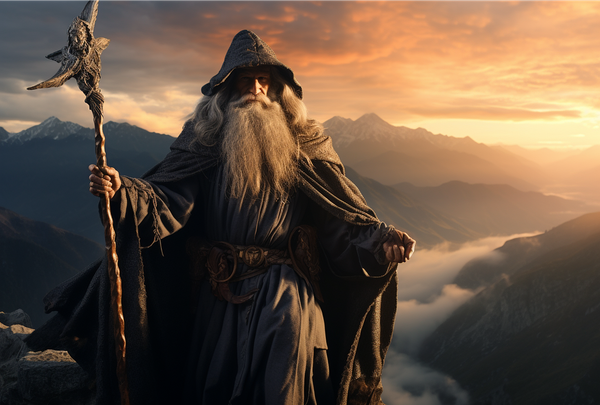
After the shock of battle and the death of companions, he withdraws into the forest — not as an escape, but as a necessity. Society has become too dense, too loud, too opaque for a perceptive organism undergoing transformation.
What looks like madness may instead be read as a reordering of perception.
Such moments often appear pathological to the surrounding culture because the frameworks needed to recognize them have already begun to fade.
Yet the wilderness does not swallow Merlin. He does not dissolve into nature. Something profoundly modern occurs: he remains himself.
Withdrawal Is Not Regression
One of the great misunderstandings of spiritual life is the assumption that turning toward nature implies a desire to return to earlier stages of consciousness.
Merlin shows something else.
He refuses wealth. He declines political power. He chooses the forest — but not to abandon the human. Rather, he seeks a perceptual atmosphere in which the world can again become legible.
This distinction is essential for our time.
The task is not to regress into older clairvoyance, nor to romanticize animistic states that belonged to very different structures of consciousness. What is required is far more demanding:
to awaken perception without surrendering wakefulness.
In Merlin we witness an individuality learning, almost painfully, how to stand inside a living world without losing itself.
This is not the dreamlike participation of early humanity.
It is participation regained.
When the World Speaks Again
In the forest, the cosmos is no longer abstract.
Animals move within meaningful patterns.
The stars become intelligible gestures.
Fountains heal not only the body but the mind.
The world begins to speak — yet not in the overwhelming way it once did for archaic humanity.
Instead, it speaks to someone who has become capable of listening.
Here we approach a decisive insight: initiation is not primarily about acquiring hidden knowledge. It is about becoming perceptually available to reality.
The modern danger lies at both extremes.
One path reduces the world to mechanism, leaving the human being existentially isolated within a mute universe.
The other attempts to leap backward into enchanted cosmologies, often through imagination rather than transformation.
Neither restores relationship.
Merlin points toward a third possibility: a conscious participation in a living cosmos.
The Individual Does Not Disappear
Perhaps the most modern aspect of Merlin’s path is that he does not merge with what he perceives.
He remains distinctly present.
He chooses.
He refuses.
He speaks with authority.
Even when called mad, he does not surrender his orientation.
This preservation of individuality marks a profound evolutionary step. Initiation is no longer absorption into the whole, but a meeting between the awakened human center and a world that reveals itself in response.
One might say that the human being is beginning to learn how to face reality without either dominating it or dissolving into it.
Such balance is extraordinarily difficult.
It may also be one of the defining tasks of future consciousness.
Initiation Is Not Private
Another striking feature of Merlin’s life is that his transformation is repeatedly witnessed.
Kings seek him.
Messengers search the forest.
Society turns toward the one who has stepped beyond it.
Initiation does not unfold as a hidden, self-enclosed spirituality. It becomes an event within the fabric of the world.
This too is deeply relevant today.
Modern spirituality often gravitates toward inwardness alone, as though awakening were a private attainment. Yet genuine transformation alters one’s relationship to reality itself — and reality responds.
The world becomes both partner and witness.
Not spectator, but participant.
A Question for Our Time
We no longer inhabit a culture that naturally recognizes initiatory processes. Experiences that might once have been understood as thresholds are frequently medicalized, pathologized, or dismissed.
And yet the need for transformation has not disappeared.
If anything, it has intensified.
For perhaps the central question emerging today is this:
Can the human being rediscover beingness within the world — consciously — without abandoning the clarity of modern awareness?
Not by retreating from the world.
Not by reducing it.
But by learning again how to encounter it.
Merlin does not provide a method. What he offers is orientation.
He shows that initiation may require solitude — but not isolation.
Withdrawal — but not rejection.
Perception — without loss of self.
Above all, he reveals that awakening is not an escape from the world.
It is a way of standing within it so fully that the world itself begins to speak.
And perhaps even more:
that the world, in its quiet way, is waiting to witness the human being become capable of hearing it again.