When Good Intentions Stop Looking at Reality
Can an accepted hierarchy of values begin interfering with our willingness to examine all the physical parameters equally?
– 6 min read
Can an accepted hierarchy of values begin interfering with our willingness to examine all the physical parameters equally?
There is a peculiar danger in good intentions. Because the intention is good, we tend to assume that the action flowing from it must also be good. Yet between intention and result lies the entire complexity of reality, and reality does not rearrange itself according to the moral quality of our intentions. Sometimes a small, everyday situation is enough to reveal how easily a morally compelling abstraction can prevent us from seeing the whole.
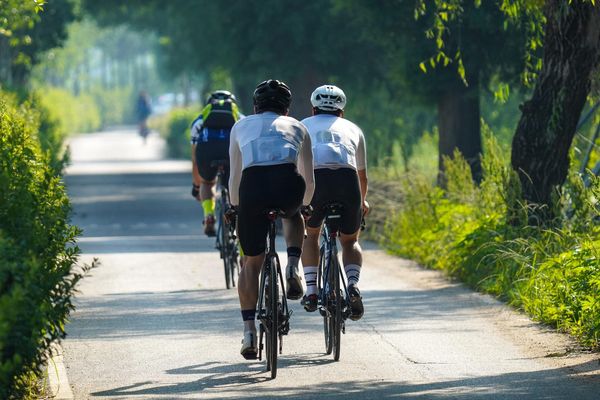
Where I live, in a heavily forested region of Quebec, bicycle and pedestrian paths frequently cross roads. In some places these crossings are diagonal rather than perpendicular, and the paths can emerge quite suddenly from trees and bushes. Speed bumps have been installed at a number of these crossings, presumably with the perfectly reasonable intention of slowing cars and protecting cyclists and pedestrians.
Nobody needs to object to that intention. The interesting question begins when we actually stand at one of these crossings and look at what is happening.
A cyclist approaching a road has a considerable perceptual advantage. There is no metal structure surrounding the cyclist. He can look to either side, listen for traffic and reduce his speed. If necessary, he can stop and put a foot on the ground. The physical act of checking whether a car is approaching is relatively simple.
The situation inside the car can be very different. If the bicycle path approaches diagonally and emerges from behind vegetation, an approaching cyclist may be situated considerably behind the driver's normal field of vision. The driver may have to turn far toward the rear-left while looking through windows, pillars, headrests and the structural framework of the vehicle. At the same time, the driver must continue observing the road ahead and whatever else is happening around the vehicle.
At 25 kilometres per hour, a bicycle travels almost seven metres every second. An e-bike may approach considerably faster. A piece of pathway that appears empty when the driver begins looking can therefore produce a cyclist at the crossing only moments later.
None of this means that cars should have priority over bicycles. It does not mean that cycling should be discouraged, nor that cyclists are responsible for collisions simply because they are cyclists. It means something much more elementary: the physical situation has to be perceived before it can be intelligently organized.
This is precisely where a broader question arises: can an accepted hierarchy of values begin interfering with our willingness to examine all the physical parameters equally?
Over recent decades a moral colouring has understandably developed around different forms of transportation. The bicycle is green, healthy, quiet and relatively harmless. The automobile is associated with pollution, congestion, fossil fuels, accidents and the domination of public space. There are perfectly legitimate reasons behind many of these associations.
But associations can gradually harden into categories: bicycle good, car bad; cyclist vulnerable, driver dangerous; therefore cyclist to be protected, automobile to be restrained.
Something important has been lost once thinking reaches that stage. A general truth has begun replacing a particular reality.
The cyclist is indeed more vulnerable in a collision. But vulnerability does not make a person more visible. The automobile is indeed capable of causing much greater injury. But that does not enable its driver to see through bushes, steel pillars or the back of his own head. A cyclist may possess legal priority at a crossing, but legal priority cannot alter reaction time, stopping distance, visibility or the laws of motion.
There is even a paradox here. If a strong culture of bicycle priority encourages some cyclists to approach crossings with the assumption that the automobile must stop for them, an idea originally intended to increase their safety can contribute to behaviour that reduces it. The cyclist can be legally correct and physically endangered at exactly the same moment.
Reality has no difficulty containing such contradictions. Ideology does.
The speed bumps themselves make the example still more interesting. At some of these locations, the raised portion of the road lies precisely where the bicycle and pedestrian path crosses it diagonally. I do not know why they were designed this way. Perhaps the intention was also to slow bicycles. Perhaps the designers or workers encountered the very practical problem created by the diagonal crossing: should the speed bump be placed before the path, after it, or directly across it?
But intention is secondary once asphalt meets bicycle tire.
A cyclist crossing a raised edge obliquely encounters a different physical situation from an automobile crossing it more or less squarely. Add rain, wet leaves, frost or ice—as one certainly can in Quebec—and an intervention constructed in the name of safety may itself introduce an additional instability at precisely the location where cyclists and automobiles are already interacting.
This does not prove that the speed bump is badly designed. That would require actually examining the site, its dimensions, construction and traffic patterns. But that is exactly the point.
One has to stand there and ask: Where does the cyclist first become visible? How fast are bicycles actually travelling? How far must the driver turn his head? What is obscured by vegetation? How does the crossing behave when wet? What does a cyclist experience when traversing the raised surface diagonally? Could the vegetation be cut back? Could the path be redirected during its final approach so that bicycles meet the road at a more visible angle? Should the geometry itself naturally induce both cyclist and driver to slow down?
Those are questions arising from reality rather than from allegiance to either side.
And they illustrate a much broader problem in contemporary thinking. Increasingly, we seem to begin not with the phenomenon but with a morally weighted interpretation of the phenomenon. Once something has been classified as environmentally desirable, socially progressive, safe, inclusive or otherwise “good,” questioning how it functions in a particular situation can itself begin to feel morally suspect. Conversely, once something has been placed in a negative category, inconveniencing or restricting it can acquire an almost automatic justification.
Sentimentality does not necessarily mean excessive emotion or people being nice to one another. It can mean allowing the moral attractiveness of an intention to relieve us of the obligation to investigate its consequences.
Protecting cyclists is a good intention.
Making roads safer is a good intention.
Reducing pollution is a good intention.
Encouraging people to walk and cycle is a good intention.
But good intentions are hypotheses until reality has answered them.
If an intervention actually reduces visibility, creates unexpected trajectories, introduces slippery surfaces, encourages unsafe assumptions, or shifts danger somewhere else, its benevolent intention cannot make those consequences disappear.
This is where ideology and genuine thinking part company.
An idea is not yet an ideology simply because it is strongly held. Ideas are indispensable to thinking. We could not understand anything without concepts. The problem begins when an idea becomes so morally charged that perception is no longer allowed to correct it.
Genuine thinking moves in both directions. We approach the world with concepts, encounter something that does not quite fit them, and allow the encounter to modify our concepts. Then we look again.
Ideological thinking increasingly moves in only one direction. The concept tells us what the world means, and whatever does not fit is ignored, explained away or forced into conformity.
This is how surprisingly intelligent people can create surprisingly unintelligent systems. It is not necessarily because they lack knowledge or technical expertise. They may simply be working within a conceptual architecture that has already determined which parameters matter.
The bush remains opaque. The bicycle continues moving seven metres per second. The driver's neck still turns only so far. The pillar of the car remains in the way. The wet surface remains slippery. Winter still comes. Human attention remains limited.
Reality patiently retains everything our theory has omitted.
Then, when the theory is translated into the physical world, those neglected elements return as friction. Another sign is required. Another barrier is installed. Another speed bump is added. Another regulation is introduced to correct the unforeseen consequence of the previous regulation. Before long, we are constructing corrective mechanisms to correct the consequences of other corrective mechanisms.
The resulting mess may have been produced almost entirely by people with good intentions.
That is why a more humane society does not merely require better values. It requires a better relationship between values and perception.
Compassion should make us look more carefully, not less. Environmental concern should enlarge the number of realities we take into account, not predetermine the answer. Concern for vulnerable people should make us investigate the actual conditions producing vulnerability rather than simply assigning moral identities to the participants.
Reality must always retain the right to correct our ideas about it.
The moment we take that right away—because our intentions are good, our politics are righteous, our engineering standards are approved, or our moral categories appear self-evident—we stop thinking in the fullest sense.
We begin administering an idea.
And reality, sooner or later, answers back.