B. The Rhythmic System: The Gesture of Balance and Warmth
Through this rhythmic system, the human being ceaselessly balances heaven and earth, thought and deed, light and gravity.

– 2 min read
Through this rhythmic system, the human being ceaselessly balances heaven and earth, thought and deed, light and gravity.
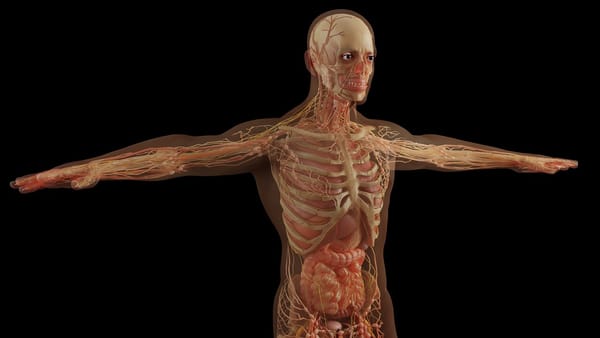
Between the stillness of thought and the motion of will lies a region that never rests — the domain of rhythm.
Here, contraction and expansion, inhalation and exhalation, heartbeat and pause weave the world’s polarities into living unity.
Through this rhythmic system, the human being ceaselessly balances heaven and earth, thought and deed, light and gravity.
Where the head reflects and the limbs act, the chest breathes.
It transforms the vertical axis of the human being into a gentle oscillation — a perpetual reconciliation.
It is the music within the architecture of form.
The heart does not beat as a mechanical pump, but as a listening organ.
Each systole and diastole echoes the gestures of giving and receiving, courage and surrender.
It gathers the warmth of the limbs and the light of the head, blending them into a moral equilibrium.
The heart’s true gesture is offering.
In its quiet labor, it transforms the sharp boundaries of the head into living movement, and the dense currents of metabolism into radiant order.
It is not master nor servant but mediator, the rhythmic priest between heaven and earth.
The lungs stand beside the heart like twin wings.
Through them, the outside world enters the inner space — not as substance, but as rhythm.
Each breath is a crossing of thresholds: the world becomes self, the self returns to world.
In every inhalation, the cosmos touches the soul; in every exhalation, the soul answers.
This alternation is the archetype of all relationship.
Through it, the human being learns that existence itself is dialogue.
Breathing thus unites two forms of knowledge: the still perception of the head and the active deed of the limbs.
It keeps the one from freezing and the other from consuming itself in heat.
Through rhythm, life becomes conscious without ceasing to be alive.
Where light orders and substance anchors, warmth relates.
It is the invisible tissue that joins every process to every other.
Physiologically, it carries metabolism upward and perception downward; spiritually, it is the medium of sympathy and compassion.
When warmth flows freely, the soul can meet the world in openness.
When it is blocked or overdrawn, coldness or fever arise — both in body and in character.
Thus the rhythmic system is the organ of empathy.
It teaches that the highest equilibrium is not neutrality but love made rhythmic —
feeling that breathes between self and world without losing either.
Every polarity in human nature seeks its healing here.
The chest is the field where opposites find proportion, where “too much” and “too little” become the living art of “enough.”
In this sense, health is not a fixed state but a musical one — an ever-renewed consonance.
So too in the soul:
justice, compassion, courage, patience — these are not absolutes, but rhythms.
The heart teaches us that morality is a tempo, not a rule.
Sit upright, hands resting gently on the chest.
Notice the rhythm of your breathing.
Let the inhale and exhale lengthen naturally, until you feel a quiet pendulum between world and self.
Now attend to the heartbeat within that rhythm — the pulse that lives between thought and will.
Sense that this rhythm does not belong to you; it is shared.
It connects you to the entire breathing cosmos — trees, tides, winds, stars.
In this awareness, say inwardly:
May my heart learn to beat in harmony with the world.