A Contemplation on Perception as Cosmic Remembrance
The nerve–sense system lives at the poles of the human organism — in the head, the spinal pathways, and the delicate mesh of sensory organs.
It is our most crystalline realm, cool and precise, the region where the human being ceases to act and begins to behold.
Here, matter itself has almost come to rest; the metabolic fire has cooled into transparency so that light may pass through.
If the metabolic–limb system is a forge and the rhythmic system a breathing, the nerve–sense system is a mirror.
It reflects the world with the still clarity of winter, preserving its image as memory.
1. The Gesture of Contraction
Everything in the head reveals a gesture of inward gathering.
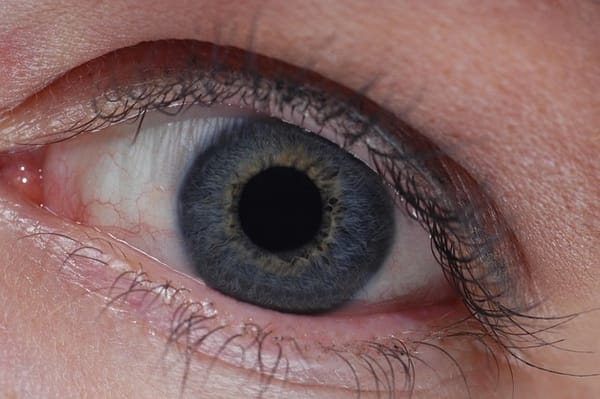
The skull encloses; the eyes form tiny domes of inwardly folded light; the ear’s spiral winds the world’s motion into a point of stillness.
Through this entire domain runs a single motif — concentration, the drawing-together of substance until it becomes almost spiritual.
This is why Steiner could say that the head is a transformed past.
It no longer creates; it remembers.
Its tissues are old in form but young in clarity.
The brain’s whiteness is not lifelessness but the peace that arises when movement has become law.
To think is therefore not to invent, but to remember rightly —
to let the world’s essence reappear in us as image, freed from compulsion.
2. The Polarity of Perception and Death
In the nerve–sense realm, the world enters the human being only by passing through a subtle dying.
Perception is a sacrifice of life: the plant’s green vitality becomes pure color in the eye; the sound’s vibration ceases in the stillness of hearing.
To know something truly is to allow its life to fall away so that its essence may arise as meaning.
This is the mystery of the head: it is the grave of instinct, but also the womb of spirit.
Every clear thought is a resurrection of what has died to sense.
Thus, the head’s coolness is not the absence of warmth but its transmutation —
fire lifted into clarity, motion lifted into form.
3. Light as Memory of Will
In cosmic evolution, the forces now resting in the head once lived in the limbs as active will.
What we experience as calm thought is the echo of ancient deeds — the will of past worlds turned into image.
The nerve–sense system is therefore willed memory: the body’s capacity to hold still long enough for the spirit to see itself.
When we think in reverence, we awaken those sleeping cosmic deeds and begin to transform them again into future creativity.
When we think mechanically, we leave them imprisoned as mere reflection.
4. The Moral Dimension of Perception
To perceive without grasping, to know without consuming — this is the moral task of the nerve–sense system.
Its purity depends on restraint.
Every sense organ is an act of renunciation: the eye does not seize light; it receives it; the ear does not chase sound; it waits.
Thus, the head is not the seat of domination but of service.
It is the priestly part of the human organism, consecrated to the truth of things.
When thought remains humble, perception becomes prayer —
and the world, reflected in such stillness, begins to reveal its own interior life.
5. Contemplative Practice
Sit in quiet observation of a simple object — a leaf, a stone, a flame.
Do not analyze; simply let it be present before you.
Notice how your attention wants to grasp or interpret, and gently release that impulse.
Let the object rest within your awareness as in a calm pool.
Then sense that this clarity is not produced by you but allowed by you —
that your very stillness is the world’s opportunity to appear.
In this moment, thinking becomes remembrance, and perception becomes reverence.