The Dutch and The Loved Form
In the Dutch context, what appears outwardly as neatness, results from a way of inhabiting the world that has become pleasurable, the more care it receives.

– 4 min read
In the Dutch context, what appears outwardly as neatness, results from a way of inhabiting the world that has become pleasurable, the more care it receives.
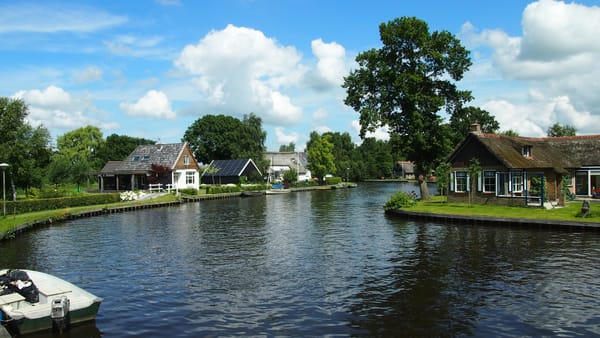
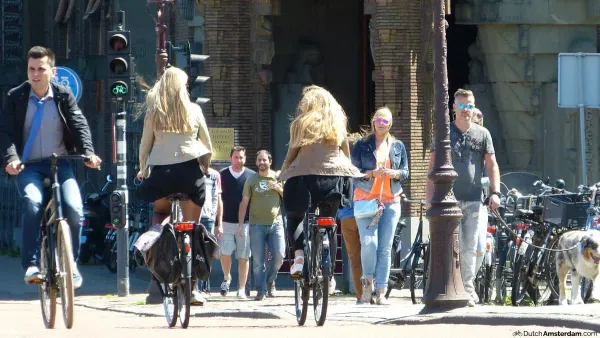
One could add: the Dutch love it! And because they love it, they take great enjoyment from from their lifestyle, which could easily seem too disciplined at times, when viewed from the outside. Therefore it has to be distinguished it is not a lawfulness that they impose on themselves and obey, but rather they have learn to love it through and through as a lifestyle that impregnates their lives from the moment they are born. And even the landscape in all its forms cultivates this fundamental attitude of its people, as exemplified so clearly in the case of the Dutch people. There is for instance something so pure to riding through the air on a bike in a flat landscape, especially one so maintained as it is typically crisscrossed by very little canals draining the water from the grasslands. Also, the Dutch, tall as they are, stand on this flat land, surrounded only by air and light, have naturally the virtue of "not hiding", because you can't, in all this neatness, while hiding, or shadow, or crookedness stands out—at least, in principle. So it is not something they force themselves to do or adopt, because they are stimulated to do so in their social interactions and codes, where they derive great pleasure being with one another. This is reflected in their great and strong "we", which too is a source of pleasure to them.
This is therefore pointing to something essential: an order that is loved, not imposed. When a form of life is loved, it ceases to feel like constraint and becomes a medium of participation. That is a very different origin for “neatness” than rule-following.
Let's look at how the inner gestures behind the Dutch attitude manifests, and then carries over into the planetary question.
There exists a form of order that is not experienced as law.
It is loved.
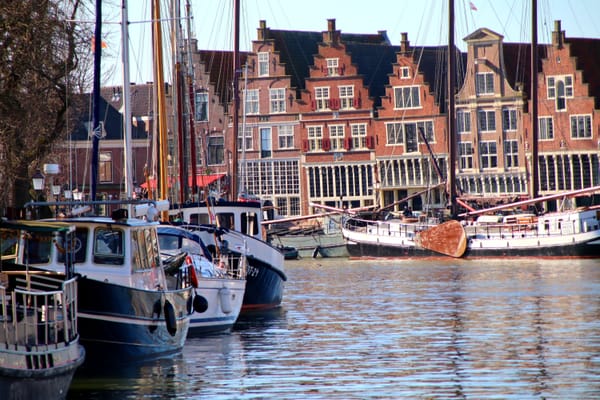
In the Dutch context, what appears outwardly as neatness—tidy cities, measured fields, careful maintenance—is not merely obedience to rules. It is a way of inhabiting the world that has become pleasurable in itself.
One does not keep things in order because one must.
One keeps things in order because one, for instance, enjoys the coherence it creates.
This is not trivial. It changes the entire nature of order.
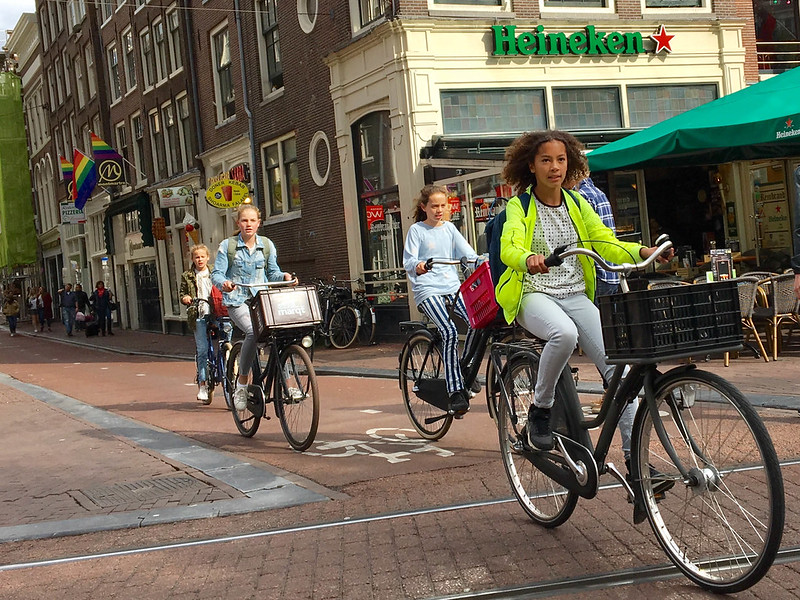
The bicycle becomes an image of this.
A tall figure moving through open air, across a flat horizon, along lines that are held and maintained—not rigidly, but continuously. No need to dramatize. No need to hide. The landscape itself does not permit much concealment.
In such a field:
This gives rise to a particular social atmosphere:
A strong “we”—not ideological, but lived.
The Dutch term gezelligheid gestures toward this:
Here, order is not the opposite of freedom.
It is the condition for a shared freedom that can be enjoyed.
If one looks beneath the cultural surface, several inner gestures can be discerned:
These gestures arise in a bounded world.
A country below sea level must be held together.
Water teaches accountability.
But over time, necessity becomes style, and style becomes pleasure.
This is the decisive transformation:
What was once required becomes loved.
As these gestures migrate outward—into larger, less bounded contexts—they change character.
But something is lost along the way:
The felt enjoyment of form.
Order becomes:
No longer a lived field, but a framework to operate within.
We now stand in a different condition:
The world itself has become the field.
Not metaphorically, but materially:
Eight billion people share one finite system.
And yet, the inner gesture adequate to this condition is not yet fully present.
We often:
This creates a tension:
A planetary system inhabited by pre-planetary consciousness
This insight introduces a decisive possibility.
If order is to return at a global level, it cannot be:
It must become, once again:
something that can be lived and even loved
Not the replication of Dutch culture, but the reappearance of the gesture at a higher level:
This would be a new form of maturity.
Not:
The Dutch example shows a strong, lived “we” within a bounded field.
The question now becomes:
Can humanity develop a “we” adequate to the planet?
Not abstractly.
Not ideologically.
But as:
A “we” that does not erase individuality,
but situates it within a coherent whole.
With practice, it becomes habit, with habit, it becomes life-style, since life always ends up organizing and re-organizing itself we can say something like this:
The task is no longer to impose order on the world,
but to learn to inhabit the order the world already requires.
And perhaps, at the same time,
by finding the positive in it, to love it.