A sample "Community Charter" constitution that outlines the exact rules for a local Usufruct Cooperative bank
To take the very first step toward launching something like this, a next move could be:
Draft a sample "Community Charter" constitution that outlines the exact rules for a local Usufruct Cooperative bank or asset-sharing guild
Map out a specific workshop or launching event template to introduce these concepts of Sobornost and relational ownership to your local neighbors
1. The Local Usufruct Guild: Sample Community Constitution
This foundational document establishes a local framework for managing common assets, funding youth endowments, and ensuring that individual striving always feeds the collective soul.
CONSTITUTION OF THE [INSERT TOWN/NEIGHBORHOOD NAME] USUFRUCT GUILD
Preamble
We, the members of this community, reject the false dichotomy between isolated self-interest and faceless collective conformity. We come together to practice Sobornost—a living togetherness where the unique individual "I" is celebrated and fully integrated (eingegliedert) into the communal "We." We declare that true human and economic maturity is measured not by how much an individual can hoard, but by how beautifully they steward resources to enrich the living whole.
Article I: The Principle of Usufruct (Rights of Use)
The Common Pool: All assets contributed to or purchased by the Guild—including land, tools, digital platforms, and financial capital—belong to the community common pool.
Conditional Stewardship: Guild members do not hold absolute, permanent ownership over common resources. Instead, they are granted a Charter of Use.
The Utility Mandate: A Charter of Use grants an individual full autonomy, creative freedom, and the right to profit from a resource, provided it is kept in active, socially beneficial utility. If an asset is left speculative, hoarded, or neglected for a period exceeding six consecutive months, the Charter of Use automatically expires, and the asset reverts to the common pool.
Article II: The Youth Capital Endowment Loop
The Systemic Pump: The Guild operates a localized, circulating financial fund. This fund is sustained by progressive contributions from member enterprises and voluntary legacy donations from older members.
The Endowment Grant: Upon reaching the age of local maturity (e.g., 21 or 25), any young person who has completed a Guild apprenticeship is eligible for a one-time Local Capital Endowment.
Non-Extractive Security: This endowment is not a commercial loan requiring asset collateral, nor is it charity. It is a baseline of economic safety meant to fuel the young person's unique creative or entrepreneurial identity, allowing them to launch a project without falling into defensive, survival-driven anxiety.
Article III: The Code of Relational Responsibility
Bilateral Negotiation: When disputes over resource allocation arise, members agree to forgo rigid legalistic contracts in favor of facilitated bilateral negotiation. All agreements must respect the moral stance of mutual benefit.
Reputation as Capital: Individual status within the Guild is determined by an individual's Stewardship Record—the measurable care they extend to common tools, the mentorship they offer to youth, and the harmony they bring to collective projects.
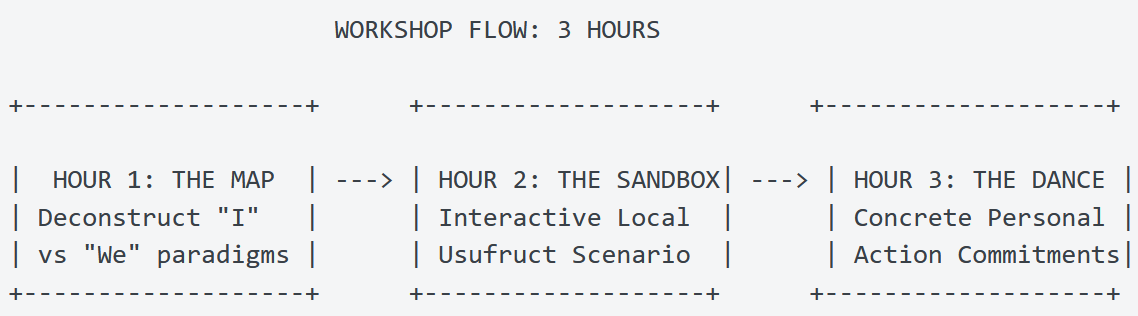
2. Launching Event Template: "The Relational Economy" Workshop
This interactive, 3-hour community workshop is designed to introduce these concepts to your neighbors, breaking down defensive ideological barriers (like the fear of "communism") and inviting collective imagination.
Workshop Overview
Title: Restoring the Balance: Moving from "Having" to "Being" in Our Community
Target Audience: Local residents, underemployed youth, retiring elders, small business owners, artisans, and community organizers.
Materials Needed: Large flipcharts, markers, a physical "token" object (to represent an asset), and copies of the Sample Constitution.
Hour 1: Mapping the Tug-of-War (45 Mins + 15 Min Break)
The Hook: Begin by mapping the cultural continuum we discussed. Write "Hyper-Individualism (The Isolated Ego)" on the far left of a giant board, and "Rigid Collectivism (The Crushed Ego)" on the far right.
The Discussion: Ask the room: "Where do you feel trapped today? Are you exhausted by the hyper-competitive 'survival of the fittest' economy? Do you worry that the alternative means losing your freedom?"
Introducing the Third Way: Introduce Slavic Sobornost and Indigenous stewardship. Explain that the goal is not to eliminate the "I," but to give it the economic safety to freely join the "We" through Usufruct (use-rights).
Hour 2: The Usufruct Sandbox (60 Mins)
The Setup: Divide the room into multi-generational teams of 4 to 6 people. Ideally, pair an elder with a young person in each group.
The Scenario: Hand each group a scenario: "An elder has a beautiful, fully equipped woodworking workshop (or commercial kitchen) that they can no longer physically use. A young person has the passion and skill to make furniture (or bake bread) but has zero capital to rent a space. Under standard capitalism, the space sits empty, and the youth remains underemployed. Under state communism, the state seizes the space."
The Task: Instruct the groups to design a Use-Right Agreement using the principles of the Guild Constitution. How does the young person reward the elder? How do they ensure the tools are cared for? How does the neighborhood benefit?
The Harvest: Have each group briefly present their agreement. Highlight the creative, fluid solutions that emerge when people stop worrying about "who owns it" and start focusing on "how we use it."
Hour 3: Grounding the Dance (60 Mins)
The Personal Audit: Ask everyone to silently write down two things:
What is one asset, space, tool, or deep skill I currently have locked away or underutilized? (The Hoarding Check)
What is one creative project or livelihood I want to launch, but I am blocked because I lack capital or a foothold? (The Scarcity Check)
The Matching Exercise: Create a physical or digital "Common Ledger" on the wall where people post these notes. Spend the remaining time facilitating matches. Watch as the rigid, stiff boundaries of individual anxieties melt into practical, collaborative pairing.
Closing: Review the Guild Constitution and invite attendees to sign up for a working group to launch a pilot Usufruct Bank or Tool Commons in your immediate area.
Seeing Beyond, a research initiative focused on spiritual science, living cognition, and the threshold experiences of modern life.
An initiative grounded in a spiritual-scientific approach to self- and world-observation.
Comments
Human beings have the unique privilege to grow up twice: once physically, and again spiritually.
In Japanese pop-culture, anime, and games, characters constantly execute precise, spatial "summoning," drawing seals (kuji-kiri) in mid-air, or holding elemental spheres of force between their hands before releasing them.
The popular image of the ninja performing hand seals (kuji-kiri) to summon giant frogs, turn invisible, or control fire isn't purely a modern gaming trope—it stems from esoteric Buddhism (Mikkyō) and Shugendō (mountain asceticism).