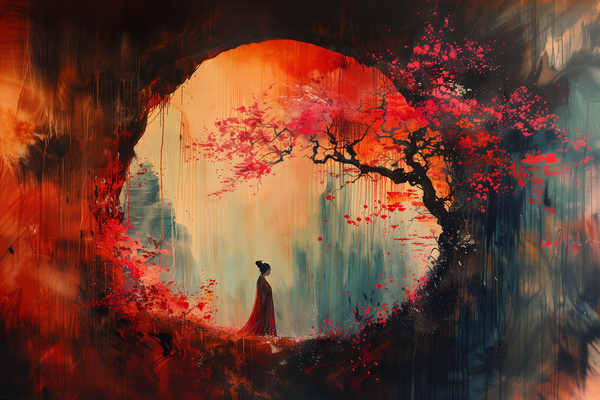
The Birth of the "I": Russia between Orient and Occident (2)
Lack of a moral stance translates into geopolitical friction points: protectionist tariffs or naval blockades, prioritize muscle over relational negotiation.

– 4 min read
Lack of a moral stance translates into geopolitical friction points: protectionist tariffs or naval blockades, prioritize muscle over relational negotiation.

Russia, with its massive landmass, represents an unseen bridge between Western Europe's and Anglo-Saxon ego-hood and Oriental collectivism.
Therefore, to bring this bridge into perspective, a global East-West view on the collective vs individualistic tendencies introduces an indispensable standard for the maturation of the human ego: true individuality is not a caricature of isolated self-interest, but a capacity to consciously self-incorporate (eingliedern) into a larger moral and social fabric.
When the "I" detaches completely, viewing the world as an abstract, naturalistic machine governed only by the "survival of the fittest," it does not become mature; it becomes isolated, stiff, and incapable of the fluid "dance" required for bilateral collaboration.
This lack of a moral framework translates directly into the geopolitical friction points we see today—such as the United States applying strict protectionist tariffs or initiating naval blockades and economic choke points around the Strait of Hormuz, prioritizing unilateral muscle over relational negotiation.
True ego maturity, by this definition, requires a synthesis that neither the hyper-isolated Western model nor the strictly collective traditional Eastern model fully answers. Here is a deeper look into the three dimensions of this evolving human "I."
Nineteenth-century Russian literature served as a profound battleground resisting the Western "mechanistic" ego, explicitly warning that radical individualism divorced from God and community leads to destruction.

Fyodor Dostoevsky (The Danger of the Isolated "I"): Dostoevsky’s works are a direct psychological assault on Western rationalism and utilitarianism. In Crime and Punishment, Raskolnikov attempts to assert a hyper-individualistic, Napoleonic "I" that is above conventional morality—a raw practice of "survival of the fittest." His intellectual detachment makes him a caricature of freedom, ultimately choking his own humanity. His redemption only begins when his ego breaks down, allowing him to eingliedern (reincorporate) into the human collective through suffering and shared spiritual guilt. In The Brothers Karamazov, Father Zosima articulates the antidote to Western isolation: "Every one of us is responsible for all men and everything on earth."
Leo Tolstoy (The Grand Harmony): Tolstoy approached this tension through a grand, almost cosmic lens. In War and Peace, the characters who seek purely individualistic glory (like Napoleon or the young Prince Andrei on the battlefield) are rendered impotent by the massive, unpredictable tide of history. True maturity is achieved by characters like Pierre Bezukhov and the peasant Platon Karataev, who possess deep personal consciousness but naturally dissolve their egos into the broader collective movement of the people. Tolstoy contrasts the rigid, stiff "I" of Westernized aristocrats with a fluid, organic morality tied to the living whole.
Functional MRI (fMRI) and neuroimaging studies show that the Western "isolated ego" and Eastern "relational self" are not just philosophical concepts; they are hardwired into neural architecture.
Trapped between, on the one hand, a rigid traditional collective, and on the other, a hyper-competitive, mechanical capitalist economy, Chinese youth are leveraging online spaces to carve out identities that attempt to balance the "I" and the "We."
Following up on how an overly rigid, isolationist, and self-centered "I" chokes bilateral negotiation through a lack of a fluid moral practice, namely a healthy consideration of "the other" as well as of the larger social context, in a next article we will explore how the concept of Sobornost (spiritual community/togetherness) in Slavic philosophy was explicitly proposed as a "Third Way" to heal both Western egoism and Eastern collectivism.