Design local, scalable pilots that function as "micro-habitats" or sandboxes for this mature ego-development.
To ground this grand philosophical continuum into immediate reality, we can design local, scalable pilots that function as "micro-habitats" for this mature ego-development. These projects must act as a sandbox where individuals can safely practice Eingliederung—developing a distinct, highly capable "I" that voluntarily coordinates with a supportive "We."Here is how we can architect three concrete local pilots in our immediate communities today.
1. The Usufruct Cooperative Bank (Financing the Emerging "I")
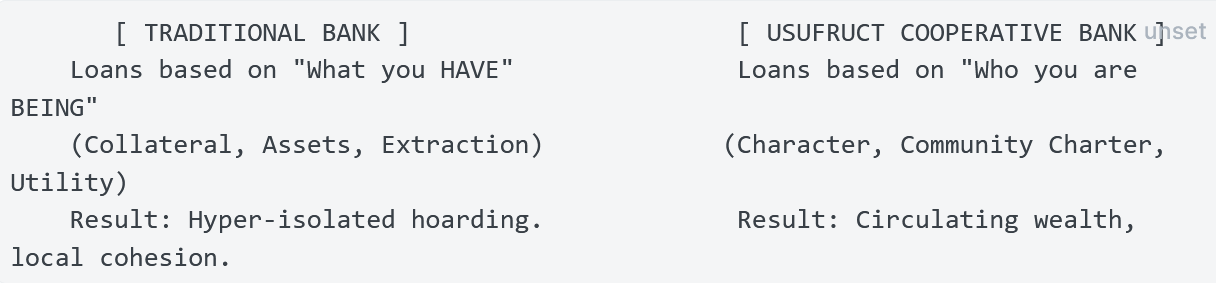
Traditional commercial banks treat money as a dead, extractive mechanism designed to maximize individual profit while demanding rigid collateral (existing "having"). A Usufruct Cooperative Bank completely flips the incentive structure.
Character-Based Lending over Asset-Collateral: Instead of evaluating a young person based on their credit score or family assets, this local cooperative bank issues micro-endowments and low-interest loans based on a "Community Charter of Intent." The young person pitches how their business, art, or trade will serve a tangible local need.
The Use-Right Contract: The money is granted with explicit usufruct constraints. The recipient has full autonomy to run their venture ("I"), but if they use the capital to speculatively buy up local housing or hoard resources without active utility, the community board triggers a claw-back clause.
The Repayment Dance: Repayments do not just vanish into an abstract corporate headquarters; they are visually tracked on a public ledger. The young entrepreneur directly witnesses their success refilling the local pool to fund the next young person’s endowment, immediately reinforcing that their individual striving directly feeds the collective soul.
2. The Sobornost Mentoring Network (The Multi-Generational Bridge)
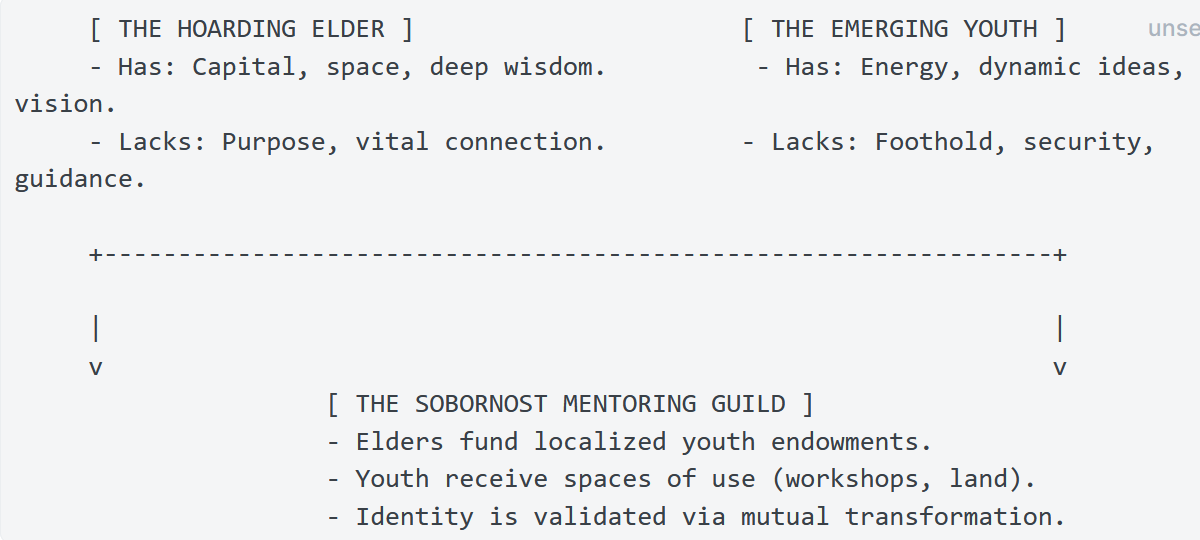
To heal the psychological tension between the hoarding older generation and the anxious, asset-less youth, we can establish structured, local mentoring guilds that trade material security for living legacy.
Asset-Transfer for Creative Use: Wealthier elders in the community covenant to place underutilized assets—such as vacant storefronts, empty barns, agricultural land, or industrial tools—into a local Community Land Trust. [1]
The Apprenticeship of the Ego: Young people are granted free, long-term rights of use to these spaces and tools. In return, they enter into a formal relationship with the elder. The elder does not act as a dictatorial "boss," but as a custodian of wisdom.
Mutual Validation: This framework completely re-engineers the psychology of both generations. The young person gets the economic safety required to safely differentiate and build an assertive "I" without fear of ruin. The elder lowers their defensive armor, experiencing the immense psychological relief of watching their life's work transform into a living, breathing legacy right in front of them.
3. The Localized Commons Digital Platform (Digital Eingliederung)
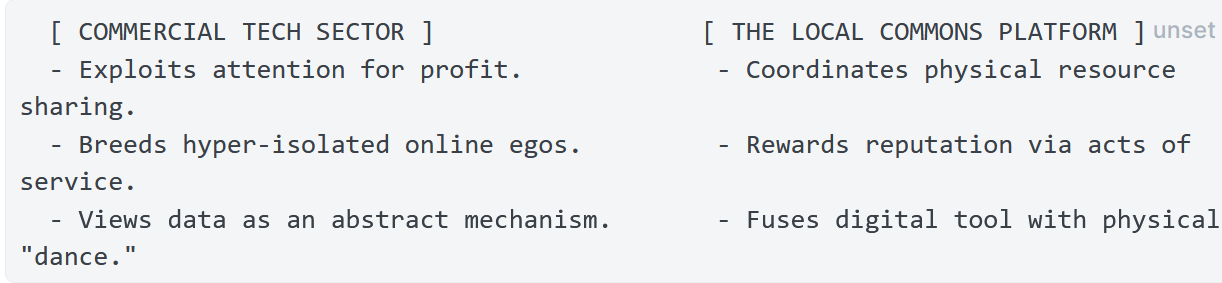
To counter the hyper-isolated, algorithmic echo chambers of standard American social media, a community can launch a localized, open-source digital platform (built on protocols like Matrix or ActivityPub) dedicated entirely to mutual aid and resource-sharing.
The Skill and Tool Commons: The platform acts as a community inventory. Instead of every household buying an expensive, isolated lawnmower, power tool, or commercial kitchen appliance, these items are logged into a shared pool. Individuals reserve them based on "use-rights" and a code of care.
Reputation Capital over Financial Hoarding: The platform tracks contribution rather than financial balance. If a software developer builds a local scheduling tool, or an artist paints a community mural, they earn Reputation Points. These points cannot be hoarded or converted into speculative cash, but they grant the individual higher priority access to the common workshop spaces, local event stages, or community-backed toolkits.
Fusing Morality and Pragmatism: This digital sandbox teaches the youth that standing out and being excellent at their craft ("I") is what makes them highly valued on the platform, but that value is only realized when they fluidly activate their skills to help a neighbor ("We").
By weaving these three pilots together, a town or neighborhood creates a micro-society where a stiff, isolated posture becomes impossible. The economy is transformed into a living, localized "dance," proving that a moral stance is the most practical framework for human survival and happiness.
To take the very first step toward launching something like this, a next step could be to:
Draft a sample "Community Charter" constitution that outlines the exact rules for a local Usufruct Cooperative bank or asset-sharing guild
Map out a specific workshop or launching event template to introduce these concepts of Sobornost and relational ownership to your local neighbors
Seeing Beyond, a research initiative focused on spiritual science, living cognition, and the threshold experiences of modern life.
An initiative grounded in a spiritual-scientific approach to self- and world-observation.
Comments
Human beings have the unique privilege to grow up twice: once physically, and again spiritually.
In Japanese pop-culture, anime, and games, characters constantly execute precise, spatial "summoning," drawing seals (kuji-kiri) in mid-air, or holding elemental spheres of force between their hands before releasing them.
The popular image of the ninja performing hand seals (kuji-kiri) to summon giant frogs, turn invisible, or control fire isn't purely a modern gaming trope—it stems from esoteric Buddhism (Mikkyō) and Shugendō (mountain asceticism).