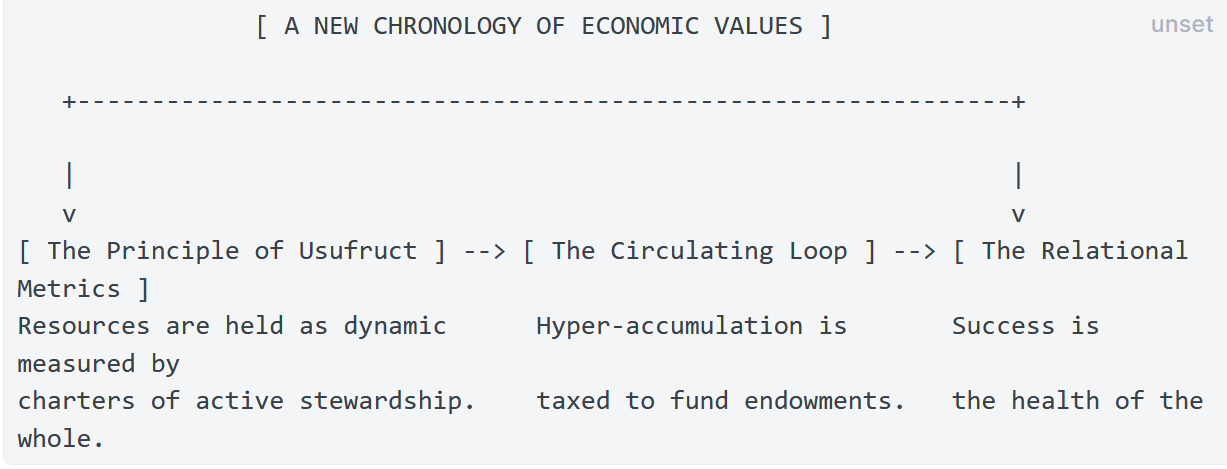
Morality and pragmatism fuse: economic practice becomes a sophisticated "dance" of mutual benefit.
To deepen this synthesis of psychology and systemic design a little more, we could still add one more article based on:
Exploring how educational systems would need to change to prepare youth for a world focused on self-incorporation rather than corporate competition
Examining how the concepts of Sobornost and Indigenous stewardship could be integrated into a new, global code of economic ethics for the 21st century
Discussing the psychological transition an older, hoarding generation must undergo to accept this shift from absolute ownership to temporary stewardship
1. Educational Systems: Educating for Eingliederung
To prepare youth for a world anchored by a Universal Capital Endowment, education must shift away from the factory model of standardization, which trains individuals to become obedient cogs or hyper-competitive utility maximization machines. Instead, it must foster a pedagogy of differentiation and conscious self-incorporation.
The Discovery of the Unique "I": Education must first guide the student to discover their internal compass, creative inclinations, and unique psychological makeup. Rather than forcing every child down the same narrow academic pipeline, the curriculum treats the student as an emerging, distinct consciousness. This phase values deep focus, artistic expression, and independent critical thinking to build a robust, un-crushed ego.
The Practice of Collective Mastery: Once individual capacity is cultivated, the educational architecture shifts toward intensive group orchestration. Students apply their unique skills to collective, open-ended projects—such as building community infrastructures, staging complex theatrical productions, or solving local ecological challenges.
Grading the "Dance": Assessment moves away from individualistic, curved grading scales that breed resentment. Instead, it measures how effectively a student can articulate their distinct voice while simultaneously tuning themselves to the team's shared harmony. They learn that their personal genius reaches its peak realization not by defeating their peers, but by elevating the collective output.
2. A Global Code of Economic Ethics
By weaving together Slavic Sobornost, Indigenous stewardship, and Piketty’s circulating capital frameworks, we can outline a new global economic paradigm for the 21st century. This code replaces the dead, mechanistic concept of "survival of the fittest" with a living framework of relational responsibility.
The Principle of Usufruct (From Asset to Custodianship): The absolute right to exploit and hoard vital global resources—such as land, housing, foundational software, and natural ecosystems—is abolished. True to Indigenous worldviews, individuals and corporations hold conditional charters of stewardship. If an entity leaves land speculative and barren, or locks away software behind rent-seeking paywalls, their right of use expires and reverts to the common pool.
The Circulating Loop (Systemic Sobornost): To prevent the economic field from petrifying into defensive choke points, wealth is treated like blood in a living organism—it must circulate to sustain life. Progressive annual wealth and inheritance taxes act as the systemic pumps that continuously dissolve rigid capital blockades, transforming hoarded billions into fresh capital endowments for the next generation.
Relational Metrics of Success: Gross Domestic Product (GDP)—which blindly measures transactional velocity even if it stems from destruction—is replaced by holistic indicators. National success is measured by the health of the ecological commons, the psychological well-being of the youth, and the fluidity of cooperative bilateral agreements. Morality and pragmatism fuse: economic practice becomes a sophisticated "dance" of mutual benefit.
3. The Psychological Transition of the Hoarding Generation
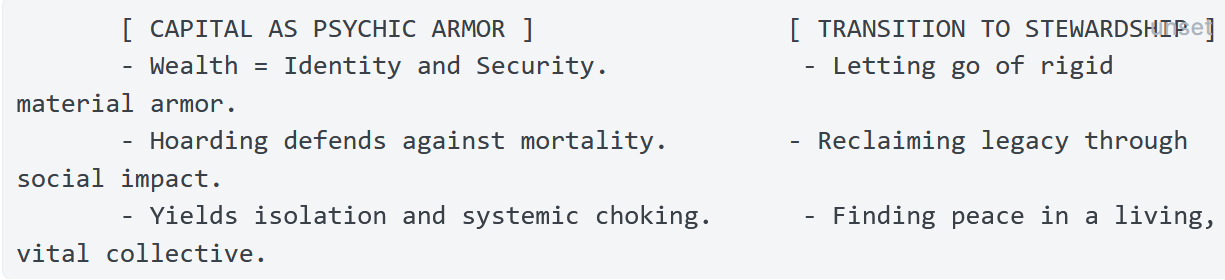
Transitioning to this model requires addressing the profound psychological resistance of the older generation, whose identities have been completely forged within the matrix of hyper-capitalist accumulation. For many, their accumulated wealth is not just money; it is the physical armor protecting an anxious, isolated ego from existential dread.
De-linking Identity from Possessions: For decades, the dominant cultural narrative equated having with being. To ask an elder to surrender their hyper-fortunes or absolute property rights feels to them like an existential assault—an erasure of their hard-won ego. The transition requires deep cultural empathy, reframing the dissolution of their private hoard not as a confiscatory "loss," but as an invitation to step into a higher stage of maturity.
The Shift from Accumulation to Legacy: The hoarding psyche operates out of a fear of mortality, trying to achieve permanence through frozen assets and dynastic inheritances. The psychological remedy is to redirect this desire toward living legacy. Instead of locking wealth away in dead bank accounts, elders are incentivized to witness their accumulated resources actively breathing life into the world during their lifetimes—funding youth endowments, restoring local ecosystems, and anchor-building community trusts.
The Relief of Lowering the Guard: Ultimately, the older generation must be guided to realize that maintaining a hyper-isolated, fortified ego is exhausting. Squeezing the world-economy through artificial choke points leaves the hoarder paranoid and alienated. Relinquishing the rigid grip of absolute ownership allows the aging ego to soften its borders, find peace, and safely incorporate (eingliedern) back into a vibrant, supportive human community that values them for who they are, rather than what they have.
As we close this comprehensive philosophical loop, we will explore one last aspect: how we might design concrete, local pilots today—such as localized cooperative banks or community-led mentoring networks—to begin practicing this model of ego-development in our immediate communities.
Seeing Beyond, a research initiative focused on spiritual science, living cognition, and the threshold experiences of modern life.
An initiative grounded in a spiritual-scientific approach to self- and world-observation.
Comments
Human beings have the unique privilege to grow up twice: once physically, and again spiritually.
In Japanese pop-culture, anime, and games, characters constantly execute precise, spatial "summoning," drawing seals (kuji-kiri) in mid-air, or holding elemental spheres of force between their hands before releasing them.
The popular image of the ninja performing hand seals (kuji-kiri) to summon giant frogs, turn invisible, or control fire isn't purely a modern gaming trope—it stems from esoteric Buddhism (Mikkyō) and Shugendō (mountain asceticism).