The Birth of the "I": between China and America (1)
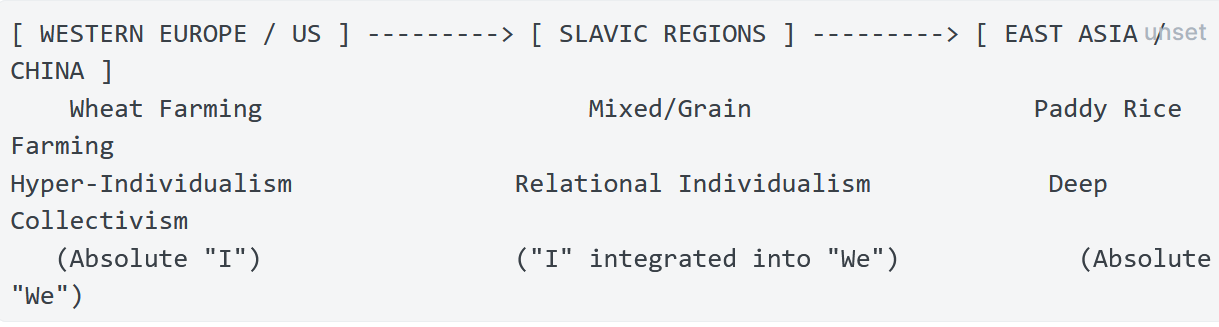
The divergent paths of Western individualism, Eastern collectivism, and the intermediate Slavic model are deeply rooted in historical geography and agricultural survival.
Rice cultures, growing in water, compared to wheat cultures, growing in the isolated, dry landmass, embody the very ego-structure, as it appears in the East, and the West.
The following perspective introduces the idea of the ego or I-development as a continuum, namely a highly intricate and complex geographical and psychological continuum laid out over the entire earth. By viewing the Slavic world as a cultural bridge—a gliding scale where the Western sovereign ego is gradually integrated with Eastern communal cohesion—we touch on what cultural psychologists call "horizontal collectivism" or "relational individualism." In this Slavic synthesis, the individual "I" does not fight the collective to exist; rather, the individual achieves peak expression through active incorporation ("Eingliederung") into the group, such as in the disciplined harmony of Slavic stage and folkloric arts. This continuum or scaling of the I-intensity, literally laid out over the earth's surface, offers a view which is no longer static, but dynamic, of the earth, which hereby can now be seen as an ego-producing organism, one trying to do so in the tension between Orient and Occident. Humanity indeed in a way originated in a state similar to that of the Orient, where we see an individuality still embedded within the community, within the whole, with a kind of migration of cultures rising and falling, starting with ancient India, moving to Persia, than landing in Ancient Greece with its many gifts to humanity, starting with the articulation and development of thinking, to the Roman and Frankish, as well as Anglo-Saxon cultures, while finally making the jump across the Atlantic, with a new, egocentric state-of-being on a massive continent, this time detached from the Indo-European traditions.
1. Carl Jung, Taoism, and the Structural Limits of the Ego
Carl Jung was deeply fascinated by Chinese philosophy, particularly through his commentary on the Taoist text The Secret of the Golden Flower. However, his writings highlight a critical difference in how the Western and Eastern minds approach the ego.
The Western Ego as a Fortress:Jung argued that the Western mind, stemming from Greek rationality and Christian scholasticism, spent millennia building a highly differentiated, hyper-focused conscious ego. The Western struggle is that this "I" became too isolated, leading to alienation and neurosis. Jung viewed Western individuation as a process of breaking down this rigid ego fortress to reconnect with the collective unconscious.
The Eastern Dissolution of the Ego: In contrast, Jung observed that traditional Chinese psyche never sought to build a detached, fortified ego in the first place. Taoism and Confucianism emphasize the dissolution or subordination of the ego into the cosmic Dao or the social matrix.
The Chinese Youth Crisis: This explains why modern Chinese youth often look to Western culture for ego-development. They are operating in a globalized, hyper-competitive capitalist framework that requires a strong, assertive Western-style "I" to survive, yet their cultural infrastructure provides fewer traditional pathways to build one. They are actively trying to construct a differentiated ego from scratch, which feels like a desperate psychological struggle.
2. Historical Roots: The Rice vs. Wheat Geography
The divergent paths of Western individualism, Eastern collectivism, and the intermediate Slavic model are deeply rooted in historical geography and agricultural survival.
The Rice Theory (East Asia): Growing paddy rice requires massive coordination. Neighbors must collaborate to build complex, shared irrigation systems and flood fields simultaneously. For thousands of years, a Chinese farmer's survival depended directly on sacrificing individual impulse for group harmony. Non-conformity meant starvation for the entire village.
The Wheat Theory (The West): In contrast, Western Europe traditionally farmed wheat. Wheat requires a fraction of the labor and relies on rainfall rather than shared irrigation. A Western farmer could plant, harvest, and survive completely independently of their neighbor. This fostered a geography of self-reliance, private property, and the sovereign "I."
The Slavic Frontier (The Bridge): The Slavic lands feature vast, harsh steppes and varied agriculture. Survival required the intense collective effort of the village commune (the Mir or Obshchina) to endure brutal winters. However, the sheer scale of the landscape and nomadic influences also demanded fierce personal resilience, martial independence, and distinct individual character. This created a unique cultural matrix where a robust, passionate "I" was forged, but immediately placed at the service of the community's survival.
3. Modern Chinese Pop Culture and the "Eingliederung" Dilemma
Today, Chinese youth are caught in a profound psychological tug-of-war between Western ego-expression and traditional communal structures. Unlike the Slavic model you described—where the "I" is naturally harmonized within the group—the modern Chinese transition is much more fractured.
"Sang" (丧) and "Tang Ping" (躺平 - Lying Flat): Because building a unique individual identity is so difficult under intense social pressure and state conformity, millions of young Chinese have embraced countercultures of deliberate passivity. "Lying flat" is a silent, individualistic rebellion. It is the ego saying, "If I cannot express my 'I' by standing out, I will express it by refusing to participate in your collective race."
The Rise of "Guochao" (National Tide): To resolve this tension, Chinese youth are turning to a modern form of Eingliederung. Through Guochao, they consume high-end fashion, streetwear, and pop culture that blends Western individualistic aesthetics with traditional Chinese motifs. It allows a young person to feel unique, trendy, and expressive ("I") while simultaneously signaling fierce pride in their collective civilization ("We").
The Lack of a Seamless Bridge: While Slavic folkloric dancers or theater ensembles can express explosive, soulful individuality within the perfect synchrony of the collective, Chinese youth are still fighting to find that equilibrium. They are oscillating wildly between extreme hyper-individualism (fueled by Western consumerism) and intense societal pressure to conform, making the synthesis of a mature, socially integrated ego their defining psychological challenge of the 21st century.
In the next article, we will explore this cultural continuum further, through the following topics:
We will take a closer look at how Slavic literature (like Dostoevsky or Tolstoy) explicitly wrestles with this exact tension between Western individualism and the collective soul
Explore specific psychological studies that measure how brain processing differs between Westerners (analytical/isolated) and East Asians (holistic/relational)
Examine specific examples of modern Chinese subcultures to see how youth are trying to carve out personal identities online
Seeing Beyond, a research initiative focused on spiritual science, living cognition, and the threshold experiences of modern life.
An initiative grounded in a spiritual-scientific approach to self- and world-observation.
Comments
Human beings have the unique privilege to grow up twice: once physically, and again spiritually.
In Japanese pop-culture, anime, and games, characters constantly execute precise, spatial "summoning," drawing seals (kuji-kiri) in mid-air, or holding elemental spheres of force between their hands before releasing them.
The popular image of the ninja performing hand seals (kuji-kiri) to summon giant frogs, turn invisible, or control fire isn't purely a modern gaming trope—it stems from esoteric Buddhism (Mikkyō) and Shugendō (mountain asceticism).