The Birth of the "I": a Third Way, and Australia between Orient and Occident (3)
The post-pandemic era has driven asset prices so high that nearly half of the global population has become economically invisible, choking global consumer demand and paralyzing circulation.
Australia offers a unique, highly contradictory lens on the relationship between ownership, status, and community.
We will now explore how the concept of Sobornost (spiritual community/togetherness) in Slavic philosophy was explicitly proposed as a "Third Way" to heal both Western egoism and Eastern collectivism. A major problem arises in these considerations around individuality vs community, when considering the perspective of private ownership. While "to be or not to be" (where "being" is a verb) eventually translates into "having or not having". Indeed, Western capitalism is expressing ego-hood for a large part in terms of "possessions", namely the right to possess, and thereby to differentiate from the community, is a big problem to be solved. And in that regard, we'll have a look as well at how would Australians see this question. Especially since talking about a more communal society immediately has a ring of "communism" to it, namely "you own nothing, the collective owns it all". Rights of use, and responsibility of use, are then to be re-evaluated and brought into the discussion as well. Its is to say, evaluated through such questions as, how is one rewarded..? Who gets more..? Why, and under which circumstances..? Is there indeed a way to potentially replace, in a way that is doable and acceptable to all, today's excessive capital accumulation which over the last 25 years has grown exponentially, to the point of chocking the entire world-economy..?
1. Sobornost: The Slavic "Third Way"
Nineteenth-century Slavic philosophers, most notablyAlexei Khomyakov and later Vladimir Solovyov, explicitly proposed the concept of Sobornost (spiritual community or organic togetherness) as a metaphysical "Third Way." They designed it to heal the pathology of both Western egoism and Eastern collectivism.
The Critique of Western Egoism: Khomyakov argued that Western individualism creates a society of isolated atoms. By prioritizing the absolute right of the individual ego over the collective, the West produces a caricature of freedom. It is a state of perpetual cold war where individuals are united only by mechanical contracts, laws, and the defensive preservation of personal property.
The Critique of Eastern Collectivism: Conversely, these philosophers viewed Eastern collectivism (and later, mechanical state communism) as an oppressive hive. In this model, the individual ego is forcibly crushed or dissolved into a faceless herd. The collective demands blind conformity and total submission, erasing the unique human conscience.
The Synthesis of Sobornost:Sobornost defines a community where the individual "I" is fully preserved and celebrated, yet completely integrated (eingegliedert) into the "We" through a shared moral and spiritual reality. It is not an external law or state mandate that binds people, but a free, inward orientation toward truth and mutual love. The individual does not lose their freedom to the group; rather, they find their ultimate purpose and highest expression by voluntarily offering their unique gifts to the community.
2. The Australian Perspective on Possessions and Identity
To understand how Western capitalism expresses ego-hood through "having," we can examine Australia. On the Hofstede Cultural Dimensions Index, Australia scores an exceptionally high 90 in Individualism. However, Australia offers a unique, highly contradictory lens on the relationship between ownership, status, and community.
The Ego of Property Ownership: Australia features an intense cultural obsession with real estate and private property, often viewed as the ultimate benchmark of maturity and successful adulthood (the "Australian Dream"). In this sense, the Australian ego aligns with Western capitalism: identity and security are explicitly anchored in having—in fencing off a piece of land to differentiate oneself from the collective.
The "Tall Poppy Syndrome": Paradoxically, Australia harbors a powerful counter-cultural force known as Tall Poppy Syndrome. If an individual accumulates excessive wealth, boasts about their possessions, or attempts to place their ego above the group, society actively cuts them down. There is a deep cultural demand for egalitarianism and "mateship."
The Cultural Friction: This creates a unique psychological friction. Australians are expected to be fiercely self-reliant, competitive, and driven to possess. Yet, they face intense social pressure to remain unassuming and embedded in the casual camaraderie of the group. It is a Western ego that desperately wants to have, but must pretend it only wants to be equal to everyone else.
3. Redefining Property: Rights of Use vs. Excessive Accumulation
The global economic landscape highlights the urgency of this discussion. Data from the World Inequality Report reveals that global wealth concentration has reached a critical structural crisis, where the richest 10% of the world's population holds at least three-quarters of all personal wealth. The post-pandemic era has driven asset prices so high that nearly half of the global population has become economically invisible, choking global consumer demand and paralyzing circulation. Moving past this crisis without falling into the trap of authoritarian communism requires separating ownership from utility, shifting society's focus from "having" to "stewardship."
Re-evaluating Ownership: The Usufruct Model
A mature economic "I" can replace absolute ownership with Usufruct rights (rights of use and responsibility of use). Under this system:
You do not own the land, the factory, or the digital platform in perpetuity to hoard its value.
Instead, you hold a temporary charter of use based on your capacity to manage that resource productively for the community.
If a corporation or an individual buys up thousands of housing units or vital agricultural lands simply to sit on them as speculative capital, they lose their right of use. Ownership is tied to active, socially beneficial utility.
Rewarding the Individual Without Hyper-Accumulation
In a society focused on "being" and "stewardship," individual effort and genius are rewarded through social equity, asymmetric access, and cultural prestige, rather than exponential capital hoarding:
The "Who Gets More" Dilemma: Those who take on greater responsibility, innovate, or undergo rigorous training (such as engineers, doctors, or artists) receive higher immediate compensation and wider operational rights. However, this "more" is capped or heavily taxed at the top tiers through structures like a progressive Global Wealth Tax on Multi-Millionaires.
Shifting the Incentive Structure: Instead of allowing individuals to accumulate billions in private assets that choke the system, extraordinary performance is rewarded with stewardship points. A brilliant organizer is "rewarded" with the right to manage a larger public budget, direct a major scientific project, or command greater societal respect and creative freedom. They get the ego-satisfaction of immense impact and leadership, but they cannot convert that leadership into private, generational wealth blockades.
By shifting the definition of economic maturity from how much capital an ego can isolate and lock away to how fluidly an ego can direct resources to enrich the living whole, society begins to mirror the true moral practice of Sobornost.If you want to continue mapping out this global paradigm shift, let me know:
Following this little excursion, in the next article we will:
Look at real-world modern examples of "use-right" frameworks, such as open-source software networks or community land trusts
Explore how Indigenous Australian concepts of land stewardship completely reject Western property ownership in favor of deep relational responsibility
Examine the specific progressive tax models proposed by economists like Thomas Piketty to break up today's excessive capital accumulation
Seeing Beyond, a research initiative focused on spiritual science, living cognition, and the threshold experiences of modern life.
An initiative grounded in a spiritual-scientific approach to self- and world-observation.
Comments
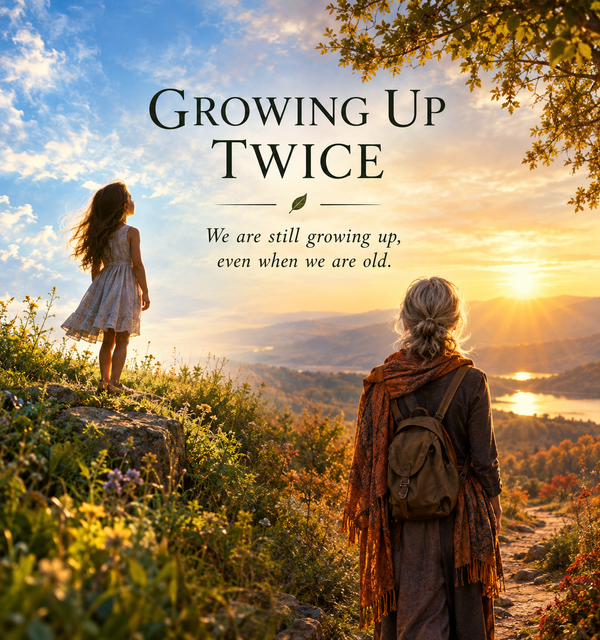
Human beings have the unique privilege to grow up twice: once physically, and again spiritually.
In Japanese pop-culture, anime, and games, characters constantly execute precise, spatial "summoning," drawing seals (kuji-kiri) in mid-air, or holding elemental spheres of force between their hands before releasing them.
The popular image of the ninja performing hand seals (kuji-kiri) to summon giant frogs, turn invisible, or control fire isn't purely a modern gaming trope—it stems from esoteric Buddhism (Mikkyō) and Shugendō (mountain asceticism).