As we synthesize these cultural, psychological, and economic frameworks, in the next and last fragment of this exploration of the "birth of the I", we will look at how the concept of a Universal Capital Endowment specifically alters the psychology of youth ego-development compared to the hyper-competitive "survival of the fittest" model we see today.

The implementation of Thomas Piketty’s Universal Capital Endowment would fundamentally restructure the psychological environment in which young people develop their sense of self. Today, youth ego-development is shaped by a scarcity-driven "survival of the fittest" model, forcing a choice between hyper-isolated individualistic hoarding or complete, passive submission to the collective.Injecting a substantial baseline of economic agency at age 25 shifts the foundational psychology of youth from a defensive posture of "having for survival" to an expressive posture of "being and self-incorporation (Eingliederung)."


1. Dismantling the "Survival-Driven" Ego Fortification

In the current hyper-competitive economic model, young people are forced to develop what psychologists call a defensive ego. Because failing to secure a place in the market can mean economic invisibility, the ego becomes rigid, calculating, and self-interested.

  • The Psychology of Scarcity: When young people perceive the world through a naturalistic, survival-of-the-fittest lens, they view their peers not as potential collaborators, but as threats to their limited resources. The "I" becomes hyper-fortified, transactional, and anxious.
  • The Endowment Buffer: A universal capital endowment strips away this foundational fear. Knowing that a baseline of economic security awaits them at adulthood provides psychological safety. The ego no longer needs to spend its developmental years building defensive walls or hyper-focusing on raw survival. Instead, it can relax its boundaries, allowing the young person to explore who they are outside the mandates of market utility.

2. From Passive Rebellion to Constructive Agency

As we explored in modern Chinese subcultures like Tang Ping ("lying flat") or Bai Lan ("let it rot"), the current lack of a healthy avenue for ego-development leads to self-destructive or passive rebellions. When the system feels like an abstract, crushing machine, the only way a young person can assert their individual "I" is by refusing to participate.

  • Reclaiming the "I" Through Action: A capital endowment converts passive frustration into constructive, self-directed agency. With a baseline of capital, a young person at 25 does not have to beg a corporate or state entity for a starting foothold in life.

  • Diverse Pathways of Individuation: Whether they use the fund to start an artisanal business, finance higher education, buy into a community land trust, or fund their creative practice as an artist, the young adult is handed the steering wheel of their own life. They are no longer a cog reacting to a machine; they become an active author of their identity.

3. Enabling True Eingliederung (The Relational "I")

A rigid, overly upright Western "I" cannot negotiate or "dance" with others because it is too terrified of losing its hard-won possessions and boundaries. True ego maturity requires the fluid capacity to insert oneself into the group without losing one's identity.
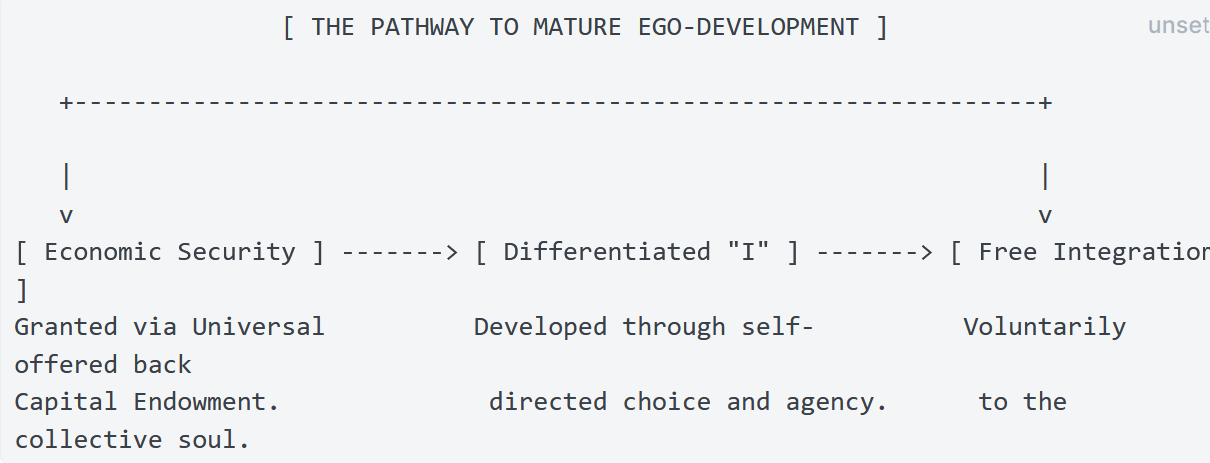
  • Security Precedes Solidarity: A person cannot genuinely collaborate or practice true moral solidarity if they are acting out of desperation or coercion. Forced collectivism (like mechanical state communism) crushes the ego; hyper-individualism isolates it.
  • The Voluntary Offering: With a universal endowment, when a young person joins an open-source software project, a community land trust, or a Slavic-style folkloric stage production, they do so freely. Their individual "I" is fully differentiated and secure, which means they can consciously choose to self-incorporate (eingedliedert) into the social fabric. They can lower their guard, ply into mobility, and engage in the complex, moral practice of bilateral negotiation with their community because their personal survival is no longer on the line. [2]

Ultimately, by replacing today's exponential capital blockades with a fluid, circulating loop of generational wealth, society alters the goal of human development. Maturity is no longer measured by how much an isolated ego can hoard away from the collective, but by how beautifully and distinctively a secure ego can contribute to the harmony of the living whole.


To deepen this synthesis of psychology and systemic design a little more, we could still add one more article based on:


  • Exploring how educational systems would need to change to prepare youth for a world focused on self-incorporation rather than corporate competition
  • Examining how the concepts of Sobornost and Indigenous stewardship could be integrated into a new, global code of economic ethics for the 21st century
  • Discussing the psychological transition an older, hoarding generation must undergo to accept this shift from absolute ownership to temporary stewardship

Share this post

Written by

Seeing Beyond (Philippe Lheureux)
Seeing Beyond, a research initiative focused on spiritual science, living cognition, and the threshold experiences of modern life. An initiative grounded in a spiritual-scientific approach to self- and world-observation.

Comments