Taking locked, stagnant billions out of the isolationist periphery and redistributing it directly to young adults, the economic system would shift its core incentives.
In the next section we will: - Look at real-world modern examples of "use-right" frameworks, such as open-source software networks or community land trusts - Explore how Indigenous Australian concepts of land stewardship completely reject Western property ownership in favor of deep relational responsibility - Examine the specific progressive tax models proposed by economists like Thomas Piketty to break up today's excessive capital accumulation
1. Modern "Use-Right" Frameworks: Open-Source and Community Trusts
To replace hyper-accumulation, modern systems are successfully utilizing Usufruct frameworks, where individuals possess the absolute right to use and benefit from a resource, but are prohibited from destroying, hoarding, or locking it away from the collective.
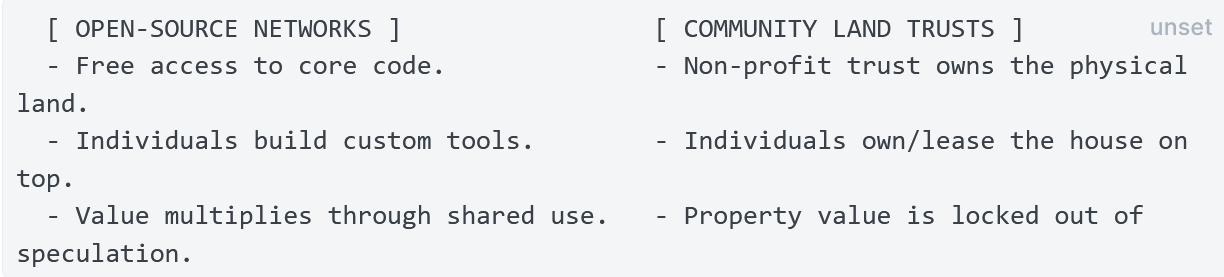
Open-Source Software (The Digital Usufruct): In ecosystems like Linux or WordPress, the foundational infrastructure is a "digital common." No single corporation can isolate it or charge rent for its existence. Anyone can access it, modify it, and build upon it to express their unique entrepreneurial "I." However, under licensing models like the GNU General Public License (GPL), if you improve the core code, you are legally obligated to share those improvements back with the collective. It perfectly mirrors the concept of Eingliederung: your individual genius is fully rewarded through reputation and specialized commercial services, but you cannot choke the digital pipeline for others.
Community Land Trusts (CLTs) (The Physical Usufruct): In the physical world, CLTs decouple the ownership of land from the ownership of the structures built upon it. A non-profit community trust owns the land permanently to keep it out of the speculative market. An individual or family buys or leases the house sitting on that land. They have full security, autonomy, and use-rights to customize their home. However, if they decide to sell, a equity-limiting formula ensures the home remains permanently affordable to the next community member. The ego’s desire for a secure home is fulfilled, but its ability to exploit the community via real estate speculation is entirely neutralized.
2. Indigenous Australian Stewardship: Relational Responsibility
The traditional Western concept of property assumes that the human ego stands above nature, slicing it into dead, abstract parcels to assert ownership. Indigenous Australian ontology completely flips this paradigm. You do not own the land; the land owns you.
"Country" as a Living Relative: For Indigenous Australians, "Country" is not a passive, naturalistic mechanism or economic asset. It is a living, conscious entity encompassing earth, water, sky, ancestors, and stories. The human "I" is not an isolated consumer but an integrated custodian.
The Law of Obligation over Rights: In Western law, property ownership grants the absolute right to exclude others and exploit resources. In Indigenous law, identity is defined by Caring for Country. An individual’s status and spiritual maturity are measured by how deeply they understand their specific ritual and ecological obligations to keep the land healthy.
The "Dance" of the Ego: This is a profound, non-stiff expression of identity. An elder holds immense, highly individualized cosmological knowledge and authority (a fully developed spiritual "I"), yet this authority is entirely synchronized with the survival of the ecosystem and the group. There is no concept of hoarding land or resources, because doing so would sever the vital, moral relationships that sustain life itself.
3. Thomas Piketty’s Models: Breaking the Capital Blockade
French economist Thomas Piketty, renowned for his exhaustive historical analysis of wealth inequality in books like Capital in the Twenty-First Century and Capital and Ideology, argues that under unregulated capitalism, the rate of return on capital ($r$) consistently outpaces economic growth ($g$). This formula ($r > g$) means that inherited, accumulated wealth naturally concentrates at the top, choking circulation and threatening the global democratic fabric. To dismantle this choke point without resorting to authoritarian state-communism, Piketty proposes a model of "Participatory Socialism" designed to transform permanent property into temporary stewardship.
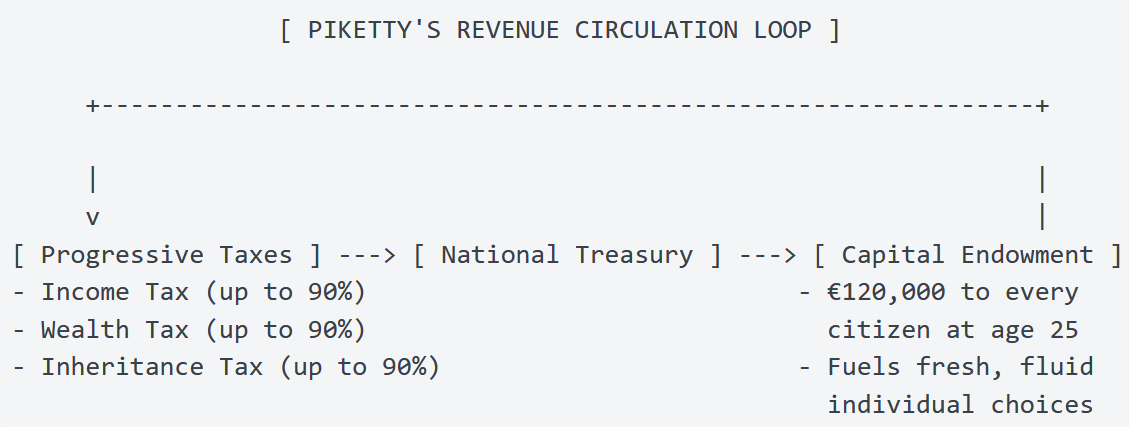
The Annual Progressive Wealth Tax: Piketty proposes a steep, sliding-scale annual tax on all private wealth (real estate, stocks, financial assets). While small fortunes would face minimal taxes, multi-millionaires and billionaires would face marginal tax rates scaling up to 10% or even 90% annually on hyper-fortunes. This acts as a systemic ceiling: it allows an individual to become wealthy through innovation, but systematically dissolves multi-billion-dollar empires over time, preventing private dynasties from choking the economy.
The Inheritance Tax Structure: To ensure every generation starts with a dynamic platform for ego-development, inheritance taxes would also top out at 90% for the ultra-wealthy. This prevents the petrification of society into a rigid class of permanent asset-holders who extract rent without producing value.
The "Capital Endowment" (Circulating the "I"): The massive revenues generated from these wealth and inheritance taxes would not simply fund state bureaucracy. Instead, Piketty proposes using them to grant a universal capital endowment (e.g., approximately €120,000 or $130,000 USD) to every single citizen automatically when they turn 25.
By taking locked, stagnant billions out of the isolationist periphery and distributing it directly to young adults, the economic system shifts its core incentive. It moves from protecting the rigid, hoarding "having" of an elite few to funding the creative, fluid "being" and active self-incorporation of the entire global collective.
As we synthesize these cultural, psychological, and economic frameworks, in the next and last fragment of this exploration of the "birth of the I", we will look at how the concept of a Universal Capital Endowment specifically alters the psychology of youth ego-development compared to the hyper-competitive "survival of the fittest" model we see today.
Seeing Beyond, a research initiative focused on spiritual science, living cognition, and the threshold experiences of modern life.
An initiative grounded in a spiritual-scientific approach to self- and world-observation.
Comments
Human beings have the unique privilege to grow up twice: once physically, and again spiritually.
In Japanese pop-culture, anime, and games, characters constantly execute precise, spatial "summoning," drawing seals (kuji-kiri) in mid-air, or holding elemental spheres of force between their hands before releasing them.
The popular image of the ninja performing hand seals (kuji-kiri) to summon giant frogs, turn invisible, or control fire isn't purely a modern gaming trope—it stems from esoteric Buddhism (Mikkyō) and Shugendō (mountain asceticism).