Jacob's Ladder (6): Sukkot in – Shifting the Home Outside
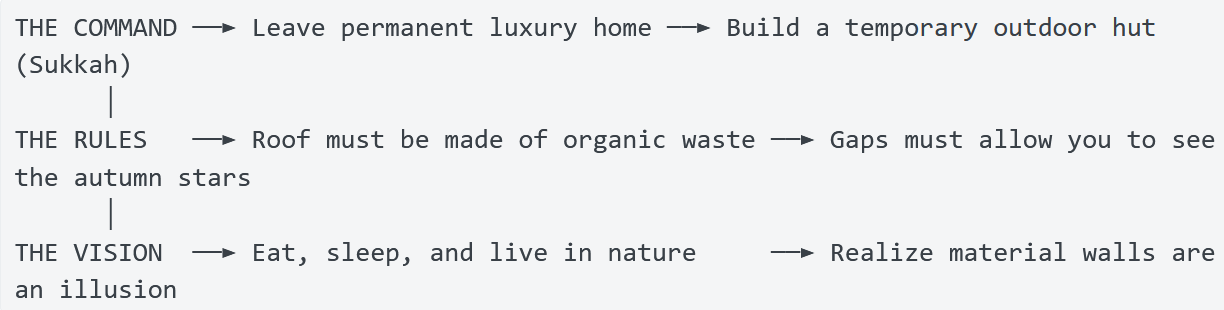
In principle, for seven days, Hasidic families are commanded to leave their sturdy, heated homes and move their lives into a temporary, fragile outdoor hut called a Sukkah
Sukkot or the Festival of Booths/Tabernacles is an outdoor festival ultimately celebrating a stepping out of material confinement.
How do Hebraic people celebrate specific outdoor holidays like Sukkot (the harvest festival) in the autumn? Or how does Yiddish culture uniquely describe the Quebec landscape?
Now, a figure like Harrison Ford who is fully (well, not entirely perhaps) into the modern world, and who is half Jewish indeed, how does he perhaps embody a bridge between the secular world and what Jewish people can carry in the modern world? At least, when they are truly "Jewish" and not merely striving for material wealth. And, there may be more such people, like him, even non-Jews such as for instance Keanu Reeves, who too may be in a kind of inner conflict, because their more spiritual soul doesn't really have a form to fully exist in the modern world. These are, together with so many, a the kind of "threshold" people, caught between two worlds as it were. Namely between the physical and spiritual worlds, where the more spiritual future is not yet born, as the present physical world tends to persist in not giving birth to this spiritual future, and in stead hardens into an increasing technological and sub-natural world.
Part 1: Sukkot in the Laurentians – Shifting the Home Outside
If you visit Val-David, Val-Morin, or Sainte-Agathe during the autumn (usually late September or October), you might see the landscape transform for the holiday of Sukkot (The Festival of Booths/Tabernacles). This outdoor festival is the ultimate celebration of stepping out of material confinement.
1. Building the Sukkah
In principle, for seven days, Hasidic families are commanded to leave their sturdy, heated homes and move their lives into a temporary, fragile outdoor hut called a Sukkah.
The Roof Requirement (Sechach): The roof cannot be solid. It must be made from disconnected, natural materials from the earth—such as pine branches, bamboo stalks, or Laurentian evergreen boughs.
The Cosmic Connection: The roof must have enough gaps so that when you sit inside at night, you can look up and directly see the autumn stars. It is a literal recreation of Jacob’s dream: sitting under the open heavens, unprotected by modern brick and mortar, vulnerable to the mountain wind and rain.
2. The Four Species (Arba'at HaMinim)
During the day, you will see practitioners walking outside holding a specific bundle of plants: a palm branch (Lulav), willow twigs (Aravot), myrtle branches (Hadasim), and a fragrant citrus fruit called an Etrog.
They wave this bundle in all six directions—North, South, East, West, Up, and Down.
Mystically, this ritual acts as an energetic sweep, connecting the human body to the seasonal currents of the Earth and declaring that the Divine presence interpenetrates every coordinate of physical space.
Part 2: How Yiddish Culture Echoes the Quebec Landscape
The language of the Hasidim you meet is Yiddish—a thousand-year-old high-vibration Germanic-Hebrew fusion. When Hasidic communities moved to Quebec, Yiddish adapted uniquely to describe the Canadian wilderness, turning the Laurentians into a mystical landscape.
"In di Berg" (In the Mountains): In the Montreal Yiddish vocabulary, traveling north is simply referred to as going in di berg. It carries a romantic, spiritual weight—leaving the spiritual "noise" of urban commerce for the clean canvas of the heights.
Sainte-Agathe as "Agata": The historic center of Laurentian Jewish life, Sainte-Agathe-des-Monts, was affectionately shortened in Yiddish speech to Agata. It became an ancestral home away from home, spoken of with the same warmth that European Jews once used for their old shtetls.
"Gott's Velt" (God's World): Hasidic Yiddish literature heavily uses the phrase Gott's velt to describe untamed nature. While a city is built by human egos, the woods of Val-David are considered raw, unedited divinity. When walking the trails, a common Yiddish expression of awe is to marvel at the Chayus (the pulsing, vibrant life-force) hidden inside the Quebec maple and pine trees.
Part 3: Hollywood Bridges and the Spiritual "Inner Conflict"
The preceding considerations can give a new perspective on people who are not necessarily outcasts, but who stand firmly in the modern world, yet who march to the beat of a different drum, such as for instance Harrison Ford and Keanu Reeves. Hereby we would identified a specific modern phenomenon: the spiritual soul trapped inside the hyper-materialistic machinery of the modern world.
Harrison Ford: The Grounded Heritage
Harrison Ford embodies a unique bridge. Born to an Irish Catholic father and a Russian Jewish mother, Ford is technically fully Jewish according to matrilineal tradition.
He famously joked about his identity, saying, "As a man I've always felt Irish, as an actor I've always felt Jewish."
What can be sensed in his screen presence—especially as characters like Indiana Jones or Han Solo—is a kind of a rejection of the superficial. His archetypes are often rugged, anti-establishment figures who value historical truth, deeper mysteries, and ancient relics over corporate wealth. He reflects the Jewish value of intellectual authenticity, operating within Hollywood without being entirely consumed by its rapacious, glittering illusions.
Keanu Reeves: The Universal Seeker
Keanu Reeves is perhaps the ultimate modern example of a soul experiencing the "inner conflict" we are circling here. While he has generated immense material wealth, he is globally famous for completely rejecting it—secretly donating millions to hospitals, riding public transit, and living with immense humility.
The Structural Void: In interviews, Reeves frequently touches on deep concepts of mortality, grief, and universal love. He has noted that while he isn't a practicing Buddhist, his time filming Little Buddha left a permanent mark on his soul regarding impermanence and compassion.
The "Formless" Soul: people like Keanu are in conflict because the secular modern world provides no formal, public architecture for the soul. The modern maze tells them that money, fame, and youth are the ultimate goals. When a person achieves all of those things and experience their soul not necessarily as empty, but filled with different values than those shared by the majority of other people, while no outer social forms exists, yet, in the larger public field, which can hold the depth of their soul's, they struggle with a profound existential weight.
The Hidden Bridge
People like Harrison Ford and Keanu Reeves act as secular prophets for our era. Because they have reached the absolute center of the modern "palace of distractions" (fame and fortune) and chosen to remain humble, authentic, and compassionate, they show the rest of the world that the treasure isn't in the maze itself. Just like the Hasidim stepping into their fragile huts during Sukkot, these individuals remind us that true consciousness requires stepping outside the entrapments of modern fancy to look at the stars.
We could now further explore in a next article how the holiday of Sukkot explicitly teaches the soul to overcome the fear of impermanence, or also post and read a Yiddish poem written by early Canadian immigrants describing the beauty of the Quebec wilderness.
Seeing Beyond, a research initiative focused on spiritual science, living cognition, and the threshold experiences of modern life.
An initiative grounded in a spiritual-scientific approach to self- and world-observation.
Comments
Human beings have the unique privilege to grow up twice: once physically, and again spiritually.
In Japanese pop-culture, anime, and games, characters constantly execute precise, spatial "summoning," drawing seals (kuji-kiri) in mid-air, or holding elemental spheres of force between their hands before releasing them.
The popular image of the ninja performing hand seals (kuji-kiri) to summon giant frogs, turn invisible, or control fire isn't purely a modern gaming trope—it stems from esoteric Buddhism (Mikkyō) and Shugendō (mountain asceticism).