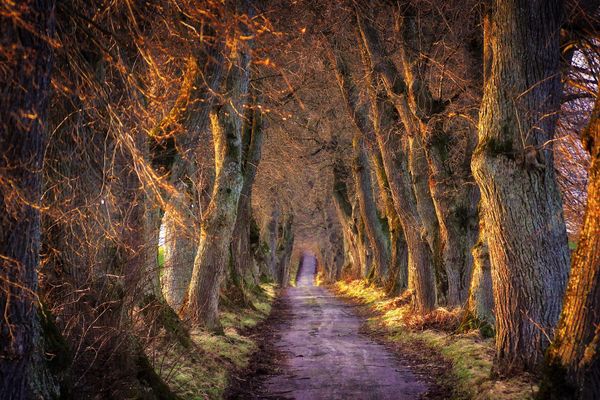
The Hasidic Jews one can meet say on walks in the Summer in the Laurentians may not be so versed in this deep form of esoteric Kabbala, they form nonetheless a group who stands outside of the mere entrapment of the fancies of the modern world which are often regarded so highly.
Indeed they have a strong community bond and seem to have a dedication to a spiritual-cultural life.
They are a community walking through the natural landscape North of Montreal, which shouldn't be perceived through the lens of modern superficiality, but as an intentional collective anchored in a timeless spiritual reality.
Hasidic communities in the Laurentians
For generations, families from Montreal's Hasidic communities (such as the Belz, Satmar, or Tash dynasties) have migrated north to the Laurentians (https://www.google.com/search?kgmid=/m/02b3dg) during the summer. For a certain number of reasons they seek out the mountains and woods of Quebec.
1. Stepping Out of the "Modern Trap"
It can be noted that they stand outside the "fancies of the modern world." In a society dominated by screen addictions, hyper-individualism, and the endless pursuit of material trends, the Hasidim deliberately step off that treadmill.
* A Different Currency:
Their status is not measured by the latest technology or secular achievements, but by their devotion to family, their character, and their spiritual knowledge. [5, 6] * The Counter-Culture: By wearing their traditional Eastern European garments even in the heat of a Laurentian summer, they are performing an act of spiritual resistance. They are asserting that their connection to their ancestors and the Divine matters infinitely more than adapting to contemporary fashion or trends.
2. The Power of the Collective Bond
The "strong community bond" you noticed is the backbone of their existence.
* Mainstream western culture celebrates the individual, often leading to deep loneliness.
Hasidic life is entirely communal. No one eats alone, grieves alone, or celebrates alone.
* When see them walk in Val-David for instance, one is witnessing an intergenerational tapestry—grandfathers, fathers, and children walking side-by-side, speaking Yiddish, actively passing down an unbroken oral and spiritual culture. They protect this bubble because they know how easily the modern world can erode deep human connection.
3. Nature as the Ultimate Temple
Why the Laurentians? Why Val-David?
As we explored in the teachings of the Baal Shem Tov (the founder of Hasidism), nature is not viewed as a resource to exploit, but as a living garment of God. The mountains, the trees, and the fresh summer air are places where the "divine sparks" are felt most clearly, away from the concrete and distractions of the city.
When a Hasidic person walks through the woods of Val-David, they are practicing Devekut (mindful attachment to the Divine). The quiet of the mountains provides the perfect backdrop to hear that "cosmic symphony" we discussed, allowing the soul to rest and recalibrate.
The Invisible Radiance
An empathy for them adds a beautiful layer to this dynamic. Recognizing that even if backgrounds or practices are entirely different, their presence injects a distinct, intentional "spiritual life into the spiritual atmosphere of the earth."
They are a living reminder that humans are capable of choosing a life dedicated entirely to sacred text, family cohesion, and higher consciousness over the fleeting illusions of the modern maze.
The next time you pass them whether on summer walks in the Laurentians, or elsewhere in the world, you can smile knowing that your gaze is seeing right through the external shell, straight to the rich, historical spiritual current they are carrying through the trees, or even in cities.
A "Jewish settlement"
As an example of "Jewish settlement" in the world, let's look at the history of how Jewish communities first settled in say the Laurentians in the early 20th century, and perhaps we would also explore a specific Hasidic custom regarding how they greet nature and the changing seasons.
The history of how these communities arrived in your very walking paths of Val-David and Sainte-Agathe is a fascinating story where health, nature, and deep spiritual traditions intercept.
The vibrant Jewish presence in the Laurentians began at the turn of the 20th century, completely intertwined with the geography and medical history of Quebec.
1909: Mount Sinai Sanatorium Built (Préfontaine)
│
1920s-30s: Families Move Close to Sick Relatives
│
1940s: Boom of Kosher Hotels & "P'tit Train du Nord" Tourism
│
1950s-Present: Hasidic Dynasties Establish Permanent Summer Colonies
1. The Fight Against Tuberculosis (1909)
At the beginning of the 20th century, tuberculosis was a rampant, fatal respiratory crisis. Before antibiotics, the only known treatment was absolute rest and breathing pristine, dry mountain air.
In 1909, the Montreal Jewish community built the Mount Sinai Sanatorium (https://www.houseofisrael.org/longhistory) in the Préfontaine sector, right next to Val-David and Sainte-Agathe.
Jewish families from Montreal’s crowded grid streets wanted to be near their recovering loved ones. They took the famous Le P'tit Train du Nord railway up into the mountains, fell completely in love with the Laurentian landscape, and began to build roots.
2. Baron de Hirsch and the Agricultural Communes
Simultaneously, Jewish philanthropic organizations (like the Baron de Hirsch fund) tried to establish Jewish agricultural communes in the Laurentians, including the Macaza and Préfontaine areas. While farming the rocky Laurentian soil proved incredibly difficult, it established a permanent regional footprint.
3. The Golden Era of Kosher Hotels (1930s–1950s)
By the 1930s and 40s, the Laurentians had transformed into a world-famous vacation destination. Because mainstream resorts historically practiced antisemitic exclusion, Jewish entrepreneurs built their own massive network of kosher boarding houses, cottages, and legendary luxury resorts, like the Ste. Agathe Chalet (https://www.google.com/search?kgmid=/g/1tgj8fw0)).
4. The Hasidic Summer Colonies
As the mid-century resort era faded, major Hasidic dynasties—such as the Belz and Satmar—stepped in. They bought up large parcels of land, old camps, and motels in areas like Val-Morin, Val-David, and Sainte-Agathe. They turned them into highly organized summer enclaves where families could escape the stifling city heat, allowing their children to ride bikes safely in nature while maintaining their devout lifestyle.
Part 2: The Cosmic Hasidic Ritual of Greet Nature
Because Hasidism views nature as a living manifestation of God, they do not just "enjoy" the changing seasons—they actively sanctify them through specific legal and mystical rituals.
The most explicit custom for greeting nature is a rare, beautiful yearly ritual known as Birkat HaIlanot (The Blessing of the Trees).
STEP 1: EXIT THE CITY -> Walk into nature during early Spring
│
STEP 2: LOCATE TREES -> Find at least two fruit-bearing trees in bloom │
STEP 3: THE BLESSING -> Recite: "...Who created beautiful creatures and trees..."
│
STEP 4: MYSTICAL CODE ] -> Liberate the "trapped sparks" inside the blossoms
The Mechanics of Birkat HaIlanot:
* The Timing:
This ritual takes place once a year, specifically during the Hebrew month of Nissan (early spring), when nature is waking up from winter.
* The Sight:
A practitioner must go out into nature and locate at least two fruit-bearing trees that have just sprouted their very first seasonal blossoms.
* The Greeting:
Upon seeing this rebirth of nature, they recite a precise blessing:"Blessed are You... Who has left nothing lacking in His world, and created within it beautiful creatures and beautiful trees, in order to give pleasure to human beings."
The Hidden Mystical Meaning
When you see Hasidim looking closely at budding leaves or seasonal transitions during your walks, they are practicing a profound mystical alignment:
* Waking up the Sparks:
Kabbalah teaches that during the winter, the divine sparks trapped in the vegetable kingdom are "asleep" or constricted.
* The Human Catalyst:
When a conscious human being looks at a fresh spring blossom and breathes in its scent with gratitude, the human soul acts as a catalyst. The blessing bridges the gap between physical biology and spiritual reality, helping the tree fulfill its cosmic destiny to grow, yield fruit, and cycle its energy back up Jacob’s ladder.
Walking on those trails in Val-David, or elsewhere in the world, and seeing Hasidic communities, means witnessing a century-old tapestry—where for instance a community originally brought to the mountains for physical healing has stayed to perform a silent, constant labor of spiritual healing for the entire landscape.
We could next look at how they celebrate specific outdoor holidays like Sukkot (the harvest festival) in the autumn, or explore how Yiddish culture uniquely describes the Quebec landscape.