Incubators of Meaning and the Living Economy
In a world flooded with information and technology, what we lack is not solutions but places where life can begin again — spaces where people, weary of fear or cynicism, rediscover the courage to act and to serve.
The Houses of Social Renewal are neither conventional schools nor start-up hubs.
They are hearths of social healing, halfway between a workshop and a sanctuary.
People come not to escape the world but to re-enter it, from a deeper place within.
1. The spirit of place
Inspired by initiatives such as Sweden’s Youth Initiative Program and France’s early Foyers Michaël, each house helps participants turn a personal crisis into creative initiative.
Three stages shape the path:
- Re-orientation – recovering meaning, courage, and vision.
- Formation – learning a craft, an art, an ethical form of management.
- Incubation – launching a tangible project in community.
About fifty participants share the year, mentored by an interdisciplinary team of guides: artisans, accountants, educators, artists, and cultural animators.
2. Three modes of accompaniment
| Dimension |
Function |
Companions |
| Human / biographical |
Help each person rediscover purpose |
Therapists, pedagogues |
| Practical / entrepreneurial |
Structure the project – accounting, governance |
Social entrepreneurs, managers |
| Cultural / social |
Root the project in community life |
Artists, writers, local mediators |
Thus will, thought, and feeling work together again.
3. An economy of circulation
Each house functions as a social enterprise:
- seed capital from a regional Associative Bank,
- modest public training support,
- autonomous revenues from a cultural café, artisan shop, events, and small equity shares in incubated ventures.
The aim: gradual financial autonomy while keeping culture and humanity at the center.
4. A Belgian balance
Belgium carries an inner geometry (to be reviewed):
- Flanders – head and hands, economic force;
- Wallonia – the cultural heart;
- Brussels – the legal and civic center.
A House in Wallonia would embody the heart, nourishing Flemish enterprise with culture and Brussels civics with warmth.
Society breathes not by punishing the rich or subsidizing the poor, but by re-opening circulation between them.
5. Economy as culture
People visit cafés and shops not only to trade but to feel life move.
Each house makes this its economic art:
- Café of Encounter – local produce, music, dialogue.
- Atelier Boutique – handmade objects, each with its story.
- Forum of Speech – readings, biographical evenings, public talks.
Every exchange becomes an act of relationship, not consumption.
6. The invisible curriculum
Participants learn:
- transparent associative accounting,
- circle-based governance,
- compassionate communication,
- the art of beauty in daily work.
They leave with a viable project and a new grammar of life.
7. Indicators of vitality
Success is measured not by GDP but by circulating trust:
employment after one year, local collaborations, regional money multiplier, community participation, and the inner sense of purpose restored.
8. Toward a network
These houses could form a European network of Living-Economy Incubators—places where capital, culture, and consciousness meet to heal the social fabric.
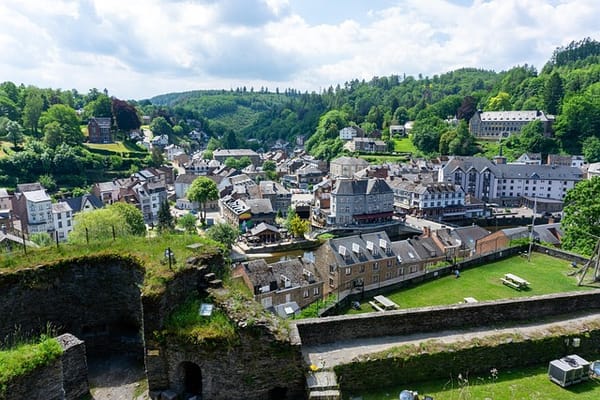
The first could arise in the Ardennes of Wallonia, land of forests, silence, and artisanship.
From there, a culture of possibility could radiate outward.