Toward the Fourfold Cosmic Imagination

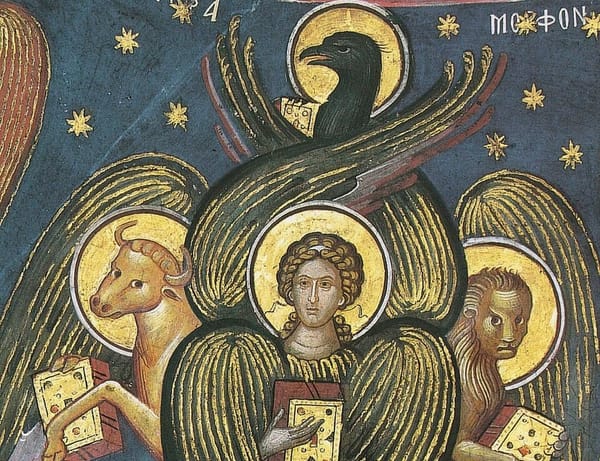
In Christian art, the tetramorph is the union of the symbols of the Four Evangelists, derived from the four living creatures in the Book of Ezekiel, into a single figure or, more commonly, a group of four figures. Each of the four Evangelists is associated with one of the living creatures, usually shown with wings. The most common association, but not the original or only, is: Mark the King, Lion; Luke the lowly Servant, Ox; Matthew the Angel; and John the Eagle.

See: https://en.wikipedia.org/wiki/Tetramorph

The tetramorph, namely — the Eagle, Lion, Bull, and Angel — represents therefore the bridge between anthropology and cosmology.
Each figure can be seen as both:

  • an archetypal system within the human being,
  • a Gospel viewpoint,
  • and a cosmic being whose gesture lives in us.

If the first series revealed the temple, this next could reveal the forces that move within it:
how the eagle-light of John, the lion-warmth of Mark, the bull-strength of Luke, and the angelic equilibrium of Matthew become modes of seeing.
Together they form the living cross of the world, the balance of heaven and earth in the human being.

A Study of the Etheric-Cosmic Forces Within the Human Form

“The human being is a microcosm of the macrocosm —
but only when seen not as mechanism, but as meaning made flesh.”
— Rudolf Steiner

1. The Orientation of the New Cycle

This series contemplates the living dynamics within the human architecture:
how the threefold systems — nerve-sense, rhythmic, metabolic-limb — are themselves expressions of deeper cosmic archetypes: the Eagle, Lion, Bull, and the Angel who reconciles them.

If The Morphology of Consciousness was an architecture of uprightness,
then The Fourfold Human Being is a choreography of movement — a study of how cosmic gestures become inner experience, moral capacity, and destiny.


✧ Structure of the Series

1. The Eagle: Light and the Nerve-Sense System

The gaze of spirit turned toward the infinite

  • The eagle’s domain: clarity, distance, overview.
  • The nerve-sense system as organ of reflection — cool, exact, receptive.
  • The Gospel of John as the “eagle-eye” of consciousness that beholds the Word in pure light.
  • The transformation of perception into reverence: knowing as an act of contemplation.
  • Shadow aspect: when detached cognition becomes cold intellect.
  • Practice: learning to “see from above” without losing warmth.
To behold the world without grasping it — that is the eagle’s wisdom.

2. The Lion: Warmth and the Rhythmic System

The heart as the throne of courage and moral fire

  • The lion’s gesture: radiating warmth, centered in rhythm and strength.
  • The rhythmic system (heart–lungs) as the organ of equilibrium between above and below.
  • The Gospel of Mark as the Gospel of action and living movement.
  • Courage as the moral transformation of instinct.
  • Shadow aspect: the heart inflamed — pride, passion, or fanaticism.
  • Practice: breathing consciously between thinking and willing; holding the middle ground.
To act from the heart without burning the world — that is the lion’s strength.

3. The Bull: Substance and the Metabolic-Limb System

The will’s descent into form and the redemption of matter

  • The bull’s gesture: grounded power, patience, endurance.
  • The metabolic-limb system as the realm of will and substance.
  • The Gospel of Luke as the Gospel of incarnation, of love entering matter.
  • Work and art as the redemption of the earthly through consciousness.
  • Shadow aspect: inertia, consumption, material heaviness.
  • Practice: transforming habit into offering — every deed as a prayer to the Earth.
To bear weight with grace — that is the bull’s devotion.

4. The Angel: Balance and the Human I

The reconciler of the three realms

  • The angel’s gesture: upright stillness, equilibrium between eagle, lion, and bull.
  • The I as the new “fourth” — not a system, but the harmonizing principle.
  • The Gospel of Matthew as the bridge between heaven and earth, genealogy and revelation.
  • The angel as future human being — consciousness becoming love.
  • Shadow aspect: fragmentation when the “I” withdraws, or sentimentality when it dissolves.
  • Practice: meditating on the cross of the four living beings — breathing between their forces in gratitude and calm.
To unite heaven and earth in freedom — that is the angel’s art.

5. The Fifth: The Human Being as Living Gospel

A synthesis and projection toward the future human form

  • The four archetypes as living organs of one world-being.
  • The metamorphosis of knowledge into compassion.
  • The etheric Christ as the new center of evolution: “Not I, but Christ in me.”
  • The human being as fifth Gospel — the world becoming self-aware in love.
  • Closing meditation: the cross within the heart — eagle above, bull below, lion to the right, angel to the left — the human standing at the center.

Share this post

Written by

Seeing Beyond (Philippe Lheureux)
Seeing Beyond, a research initiative focused on spiritual science, living cognition, and the threshold experiences of modern life. An initiative grounded in a spiritual-scientific approach to self- and world-observation.

Comments