From Atlantis to the Modern World
The physical world becomes a training ground. This is why the modern, man-made world is not merely “material.”

– 3 min read
The physical world becomes a training ground. This is why the modern, man-made world is not merely “material.”

Seeing the world did not always mean thinking it.
In early humanity, the spiritual world was not something to be known — it was something inhabited.
Only gradually did human beings come to stand opposite the world, and only through this separation could thinking arise as a new faculty.
To understand spiritual science today, we must follow this long trajectory — from Atlantis into the post-Atlantean epochs — and recognize thinking itself as a newly formed organ of perception.
Atlantean humanity possessed a dreamlike, instinctive clairvoyance.
Spiritual beings were directly experienced, but:
There was no firm boundary between:
The world was alive, but not yet faced.
Thinking, in the modern sense, did not yet exist.
After Atlantis, a decisive change occurred.
Humanity gradually lost instinctive clairvoyance and began to experience the world as:
Physical reality did not suddenly appear fully formed.
It emerged slowly, as if condensing out of mist.
This confrontation with a world that no longer spoke inwardly forced something new to arise:
Thinking as an active, inward response to an outwardly silent world.
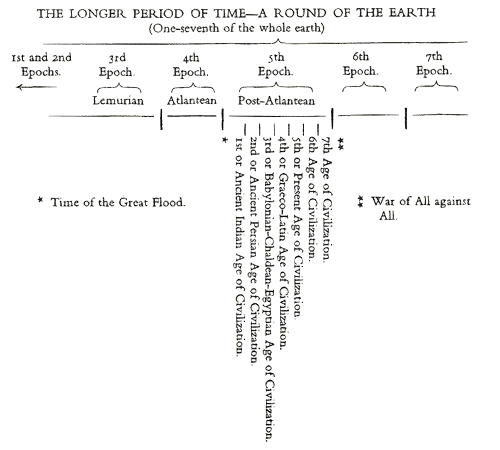
The post-Atlantean epochs: Proto Hindu, Proto Persian, Egypto-Chaledan, Greco-Latin cultural epoch, 5th Post-Atlantean epoch, whereby each epoch represents 2160 years, for a total of the entire Post-Atlantean epoch of 15120 years, which will be followed by another 6th and 7th Great Epoch of 15120 years each -although time will stretch- until a New Phase is reached, culminating in different evolutionary phases. Across these post-Atlantean epochs, human consciousness changes character:
This is not a decline, but a training process.
Thinking learns to:
In other words, thinking learns to stand on its own.
This entire process is captured in the ancient image of Pallas Athena.
She is not a dreamy goddess of inspiration.
She is the goddess of clear-eyed intelligence.
Her gesture is decisive:
This is not conquest — it is contact.
Thinking does not flee the world; it meets it.
It touches matter, resistance, and form — and through this contact, it sharpens itself.
Thinking comes down.
As humanity increasingly engages with physical reality — agriculture, architecture, tools, machines — something profound happens:
Thinking is forced to become:
The physical world becomes a training ground.
This is why the modern, man-made world is not merely “material.”
It is composed of three objective factors:
Nature (Matter) + Labor + Spirit
The Spirit here is thinking itself, embedded in:
This spiritual component is real — but often overlooked.
Here lies the decisive reversal.
Once thinking has been disciplined by physical reality —
once it can follow lawfulness without fantasy —
it becomes capable of turning itself toward the spiritual world again.
Not instinctively.
Not dreamily.
But consciously.
As articulated in spiritual science by Rudolf Steiner, thinking itself can become a perceptive organ, capable of apprehending spiritual reality with the same sobriety once reserved for the physical.
What was trained below can now be applied above.
The modern world is often criticized as soulless, mechanical, or purely material.
Yet this misses something essential.
Every object shaped by human hands carries:
The man-made world is congealed thinking.
To recognize this is to realize that spirit never left the world —
it changed its mode of presence.
From: https://en.anthro.wiki/Cultural_epochs
Humanity did not lose the spiritual world —
it lost it in order to gain itself.
Thinking arose where vision faded.
Freedom arose where guidance withdrew.
The task now is not to reject the physical world,
but to recognize it as the school in which thinking learned to see.
What thinking learned by touching the earth,
it can now learn again —
by touching the spirit.