Formative Forces — Gestures of the ‘I’
In speech, each consonant is a forming gesture; each vowel a gesture of soul relation, in the form of a gesture.
– 3 min read
In speech, each consonant is a forming gesture; each vowel a gesture of soul relation, in the form of a gesture.

Formative forces are not abstractions.
They are real, living gestures that shape life, time, substance, and inner experience.
They do not belong to the physical body as such, nor to the intellect.
They belong to the activity of the ‘I’, insofar as the ‘I’ does not merely observe the world, but acts into it.
To understand formative forces, one must therefore shift from thinking about to doing with awareness.
Every formative force is, at its core, a gesture.
A gesture is not a movement of limbs alone.
It is a directed inner activity — a shaping movement of forces — which may or may not express itself physically.
Such gestures are encountered:
In speech, each consonant is a forming gesture; each vowel a gesture of soul relation, in the form of a gesture.
These are not symbolic conventions, but objective formative activities that can be experienced when speech is inwardly re-inhabited.
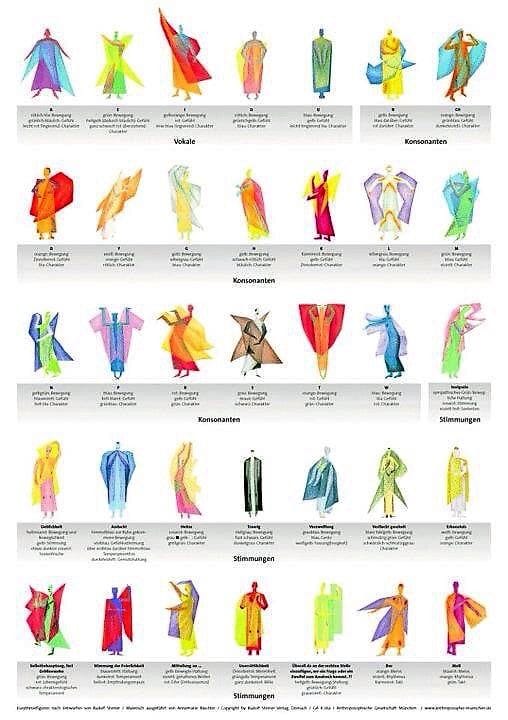
Likewise, the plant does not “grow randomly.”
Its leaf gestures, contractions, expansions, and metamorphoses are visible signatures of formative forces at work.
What distinguishes the human being is not that formative forces act in them — this is true for all living beings — but that the human ‘I’ can consciously take them up and enact them.
The ‘I’ is not merely a point of awareness.
It is a capacity for formative initiative.
This becomes evident when one observes:
The ‘I’ can:
These are not metaphors.
They are actual formative gestures, experienced inwardly, yet effective in soul and etheric life.
Life does not unfold as a continuous flow.
It unfolds in moments, separated by subtle thresholds or passages.
Between one moment and the next, something must carry over.
If this passage is left unmanaged, the soul often reaches for substitutes — distraction, habit, or compulsion.
The ‘I’, however, can learn to:
These passages are privileged sites of formative activity.
Here the ‘I’ does not add content, but applies gesture:
In this way, time itself becomes formable.
Even emotions are not fixed states.
They are plastic formations within the soul.
Anger, fear, agitation, or sadness each carry characteristic inner movements:
The ‘I’ does not need to fight these states.
It can meet them with counter-gestures:
This is not moral repression.
It is formative responsibility.
To work with formative forces is to rediscover the human being as a shaping presence in life.
It does not begin with theory, but with attentive doing:
In this sense, formative forces form a bridge:
They prepare the ground for a deeper understanding of the ‘I’ itself — an understanding that will require its own space and articulation.