Entering the Etheric
When attention is consciously placed, it can move into the surrounding space. That space is no longer experienced as empty air or void, but as etheric reality.

– 3 min read
When attention is consciously placed, it can move into the surrounding space. That space is no longer experienced as empty air or void, but as etheric reality.
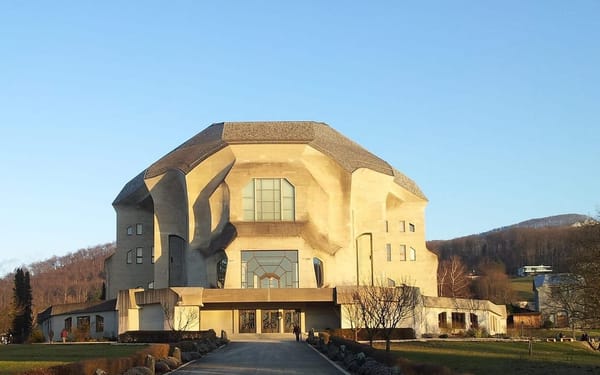
The forms and inner articulation of the Goetheanum were never meant to be merely seen or interpreted aesthetically. They were conceived as a threshold architecture: a built environment designed to host and support a change in consciousness. Its walls, transitions, curves, and metamorphic forms do not symbolize the etheric world; they train perception toward it.
To stand within the interior of the Goetheanum is to be invited into a different mode of experiencing space. Physical form loosens its dominance. Solidity gives way to movement. The eye is no longer satisfied with outlines alone but begins to follow gestures, transitions, and living continuities. In this sense, the building is not an object but a medium—one that prepares the human being for the first step of initiation as it must unfold in our time: awakening to the etheric dimension of reality.
Without this inner participation, the Goetheanum risks being reduced to an aesthetic formulation or a cultural venue. Its true meaning becomes visible only when the etheric is once again integrated into human experience.
The etheric was not lost because it became inaccessible. It was lost because it became illegitimate.
Over centuries, etheric perception was progressively suppressed or displaced. Religious dogmatism curtailed direct spiritual experience. Scientific abstraction narrowed valid knowledge to what could be measured and quantified. Social institutions favored stability, control, and repetition over living perception. The result was not a loss of human faculties, but a loss of confidence, language, and method.
What remained was an indirect relationship to the etheric—spoken about, theorized, aestheticized, or ritualized, yet rarely entered consciously. The living reality itself was set aside.
Paradoxically, entering the etheric has never been easier.
The reason lies in the modern development of the human ‘I’. Today, the experience of the ‘I’ is attainable for many. It anchors, stabilizes, and individuates. Yet the ‘I’ is often confused with personality, biography, or psychological identity—what one usually means by “who I am.”
In truth, the ‘I’ is something else entirely: an abstract point of activity, a center of attention and will that can be separated from all physical and psychological attributes. Precisely because it is abstract, the ‘I’ is free. And precisely because it is free, it can become an organ of perception.
Once the ‘I’ is grasped as such, attention is no longer merely something we “have.” Attention becomes an act—a placement of will.
Ordinary consciousness experiences movement as originating inside the body and extending outward. Etheric consciousness reverses this orientation.
When attention is consciously placed, it can move into the surrounding space. That space is no longer experienced as empty air or void, but as etheric reality. Rudolf Steiner illustrates this through a simple yet radical observation: if one moves an arm repeatedly to sense its activity, and then later performs the same movement inwardly without physically moving the arm, one has already stepped into etheric activity.
Here, entering the etheric is not accidental or mystical. It is a decision.
The will—through attention—extends outward. A field of etheric activity forms around this point of attention. Movement no longer depends on muscular impulse; perception and gesture arise within a living medium. The world begins to answer.
Much contemporary discourse emphasizes “finding oneself.” While this has value, it remains incomplete.
The ‘I’ is not the destination. It is the threshold organ.
When attention enters the etheric, the ‘I’ no longer stands over against a mute, external world. Instead, the world begins to speak—through form, mood, gesture, and meaning. Action is no longer arbitrary self-expression but participation. One no longer acts from personal impulses alone, but within a field of meaning that includes spiritual realities.
This marks the true threshold: not the loss of individuality, but the loss of arbitrariness.
Such a shift cannot remain private.
If etheric perception becomes conscious and shareable, social life itself must change. Movement life, collaboration, and cultural forms would no longer be organized purely by procedures, ideologies, or abstract goals. They would be shaped by situational awareness, attentiveness, and responsiveness to living contexts.
Historical fieldwork offers a concrete example. Through the disciplined practice of attention, landscapes and places can begin to “speak” of past events, unresolved gestures, or forgotten meanings. This is not imagination, but relationship—an etheric dialogue between present consciousness and the memory of the land.
Such practices point toward new ethics, new forms of cooperation, and new responsibilities.
None of this implies a return to atavistic clairvoyance or inherited spiritual faculties. On the contrary.
Earlier cultures often experienced the etheric unconsciously, bound to blood, land, or tradition. What is required today is something fundamentally different: conscious etheric participation guided by a fully awake ‘I’. Spiritual science provides the methodological and ethical grounding for this step.
The task before us is not to revive the past, but to meet the future. The etheric world is not foreign. It is already here—awaiting a form of attention capable of entering it freely, responsibly, and in full wakefulness.
This is the threshold the Goetheanum was built to serve. And it remains open.